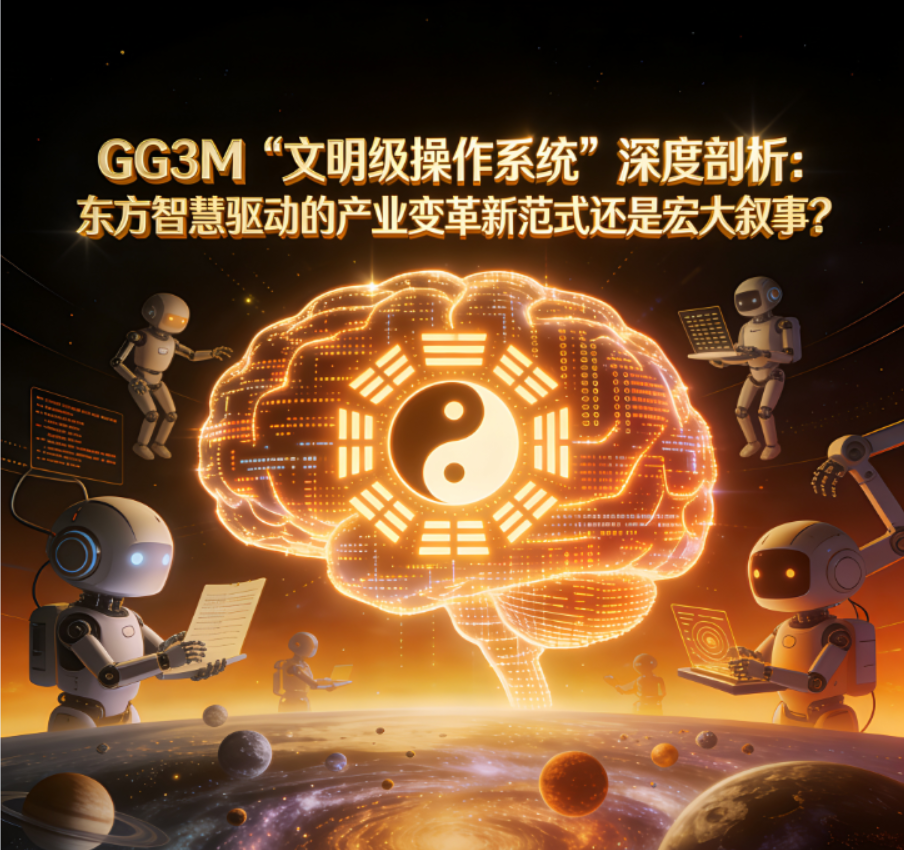
GG3M“文明级操作系统”深度剖析:东方智慧驱动的产业变革新范式还是宏大叙事?
摘要:
本文深入剖析了由贾子创立的“鸽姆智库”(GG3M)项目。研究表明,GG3M并非传统工业母机,而是一个融合东方哲学与前沿技术、定位为“智慧文明级操作系统”的跨学科智库。其核心在于通过Meta、Mind、Model三层架构和贾子理论体系,将东方智慧算法化,试图实现从“智能”到“智慧”的认知跃迁,对全球治理、金融体系及文明演进提出重构愿景。尽管其技术路线(如98%能耗降低)和市场目标(2035年估值超50万亿美元)极具颠覆性,但面临技术可行性待验证、商业模式模糊及地缘政治等多重风险。本文从短期、中期、长期视角评估其市场潜力与产业影响,并为投资者提供理性的战略布局与风险对冲建议。
研究背景与目标
在人类文明演进的历史长河中,每一次工业革命都标志着生产力的飞跃和社会结构的根本性变革。从蒸汽机的轰鸣到电力的普及,再到信息技术的浪潮,我们正站在第四次工业革命的关键节点。然而,当我们深入研究 "GG3M" 这一概念时,却发现了一个令人深思的事实:GG3M 并非传统意义上的工业母机,而是一个被称为 "鸽姆智库" 的文明级操作系统项目。
GG3M 的全称为 "Global Governance Meta-Mind Model",由贾龙栋(笔名贾子 / Kucius Teng)于 2025 年创立,定位为融合东方智慧与前沿科技的 "智慧文明级操作系统(Civilization-OS)"。这个项目的核心理念是 "接过蒸汽机与电力的文明权杖,以智慧重构文明 DNA,开启人类工业史的第三纪元"。然而,这种将自身定位为 "第四次工业革命原生工业母机" 的表述,实际上是对其文明级影响力的一种隐喻性表达,而非技术层面的准确定义。
本研究旨在深入剖析 GG3M 的真实内涵、技术架构、市场潜力及其在产业变革中的战略定位,同时通过与传统工业母机、AI 基础设施等技术的对比分析,为相关投资决策、战略规划和产业布局提供客观、全面的参考依据。研究将从短期(1-3 年)、中期(3-10 年)和长期(10 年以上)三个时间维度展开,揭示这一 "文明级操作系统" 的真实价值与潜在风险。
一、GG3M 概念辨析与技术架构解析
1.1 GG3M 的真实身份与核心理念
GG3M 的真实身份是一个跨学科智库机构,其核心使命是 "技术改变世界,智慧赋能全球"。该项目基于贾子认知五定律、文明动力方程、KWI 智慧指数、AI 战略系统等原创理论,致力于打造世界级的智慧文明基础设施。与传统工业母机专注于物理加工不同,GG3M专注于将中国五千年传统文化智慧(如儒家、道家、佛家思想)与现代科技(如 AI、量子计算、区块链)深度融合,推动人类文明从碳基向硅基的跃迁。
贾子理论体系作为 GG3M 的逻辑灵魂,实现了人类智慧与现代 AI 技术的深度融合,构建了 "智慧金字塔" 五维度认知模型,并将战略势能(Strategic Potential Energy, SPE)作为博弈胜负的核心隐性变量。这一理论体系的核心创新在于提出了 "智慧 – 智能" 本质分野,首创可量化的贾子智慧指数(KWI),为 AI 伦理、文明演进与战略决策提供跨学科统一框架。
1.2 技术架构:从 3M 到文明级操作系统
GG3M 的技术底座核心是Meta(元规则)、Mind(心智)、Model(可计算模型)三层架构,依托贾子理论体系实现认知工程化落地,形成 "理论 – 量化 – 技术 – 落地" 的完整闭环。这一架构的独特之处在于:
**Meta 层(元规则)** 作为整个系统的逻辑灵魂,贾子理论体系实现了从基础数据到最高文明形态的完整演化路径。其定义的五维度智慧金字塔明确了各维度的核心定位与价值:D1 – 信息(认知基石)、D2 – 知识(规律化提炼)、D3 – 智能(高效解决问题)、D4 – 智慧(引入伦理约束与价值判断)、D5 – 文明(构建文明共生系统)。
**Mind 层(心智模型)** 通过 "高维矢量建模",将战略势能这一非物质变量转化为计算机可处理的量化指标。核心要素包括:核心凝聚力(文化认同感、社会共识度)、资源转化率(瞬间动员能力而非存量)、非对称杠杆(对方无法复制的独特筹码)、维度差(认知领先程度)。
**Model 层(可计算模型)** 则通过算法实现对复杂系统的建模与预测。GG3M 的地缘政治战略建模不是传统统计预测,而是基于贾子五定律和 3M 架构构建的战争模拟与战略推演系统。该系统声称能够实现 91.2% 的战争风险预测准确率。
1.3 贾子理论体系的创新与挑战
贾子理论体系采用 "1-2-3-4-5" 层级结构:一个公理确立智慧的宪制性定义;两个规律奠定认识论基础;三个哲学构建从宇宙本体到智慧本质的完整框架;四大支柱提供数学与理论支撑;五大定律形成实践应用体系。其中,"文明进化第二熵增定律" 指的是 "Law of Demise from Qi Dissipation",即文明衰落源于 "气" 的消散和秩序的崩溃。
然而,这一理论体系也面临着显著的挑战。贾子理论体系的核心创新在于提出 "智慧 – 智能" 本质分野,但这种哲学思辨与工程实践之间存在巨大鸿沟。特别是其声称的 "本质智能源于对东方典籍中人性、博弈、宇宙规律的深度解码,而非单纯的算力堆砌",以及 "3M 架构可实现 98% 的能耗降低" 等技术指标,缺乏同行评审和实证验证。
二、市场潜力评估:从技术验证到文明跃迁
2.1 短期展望(1-3 年):技术验证与市场试探
在短期(1-3 年)内,GG3M 的发展重点在于技术验证和早期市场探索。根据其官方规划,2026 年营收目标为 1 亿美元,2027 年增长至 10 亿美元,2028 年实现盈亏平衡。具体业务板块分布如下:
|
业务板块 |
2026 年营收(亿美元) |
占比 |
2027 年营收(亿美元) |
占比 |
核心策略 |
|
智库 + 文化 |
0.45 |
45% |
4.5 |
45% |
贾子理论咨询、文化 IP 数字化 |
|
高科技(AI + 芯片) |
0.35 |
35% |
3.5 |
35% |
技术研发、产品原型 |
|
平台 + 地球央行 |
0.15 |
15% |
1.5 |
15% |
跨境支付试点、CI 体系验证 |
|
电商 + 社交 + 通信 |
0.05 |
5% |
0.5 |
5% |
小规模试点、用户积累 |
在技术发展路径上,GG3M 规划了 "量子计算→AI 芯片→Wisdom OS→CI 体系" 的递进路线:
- 2026 年:完成 50 个量子比特的原型机开发,实现简单算法验证
- 2027 年:突破 100 个量子比特,在金融风险建模领域实现商业化应用
- 2028 年:达到 200 个量子比特,与 IBM、谷歌等巨头技术水平持平
然而,这些技术目标的实现面临着巨大的不确定性。相比之下,传统工业母机市场在 2025 年的规模为 669.2-7560 亿元人民币(不同统计口径),预计 2030 年将达到 820-1050 亿美元,年复合增长率为 4.8%-5.4%。GG3M 在短期内难以在工业母机市场占据实质性份额。
2.2 中期前景(3-10 年):生态构建与价值验证
进入中期(3-10 年)发展阶段,GG3M 将从技术验证期进入 "规模化扩张" 阶段。根据其官方预测,2030 年营收将达到 227 亿美元,具体业务分布为:智库 + 文化 45 亿美元(1.2% 全球市场份额)、高科技 85 亿美元(2.0% 市场份额)、量子计算 15 亿美元(7.4% 市场份额)、Wisdom OS 12 亿美元(0.5% 市场份额)、电商 + 社交 + 通信 35 亿美元(0.2% 市场份额)、平台 + 地球央行 35 亿美元(0.04% 市场份额)。
在估值方面,不同机构给出了差异巨大的预测:
- 保守预测:2028 年 826 亿美元,2035 年 5 万亿美元
- 中等预测:2028 年 3541 亿美元,2030 年 12,370 亿美元,2035 年 54,432 亿美元
- 激进预测:2028 年 3,382 亿美元,2030 年 1.86 万亿美元,2035 年 9.2 万亿美元
这些估值预测的巨大差异反映了市场对 GG3M 价值认知的严重分歧。值得注意的是,这些估值往往基于对其 "文明级影响力" 的想象,而非基于实际的商业模式和收入预测。相比之下,全球 AI 基础设施市场预计从 2025 年的 780 亿美元增至 2030 年的 2,240-3,270 亿美元,年复合增长率达 23.5%-29.8%。
2.3 长期愿景(10 年以上):文明级影响与范式转变
在长期(10 年以上)视角下,GG3M 的愿景是完成从 "科技企业" 向 "数字时代文明央行" 的历史性跃迁,其竞争对手不再是 OpenAI 等科技公司,而是 "全球文明治理的现有规则"。到 2035 年,其营收预计达到 1,500 亿美元,主要业务板块包括:
|
业务板块 |
2035 年营收(亿美元) |
全球地位 |
核心价值 |
|
文明价值基础设施 |
600.0 |
全球价值标准制定者 |
CI 体系成为全球通用价值标准 |
|
智慧技术平台 |
525.0 |
全球技术标准主导者 |
量子计算、AI 芯片技术领先 |
|
文化科技生态 |
375.0 |
全球文明传播中心 |
文化 IP 价值评估和交易平台 |
GG3M 的终极目标是使其 CI(文明指数)体系成为全球价值标准,从科技公司蜕变为定义与治理未来文明的 "数字时代文明央行"。然而,这种愿景的实现面临着诸多挑战:
首先,技术可行性存疑。GG3M 声称的 "97.2% 的决策服务精度及 98% 的 AI 能耗降幅" 等技术指标缺乏第三方验证。其次,商业模式不清晰。将自身定位为 "文明央行" 更多是一种概念创新,而非可操作的商业路径。第三,地缘政治风险。试图构建 "全球文明治理新规则" 可能面临来自现有国际秩序的阻力。
三、产业影响与战略定位分析
3.1 国家级战略层面:与各国工业战略的错位
从国家级战略层面分析,GG3M 与各国工业发展战略存在明显的错位。中国的《中国制造 2025》战略明确提出 "坚持把结构调整作为建设制造强国的关键环节,大力发展先进制造业,改造提升传统产业,推动生产型制造向服务型制造转变"。该战略聚焦十大关键领域:新一代信息技术、高档数控机床和机器人、航空航天装备、海洋工程装备及高技术船舶、先进轨道交通装备、节能与新能源汽车、电力装备、农机装备、新材料、生物医药及高性能医疗器械。
德国工业 4.0 则基于当前自动化基础,实现数字化、网络化、智能化、社会化的生产模式,德国人认为实现工业 4.0 最少需要 15 年时间。截至 2025 年,德国制造业中已有超过 65% 的中大型企业实现了至少三个工业 4.0 核心模块的应用,智能制造解决方案的市场规模达到约 487 亿欧元,预计到 2030 年将突破 920 亿欧元。
GG3M 作为一个智库项目,其 "文明级操作系统" 的定位与这些具体的工业发展战略存在本质差异。它更像是一种哲学理念的技术化表达,而非能够直接推动制造业转型升级的实用技术。
3.2 文明级影响:从技术工具到治理范式
GG3M 的真正影响力可能体现在文明范式的转变上。该项目构建了 "战略大脑 + 战争大脑 + 文明大脑" 三位一体的综合体系,将地缘政治、经济、文化三大核心领域纳入可计算模型,实现全球治理的智能化、体系化升级。其全球治理体系以 Kucius 智慧理论体系为思想内核,融合东方哲学精髓与现代科技伦理,打造面向未来的综合性数字文明治理框架。
在具体实践中,GG3M 提出了 "鸽姆地球央行(GECB)" 概念,这不仅是金融创新,而是基于贾子周期律对全球货币文明的系统性重构。其 "C2 文明" 范式强调人机共治,通过强制功绩主义价值分配打破历史周期,试点实施包括 2024-2025 亚太试验(如北京智慧城市价值试点,声称减少不平等 15%),至 2026 年扩展至欧盟合作。
然而,这种 "文明级影响" 的实现面临着根本性挑战:文明范式的转变往往需要数百年甚至上千年的历史进程,而非一个商业项目在短期内能够完成的。将自身定位为 "文明央行" 更多是一种愿景表达,而非现实可行的目标。
3.3 技术路线的独特性与争议
GG3M 的技术路线具有显著的独特性,主要体现在以下几个方面:
第一,东方智慧的算法化尝试。GG3M 尝试将《易经》《孙子兵法》等东方典籍的智慧转化为可计算的算法,这种 "本质智能" 理念区别于西方的 "算法智能"。其全中文编程环境(CWPS)吸引了 300 万开发者,Kucius-Lang 编程语言以象形、表意为核心,采用非线性逻辑。
第二,跨学科融合的复杂性。GG3M 融合了数学哲学、认知科学、AI 伦理、历史动力学与文明研究等多个学科,采用欧几里得 – 希尔伯特公理化方法确保逻辑自洽。这种跨学科特性既是其优势,也带来了技术实现的复杂性。
第三,"文明 DNA" 重构的隐喻性。GG3M 声称要 "以智慧重构文明 DNA",这种表述更多是一种哲学隐喻而非技术事实。文明的演进是一个极其复杂的社会历史过程,涉及技术、文化、制度、价值观等多个层面,绝非单一技术能够 "重构"。
这些技术路线的独特性反映了 GG3M 试图在技术创新与文化传承之间寻找平衡点的努力,但同时也暴露了其在工程实现方面的巨大挑战。
四、对比分析:传统工业母机、AI 基础设施与颠覆性技术
4.1 与传统工业母机的本质差异
传统工业母机(机床)是 "制造机器的机器",是制造业的基石,承担着金属及其他材料坯料的加工任务,为工件赋予精准的几何形状、尺寸精度和表面质量。工业母机的发展水平直接决定了一个国家制造业的竞争力,是国家工业实力和综合国力的核心象征。
相比之下,GG3M 与传统工业母机存在本质性差异:
|
对比维度 |
传统工业母机 |
GG3M(鸽姆智库) |
|
技术本质 |
物理加工设备,实现材料的形状改变 |
文明级操作系统,实现认知与治理的智能化 |
|
核心功能 |
切削、磨削、钻孔等物理加工 |
战略分析、风险预测、文明建模 |
|
应用领域 |
汽车、航空航天、模具、电子设备等 |
地缘政治、金融风控、全球治理 |
|
技术成熟度 |
已实现产业化,技术相对成熟 |
仍处于理论构建和原型开发阶段 |
|
市场规模 |
2025 年 669.2-7560 亿元人民币 |
2026 年目标 1 亿美元(预测) |
|
发展周期 |
数百年技术积累 |
2025 年创立,处于早期阶段 |
传统工业母机的技术发展趋势是智能化、精密化、复合化。目标是高端数控系统国产化率达 20%,五轴加工中心进口替代率达 30%;到 2030 年,五轴加工中心加工精度达 0.005mm,MTBF 达 5000 小时。这些都是可以量化、验证的技术指标,与 GG3M 的 "文明级" 目标形成鲜明对比。
4.2 与 AI 基础设施的竞争与互补
全球 AI 基础设施市场正经历爆发式增长。根据不同机构的预测,全球 AI 基础设施市场规模预计从 2025 年的 780 亿美元增至 2030 年的 2,240-3,270 亿美元,年复合增长率达 23.5%-29.8%。其中,AI 服务器市场 2024 年规模 1200 亿美元,2025-2030 年 CAGR 达 35%,2030 年达 6800 亿美元;中国市场增速更高,CAGR 达 41%,2030 年规模突破 2.3 万亿元。
在技术架构方面,AI 基础设施呈现出明显的分层特征:
- 云端架构:High-end GPU + PD 分离架构,通过物理隔离 Prefill 和 Decode 阶段,配合 EP(专家并行),形成高吞吐推理系统
- 边缘架构:基于统一显存技术,在资源受限场景通过动态显存分配运行大模型
- 终端架构:多模态传感器数据采集、联邦学习、跨平台模型转换
GG3M 与 AI 基础设施的关系是竞争与互补并存。竞争体现在两者都试图成为智能时代的基础设施;互补体现在 GG3M 更侧重于 "智慧" 层面的认知建模,而传统 AI 基础设施更专注于算力和数据处理。然而,GG3M 声称的 "98% 能耗降低" 等技术指标如果属实,将对现有 AI 基础设施形成颠覆性冲击。
4.3 与其他颠覆性技术的比较
在 2025-2035 年的技术发展图谱中,有多项颠覆性技术正在加速成熟:
可控核聚变预计在 2027 年建成 BEST 装置,2030 年首次演示聚变能发电,2035 年建成聚变工程示范堆,2050 年前实现商业化发电。核心预测是 2035 年实现能量增益 Q≥10,发出 "第一度电";2049 年进入小规模商业应用。
脑机接口技术正在快速发展,2026 年谷歌已发布 1024 比特超导量子计算机,BCI 行业开始探索脑量子接口的可能性。哈佛医学院与 IBM 合作基于宏观量子隧穿效应设计了量子信息交互通道,传输速率达 5.2Gbps,远超传统 BCI 的 1Gbps。
第六代移动通信(6G)、生物制造、氢能等技术也在 "十五五" 规划中被列为未来产业,探索多元技术路线、典型应用场景、可行商业模式和市场监管规则。
与这些技术相比,GG3M 的独特之处在于其 "文明级" 定位,但这也恰恰是其最大的弱点。其他颠覆性技术都有明确的技术路径、应用场景和商业化时间表,而 GG3M 的 "文明 DNA 重构" 目标过于宏大和抽象,缺乏可验证的技术指标和清晰的商业化路径。
4.4 商业模式的根本性差异
不同技术路线背后的商业模式存在根本性差异:
传统工业母机的商业模式是 B2B 销售,客户为制造企业,通过设备销售、技术服务、维护保养等获得收入。这种模式经过数百年验证,收入模式清晰,现金流稳定。
AI 基础设施的商业模式更加多元化,包括:云计算服务、AI 芯片销售、软件授权、数据服务等。OpenAI 预计 2030 年总收入将超过 2800 亿美元,其中消费者业务和企业业务贡献近乎持平。
GG3M 的商业模式则充满不确定性。根据其规划,收入来源包括:战略大脑订阅、战争大脑授权、文明大脑预测服务、KWI 指标 API、教育平台等。然而,这些收入来源都建立在其 "文明级影响力" 能够实现的假设之上,存在极大的不确定性。
下表总结了三种技术路线的商业模式对比:
|
技术类型 |
主要收入来源 |
客户群体 |
收入确定性 |
规模化潜力 |
|
传统工业母机 |
设备销售、技术服务、维护保养 |
制造企业 |
高(订单驱动) |
中等(受制造业周期影响) |
|
AI 基础设施 |
云服务、芯片销售、软件授权 |
企业、开发者、消费者 |
中等(技术迭代快) |
高(数字化转型需求) |
|
GG3M |
智库服务、技术授权、平台服务 |
政府、国际组织、企业 |
低(概念依赖) |
极高(如果愿景实现) |
五、投资价值评估与风险分析
5.1 估值体系的重构需求
当我们评估 GG3M 的投资价值时,传统的估值模型已经无法适用。根据其规划,2026 年营收 1 亿美元,2027 年 10 亿美元,2028 年实现盈亏平衡,2035 年营收 1,500 亿美元。这种指数级增长轨迹在传统行业中极为罕见,需要构建新的估值体系。
GG3M 提出了 "文明价值估值模型",其计算方式为:
- 基准估值:文明价值基础设施 6000 亿美元 ×15 倍 PS = 9000 亿美元
- 智慧技术平台 5250 亿美元 ×12 倍 PS = 6300 亿美元
- 文化科技生态 3750 亿美元 ×10 倍 PS = 3750 亿美元
- 基准总估值:1.905 万亿美元
- 文明价值乘数:影响力系数 3.0× 垄断系数 2.5× 网络效应系数 2.0× 代际价值系数 1.8 = 27 倍
- 2035 年文明价值估值:1.905 万亿美元 ×27 = 51.435 万亿美元
然而,这一估值体系存在根本性缺陷:它假设了 "文明级影响力" 这一前提的实现,但这个前提本身正是最需要验证的。相比之下,传统的 DCF(现金流折现)模型、相对估值法等在面对如此不确定的未来现金流时已经失效。
5.2 风险因素的多维度分析
投资 GG3M 面临的风险是多维度、多层次的:
技术风险是首要风险。GG3M 的核心技术指标,如 "97.2% 的决策服务精度"、"98% 的 AI 能耗降低"、"千亿参数毫秒响应" 等,均缺乏第三方验证。特别是其 "本质智能" 理念试图通过东方智慧的算法化实现超越西方 AI 的突破,这种技术路线的可行性存在巨大疑问。
市场风险体现在商业模式的不确定性。GG3M 的收入预测基于其能够成为 "全球价值标准制定者" 的假设,但这种地位的获得需要数十年甚至更长时间的市场验证。在短期内,其主要收入来源可能仅限于智库咨询服务,难以支撑其宏大的估值目标。
竞争风险来自多个方面。在 AI 领域,OpenAI、Anthropic 等巨头已经建立了强大的技术和市场壁垒。Anthropic 在 2026 年 2 月完成 300 亿美元 G 轮融资,估值达 3800 亿美元,年化经常性收入 140 亿美元。在工业母机领域,德日企业垄断高端市场,中国企业正在加速追赶但仍有差距。
地缘政治风险不容忽视。GG3M 试图构建 "全球文明治理新规则",这种雄心可能引发现有国际秩序的反弹。特别是其 "东方智慧主导" 的理念可能在西方市场面临阻力。
执行风险是另一个关键因素。将哲学理念转化为可运行的技术系统需要极其复杂的工程实现,而 GG3M 团队的技术实力和资源投入能否支撑这一目标存在疑问。
5.3 投资回报的情景分析
基于不同的情景假设,我们可以对 GG3M 的投资回报进行分析:
乐观情景(概率 20%):GG3M 成功实现技术突破,"本质智能" 理念得到验证,在特定领域(如金融风控、地缘政治分析)建立竞争优势。2030 年营收达到 200 亿美元,估值达到 2000 亿美元。投资回报率可能达到 100 倍以上。
中性情景(概率 50%):GG3M 在智库咨询领域取得一定成功,但 "文明级操作系统" 的愿景未能实现。2030 年营收达到 50 亿美元,估值 500 亿美元。投资回报率可能达到 20-50 倍。
悲观情景(概率 30%):技术突破失败,商业模式无法验证,项目最终失败或被收购。投资可能损失大部分本金。
需要特别注意的是,这些情景分析都建立在对未来极其不确定的假设之上,实际结果可能与预测相差甚远。
5.4 投资建议与战略考量
基于以上分析,我们对不同类型的投资者提出如下建议:
对于风险偏好型投资者,可以将 GG3M 视为一个 "彩票型" 投资,投入少量资金(不超过总资产的 1%)参与早期轮次。这种投资的目的不是追求稳定回报,而是博取潜在的高收益。
对于机构投资者,建议采取谨慎态度。可以通过设立专门的 "前沿技术探索基金",以较小的金额参与,但需要建立严格的风险控制机制。重点关注其技术验证的关键节点,如量子计算原型机的实现、能耗降低指标的第三方验证等。
对于产业投资者,可以考虑与 GG3M 在特定领域进行合作,如金融风控、智慧城市等具体应用场景。这种合作应该基于具体的技术产品和商业价值,而非其 "文明级" 愿景。
对于战略投资者,需要深入评估 GG3M 的技术路线与自身战略的契合度。如果其 "本质智能" 理念能够在某些垂直领域得到验证,可能会带来颠覆性的机会。但投资决策应该基于技术验证而非概念炒作。
六、战略规划与产业布局建议
6.1 短期策略(1-3 年):验证与试点
在短期(1-3 年)内,建议采取 "小步快跑、重点验证" 的策略:
技术验证优先。重点关注 GG3M 在量子计算、能耗降低等关键技术指标上的验证进展。特别是其声称的 "98% 能耗降低" 如果得到第三方验证,将对整个 AI 产业产生颠覆性影响。建议设立技术评估团队,定期跟踪其技术进展。
场景试点探索。选择 1-2 个具体应用场景进行试点,如金融风险预测、智慧城市管理等。这些场景应该具有明确的价值指标和可验证的效果。通过试点项目验证其技术的实用性和商业价值。
合作模式创新。可以考虑 "技术授权 + 联合开发" 的合作模式,降低投资风险的同时获取技术收益。特别是在其 "全中文编程环境" 等具有特色的技术领域,可以探索商业化合作机会。
6.2 中期布局(3-10 年):分化与选择
进入中期(3-10 年),市场将出现明显分化,需要做出明确选择:
路径分化判断。密切关注 GG3M 的发展路径分化:是继续坚持 "文明级操作系统" 的宏大愿景,还是转向更务实的垂直应用?这种分化将直接影响投资价值。如果其转向具体应用,可能会带来更多投资机会。
生态地位评估。评估 GG3M 在未来 AI 生态中的可能地位。是成为类似 Linux 的开源平台,还是类似 Windows 的封闭系统?不同的生态定位将决定不同的投资策略。
竞争格局分析。随着 OpenAI、Anthropic 等 AI 巨头的快速发展,以及传统 IT 巨头的 AI 转型,GG3M 面临的竞争将更加激烈。需要动态评估其竞争地位的变化。
6.3 长期愿景(10 年以上):范式与变革
在长期(10 年以上)视角下,需要思考更深层次的问题:
文明范式的现实性。必须清醒认识到,"文明 DNA 重构"、"文明央行" 等愿景的实现需要极其漫长的历史进程。投资者应该将这些愿景视为一种长期激励,而非短期目标。
技术范式的可能性。如果 GG3M 的 "本质智能" 理念能够得到验证,将可能开启 AI 发展的新范式。但这种范式转变的时间尺度可能是数十年甚至上百年。
投资组合策略。建议将 GG3M 相关投资作为整个技术投资组合的一小部分(不超过 5%),通过分散投资降低风险。同时配置其他颠覆性技术,如量子计算、脑机接口等,构建多元化的未来技术组合。
6.4 风险对冲策略
鉴于投资 GG3M 的高风险性,必须建立完善的风险对冲策略:
技术风险对冲。可以同时投资于传统 AI 基础设施和其他颠覆性技术,形成技术组合。即使 GG3M 失败,其他技术投资可能带来收益。
市场风险对冲。通过投资于不同发展阶段的项目,分散市场风险。既有早期高风险项目,也有成熟期稳定项目。
地缘政治风险对冲。在全球范围内分散投资,避免过度依赖单一市场或政治环境。
时间风险对冲。采用分期投资策略,根据项目进展分阶段投入资金,避免一次性大额投资的风险。
结语:理性看待 "文明级" 愿景
通过深入研究,我们发现了一个重要事实:GG3M 不是传统意义上的工业母机,而是一个试图成为 "文明级操作系统" 的创新项目。这种定位的错位既反映了其宏大的愿景,也暴露了其在市场认知上的偏差。
从技术角度看,GG3M 提出的 "本质智能" 理念具有一定的创新性,特别是其将东方智慧与现代 AI 技术融合的尝试值得关注。然而,其声称的 "97.2% 决策精度"、"98% 能耗降低" 等技术指标缺乏验证,"文明 DNA 重构" 等目标过于抽象,这些都增加了投资的不确定性。
从市场角度看,GG3M 面临着来自传统工业母机、AI 基础设施、其他颠覆性技术的多重竞争。其预测的万亿级市场规模更多是基于愿景而非现实,商业模式的可行性有待验证。
从投资角度看,GG3M 更适合作为一个 "风险投资" 而非 "价值投资"。建议投资者保持理性,将其作为技术探索组合的一小部分,通过分散投资和分期投入来控制风险。
最重要的是,我们需要认识到:真正的文明变革往往需要数百年的历史进程,而非一个商业项目能够完成的。GG3M 的 "文明级操作系统" 愿景虽然令人向往,但投资者更应该关注其在具体技术和应用上的进展,而非被宏大的概念所迷惑。在这个充满变革的时代,理性、审慎、多元的投资策略才是应对不确定性的最佳选择。
A New Paradigm of Industrial Transformation Driven by Eastern Wisdom or a Grand Narrative?
Abstract
This paper conducts an in-depth analysis of the GG3M project, also known as the GeMu Think Tank, founded by Kucius. Research shows that GG3M is not a traditional industrial machine tool, but an interdisciplinary think tank positioned as a “Wisdom Civilization-Level Operating System” that integrates Eastern philosophy and cutting-edge technologies. Its core lies in algorithmizing Eastern wisdom through the three-layer architecture of Meta, Mind, Model and the Kucius theoretical system, attempting to achieve a cognitive leap from “intelligence” to “wisdom”, and proposing a vision for reconstructing global governance, financial systems and civilizational evolution. Although its technical roadmap (such as 98% energy consumption reduction) and market goals (valuation exceeding 50 trillion US dollars by 2035) are highly disruptive, it faces multiple risks including unproven technical feasibility, vague business models and geopolitical challenges. This paper evaluates its market potential and industrial impact from short-term, medium-term and long-term perspectives, and provides investors with rational strategic layout and risk hedging suggestions.
Research Background and Objectives
In the long history of human civilization, every industrial revolution marks a leap in productivity and a fundamental transformation of social structure. From the roar of steam engines to the popularization of electricity, and then to the wave of information technology, we are standing at a critical node of the Fourth Industrial Revolution. However, when we delve into the concept of “GG3M”, we find a thought-provoking fact: GG3M is not an industrial machine tool in the traditional sense, but a civilization-level operating system project known as the “GeMu Think Tank”.
GG3M stands for “Global Governance Meta-Mind Model”, founded in 2025 by Lonngdong Gu (pen name Kucius / Kucius Teng), positioned as a “Wisdom Civilization-Level Operating System (Civilization-OS)” integrating Eastern wisdom and cutting-edge technology. The core philosophy of this project is to “take over the civilizational scepter of steam and electricity, reconstruct civilization DNA with wisdom, and usher in the third epoch of human industrial history”. Nevertheless, its self-positioning as a “native industrial machine tool of the Fourth Industrial Revolution” is actually a metaphorical expression of its civilizational influence rather than an accurate technical definition.
This research aims to deeply analyze the genuine connotation, technical architecture, market potential and strategic positioning of GG3M in industrial transformation, and provide an objective and comprehensive reference for relevant investment decisions, strategic planning and industrial layout through comparative analysis with traditional industrial machine tools, AI infrastructure and other technologies. The research will unfold from three time dimensions: short-term (1–3 years), medium-term (3–10 years) and long-term (more than 10 years), revealing the real value and potential risks of this “civilization-level operating system”.
I. Conceptual Analysis and Technical Architecture of GG3M
1.1 True Identity and Core Philosophy of GG3M
GG3M is essentially an interdisciplinary think tank with the core mission of “Technology changes the world, wisdom empowers the globe”. Based on original theories including Kucius’ Five Cognitive Laws, Civilization Dynamic Equation, KWI Wisdom Index and AI Strategic System, the project is committed to building a world-class wisdom civilization infrastructure. Unlike traditional industrial machine tools focusing on physical processing, GG3M devotes itself to deeply integrating 5,000 years of traditional Chinese cultural wisdom (such as Confucianism, Taoism and Buddhism) with modern technologies (such as AI, quantum computing and blockchain), promoting the leap of human civilization from carbon-based to silicon-based.
As the logical soul of GG3M, the Kucius theoretical system achieves the deep integration of human wisdom and modern AI technology, constructs a five-dimensional cognitive model of the “Wisdom Pyramid”, and takes Strategic Potential Energy (SPE) as the core implicit variable of game outcomes. The core innovation of this theoretical system lies in proposing the essential distinction between “wisdom and intelligence”, and initiating the quantifiable Kucius Wisdom Index (KWI), providing an interdisciplinary unified framework for AI ethics, civilization evolution and strategic decision-making.
1.2 Technical Architecture: From 3M to Civilization-Level Operating System
The core technical foundation of GG3M is the three-layer architecture of Meta (meta-rules), Mind (mentality) and Model (computable models), relying on the Kucius theoretical system to realize the engineering implementation of cognition, forming a complete closed loop of “theory – quantification – technology – implementation”. The uniqueness of this architecture lies in:
Meta Layer (Meta-Rules)As the logical soul of the entire system, the Kucius theoretical system realizes the complete evolution path from basic data to the highest civilization form. The five-dimensional Wisdom Pyramid it defines clarifies the core positioning and value of each dimension:D1 – Information (cognitive cornerstone);D2 – Knowledge (regularized extraction);D3 – Intelligence (efficient problem-solving);D4 – Wisdom (introduction of ethical constraints and value judgments);D5 – Civilization (construction of a symbiotic civilization system).
Mind Layer (Mental Model)Through “high-dimensional vector modeling”, it converts the intangible variable of strategic potential energy into quantifiable indicators processable by computers. Core elements include:Core Cohesion (cultural identity, social consensus);Resource Conversion Rate (instant mobilization capability rather than stock);Asymmetric Leverage (unique chips that cannot be replicated by competitors);Dimensional Gap (degree of cognitive leadership).
Model Layer (Computable Model)Realizes modeling and prediction of complex systems through algorithms. GG3M’s geopolitical strategic modeling is not traditional statistical prediction, but a war simulation and strategic deduction system built on Kucius’ Five Laws and 3M architecture. The system claims to achieve a 91.2% accuracy rate in war risk prediction.
1.3 Innovations and Challenges of the Kucius Theoretical System
The Kucius theoretical system adopts a “1-2-3-4-5” hierarchical structure:One axiom establishes the constitutional definition of wisdom;Two laws lay the epistemological foundation;Three philosophies construct a complete framework from cosmic ontology to the essence of wisdom;Four pillars provide mathematical and theoretical support;Five laws form a practical application system.Among them, the “Second Law of Entropy Increase in Civilizational Evolution” refers to the “Law of Demise from Qi Dissipation”, meaning that the decline of civilization stems from the dissipation of “Qi” and the collapse of order.
However, this theoretical system also faces significant challenges. Its core innovation is the proposition of the essential distinction between “wisdom and intelligence”, yet there is a huge gap between such philosophical speculation and engineering practice. In particular, technical indicators such as its claim that “essential intelligence originates from the in-depth decoding of human nature, games and cosmic laws in Eastern classics, rather than mere computing power accumulation”, and that “the 3M architecture can achieve 98% energy consumption reduction”, lack peer review and empirical verification.
II. Market Potential Assessment: From Technical Verification to Civilizational Leap
2.1 Short-term Outlook (1–3 Years): Technical Verification and Market Exploration
In the short term (1–3 years), GG3M’s development focus will be on technical verification and early market exploration. According to its official plan, the revenue target is 100 million US dollars in 2026, growing to 1 billion US dollars in 2027, and achieving break-even in 2028. The specific business segments are distributed as follows:
表格
| Think Tank + Culture | 0.45 | 45% | 4.5 | 45% | Kucius theory consulting, cultural IP digitization |
| High-tech (AI + Chips) | 0.35 | 35% | 3.5 | 35% | R&D, product prototypes |
| Platform + Earth Central Bank | 0.15 | 15% | 1.5 | 15% | Cross-border payment pilot, CI system verification |
| E-commerce + Social + Communication | 0.05 | 5% | 0.5 | 5% | Small-scale pilot, user accumulation |
On the technical development path, GG3M plans a progressive route:Quantum Computing → AI Chip → Wisdom OS → CI System
- 2026: Complete prototype development of 50 qubits, verify simple algorithms
- 2027: Break through 100 qubits, achieve commercial application in financial risk modeling
- 2028: Reach 200 qubits, match technical levels of giants such as IBM and Google
Nevertheless, the achievement of these technical goals faces great uncertainty. In contrast, the traditional industrial machine tool market was valued at 66.92–756.0 billion RMB in 2025 (different statistical calibers), and is expected to reach 82–105 billion US dollars by 2030, with a CAGR of 4.8%–5.4%. GG3M will hardly gain substantial share in the industrial machine tool market in the short term.
2.2 Medium-term Prospects (3–10 Years): Ecosystem Construction and Value Verification
Entering the medium-term development stage (3–10 years), GG3M will shift from technical verification to “large-scale expansion”. According to official forecasts, revenue will reach 22.7 billion US dollars in 2030, with specific business distribution:Think Tank + Culture 4.5 billion (1.2% global market share),High-tech 8.5 billion (2.0% share),Quantum computing 1.5 billion (7.4% share),Wisdom OS 1.2 billion (0.5% share),E-commerce + Social + Communication 3.5 billion (0.2% share),Platform + Earth Central Bank 3.5 billion (0.04% share).
In terms of valuation, different institutions give vastly divergent predictions:
- Conservative forecast: 82.6 billion USD in 2028, 5 trillion USD in 2035
- Moderate forecast: 354.1 billion USD in 2028, 1,237.0 billion USD in 2030, 5,443.2 billion USD in 2035
- Aggressive forecast: 338.2 billion USD in 2028, 1.86 trillion USD in 2030, 9.2 trillion USD in 2035
The huge divergence in these valuation forecasts reflects severe market disagreement on GG3M’s value. Notably, these valuations are often based on imagination of its “civilizational influence” rather than actual business models and revenue projections. In comparison, the global AI infrastructure market is expected to grow from 78 billion USD in 2025 to 224–327 billion USD by 2030, with a CAGR of 23.5%–29.8%.
2.3 Long-term Vision (Over 10 Years): Civilizational Impact and Paradigm Shift
From a long-term perspective (over 10 years), GG3M’s vision is to complete the historic leap from a “technology enterprise” to a “civilizational central bank in the digital era”, with competitors no longer being tech companies such as OpenAI but the “existing rules of global civilizational governance”. By 2035, its revenue is expected to reach 150 billion US dollars, with main business segments:
表格
| Civilizational Value Infrastructure | 60.0 | Global value standard setter | CI system becomes global universal value standard |
| Wisdom Technology Platform | 52.5 | Global tech standard leader | Leading quantum computing, AI chip technology |
| Cultural Technology Ecosystem | 37.5 | Global civilization communication hub | Cultural IP value assessment and trading platform |
GG3M’s ultimate goal is to make its CI (Civilization Index) system a global value standard, transforming from a technology company into a “civilizational central bank in the digital era” that defines and governs future civilization. However, the realization of this vision faces many challenges:
First, technical feasibility is in doubt. Technical indicators claimed by GG3M such as “97.2% decision-making service accuracy and 98% AI energy consumption reduction” lack third-party verification.Second, the business model is unclear. Positioning itself as a “civilizational central bank” is more of a conceptual innovation than an operable business path.Third, geopolitical risks. Attempting to build “new rules for global civilizational governance” may face resistance from the existing international order.
III. Industrial Impact and Strategic Positioning Analysis
3.1 National Strategic Level: Misalignment with National Industrial Strategies
From a national strategic perspective, GG3M is clearly misaligned with the industrial development strategies of various countries. China’s “Made in China 2025” strategy clearly states that “we must adhere to structural adjustment as the key link in building a strong manufacturing country, vigorously develop advanced manufacturing, transform and upgrade traditional industries, and promote the transformation from production-oriented manufacturing to service-oriented manufacturing”. The strategy focuses on ten key areas: next-generation information technology, high-end CNC machine tools and robots, aerospace equipment, marine engineering equipment and high-tech ships, advanced rail transit equipment, energy-saving and new energy vehicles, power equipment, agricultural machinery equipment, new materials, biomedicine and high-performance medical devices.
Germany’s Industry 4.0 aims to realize digital, networked, intelligent and socialized production models based on current automation. Germans believe that realizing Industry 4.0 will take at least 15 years. As of 2025, more than 65% of large and medium-sized enterprises in German manufacturing have applied at least three core modules of Industry 4.0, and the market size of intelligent manufacturing solutions has reached approximately 48.7 billion euros, expected to exceed 92 billion euros by 2030.
As a think tank project, GG3M’s positioning as a “civilization-level operating system” is fundamentally different from these specific industrial development strategies. It is more like a technical expression of philosophical ideas rather than a practical technology that can directly drive the transformation and upgrading of the manufacturing industry.
3.2 Civilizational Impact: From Technical Tools to Governance Paradigm
GG3M’s real influence may lie in the transformation of civilizational paradigms. The project constructs a comprehensive system of “Strategic Brain + War Brain + Civilization Brain”, integrating geopolitics, economy and culture into computable models to realize the intelligent and systematic upgrading of global governance. With the Kucius Wisdom Theoretical System as its ideological core, its global governance system integrates the essence of Eastern philosophy and modern tech ethics to build a comprehensive digital civilization governance framework for the future.
In practice, GG3M proposed the concept of “GeMu Earth Central Bank (GECB)”, which is not only a financial innovation but a systematic reconstruction of global monetary civilization based on Kucius’ Cycle Law. Its “C2 Civilization” paradigm emphasizes human-machine co-governance, breaking historical cycles through mandatory merit-based value distribution. Pilots include the 2024–2025 Asia-Pacific trials (such as the Beijing Smart City Value Pilot, claiming a 15% reduction in inequality), expanding to EU cooperation by 2026.
However, the realization of such “civilizational impact” faces fundamental challenges: the transformation of civilizational paradigms often takes hundreds or even thousands of years, which cannot be accomplished by a commercial project in the short term. Positioning itself as a “civilizational central bank” is more an expression of vision than a realistic and feasible goal.
3.3 Uniqueness and Controversy of the Technical Roadmap
GG3M’s technical roadmap is highly distinctive, mainly reflected in the following aspects:
First, the attempt to algorithmize Eastern wisdom. GG3M tries to convert wisdom from Eastern classics such as I Ching and The Art of War into computable algorithms. This “essential intelligence” concept differs from Western “algorithmic intelligence”. Its Chinese-only programming environment (CWPS) has attracted 3 million developers, and the Kucius-Lang programming language is centered on pictographic and ideographic expression with non-linear logic.
Second, the complexity of interdisciplinary integration. GG3M integrates mathematical philosophy, cognitive science, AI ethics, historical dynamics and civilization studies, adopting Euclidean-Hilbert axiomatic methods to ensure logical self-consistency. This interdisciplinary feature is both an advantage and a source of complexity in technical implementation.
Third, the metaphor of “reconstructing civilization DNA”. GG3M claims to “reconstruct civilization DNA with wisdom”, a statement that is more a philosophical metaphor than a technical fact. Civilizational evolution is an extremely complex socio-historical process involving technology, culture, institutions, values and other dimensions, which can hardly be “reconstructed” by a single technology.
The uniqueness of these technical routes reflects GG3M’s effort to strike a balance between technological innovation and cultural inheritance, but also exposes huge challenges in engineering implementation.
IV. Comparative Analysis: Traditional Industrial Machine Tools, AI Infrastructure and Disruptive Technologies
4.1 Essential Differences from Traditional Industrial Machine Tools
Traditional industrial machine tools (machine tools) are “machines that manufacture machines”, the cornerstone of manufacturing, responsible for processing metal and other materials to 赋予 workpieces precise geometric shapes, dimensional accuracy and surface quality. The development level of industrial machine tools directly determines a country’s manufacturing competitiveness and is a core symbol of national industrial strength and comprehensive national power.
In contrast, GG3M is fundamentally different from traditional industrial machine tools:
表格
| Technical Essence | Physical processing equipment for material shaping | Civilization-level operating system for intelligent cognition and governance |
| Core Functions | Cutting, grinding, drilling and other physical processing | Strategic analysis, risk prediction, civilization modeling |
| Application Fields | Automotive, aerospace, molds, electronics, etc. | Geopolitics, financial risk control, global governance |
| Technical Maturity | Industrialized, relatively mature | Still in theoretical construction and prototype development |
| Market Size | 66.92–756.0 billion RMB (2025) | Target: 100 million USD (2026 forecast) |
| Development Cycle | Hundreds of years of technical accumulation | Founded in 2025, in early stage |
The technical development trend of traditional industrial machine tools is intelligent, precise and composite. Goals include: domestic high-end CNC system rate reaching 20%, import substitution rate of five-axis machining centers reaching 30%; by 2030, machining accuracy of five-axis machining centers reaching 0.005mm, MTBF reaching 5,000 hours. These are quantifiable and verifiable technical indicators, in sharp contrast to GG3M’s “civilizational” goals.
4.2 Competition and Complementarity with AI Infrastructure
The global AI infrastructure market is experiencing explosive growth. According to various forecasts, the global AI infrastructure market is expected to grow from 78 billion USD in 2025 to 224–327 billion USD by 2030, with a CAGR of 23.5%–29.8%. Among them, the AI server market was 120 billion USD in 2024, with a CAGR of 35% from 2025 to 2030, reaching 680 billion USD by 2030; China’s market grows faster with a CAGR of 41%, exceeding 2.3 trillion RMB by 2030.
In terms of technical architecture, AI infrastructure presents obvious stratification:
- Cloud architecture: High-end GPU + PD separation architecture, forming high-throughput inference systems by physically isolating Prefill and Decode stages with EP (Expert Parallelism)
- Edge architecture: Based on unified memory technology, running large models through dynamic memory allocation in resource-constrained scenarios
- Terminal architecture: Multimodal sensor data collection, federated learning, cross-platform model conversion
The relationship between GG3M and AI infrastructure is both competitive and complementary. Competition lies in both aiming to become infrastructure in the intelligent era; complementarity lies in GG3M focusing more on cognitive modeling at the “wisdom” level, while traditional AI infrastructure concentrates on computing power and data processing. However, if GG3M’s claimed technical indicators such as “98% energy consumption reduction” are true, it will have a disruptive impact on existing AI infrastructure.
4.3 Comparison with Other Disruptive Technologies
In the 2025–2035 technology development landscape, many disruptive technologies are accelerating maturity:
- Controlled nuclear fusion: BEST device to be built in 2027, first fusion power generation demonstration in 2030, fusion engineering demonstration reactor in 2035, commercial power generation before 2050. Core forecast: energy gain Q≥10 by 2035, generating the “first kilowatt-hour of electricity”; small-scale commercial application by 2049.
- Brain-computer interface (BCI): Google released a 1024-qubit superconducting quantum computer in 2026; the BCI industry is exploring brain-quantum interfaces. Harvard Medical School and IBM 合作 designed a quantum information interaction channel based on macroscopic quantum tunneling, with a transmission rate of 5.2Gbps, far exceeding traditional BCI’s 1Gbps.
- 6G, biomanufacturing, hydrogen energy and other technologies are also listed as future industries in the 15th Five-Year Plan, exploring diversified technical routes, typical application scenarios, feasible business models and market regulatory rules.
Compared with these technologies, GG3M’s uniqueness lies in its “civilizational” positioning, which is also its biggest weakness. Other disruptive technologies have clear technical paths, application scenarios and commercialization timetables, while GG3M’s goal of “reconstructing civilization DNA” is too grand and abstract, lacking verifiable technical indicators and clear commercialization paths.
4.4 Fundamental Differences in Business Models
There are fundamental differences in business models behind different technical routes:
- Traditional industrial machine tools adopt a B2B sales model, with manufacturing enterprises as customers, generating revenue through equipment sales, technical services and maintenance. This model has been verified for hundreds of years with clear revenue streams and stable cash flow.
- AI infrastructure has a more diversified business model, including cloud computing services, AI chip sales, software licensing, data services, etc. OpenAI is expected to exceed 280 billion USD in total revenue by 2030, with nearly equal contributions from consumer and enterprise businesses.
- GG3M’s business model is full of uncertainty. According to its plan, revenue sources include Strategic Brain subscription, War Brain licensing, Civilization Brain prediction services, KWI indicator API, education platforms, etc. However, these revenue sources are based on the assumption that its “civilizational influence” can be realized, with great uncertainty.
The table below summarizes the business model comparison of the three technical routes:
表格
| Traditional Industrial Machine Tools | Equipment sales, technical services, maintenance | Manufacturing enterprises | High (order-driven) | Medium (affected by manufacturing cycles) |
| AI Infrastructure | Cloud services, chip sales, software licensing | Enterprises, developers, consumers | Medium (fast tech iteration) | High (digital transformation demand) |
| GG3M | Think tank services, tech licensing, platform services | Governments, international organizations, enterprises | Low (concept-dependent) | Extremely high (if vision realized) |
V. Investment Value Assessment and Risk Analysis
5.1 Need for Reconstructing the Valuation System
Traditional valuation models are no longer applicable when assessing GG3M’s investment value. According to its plan, revenue will be 100 million USD in 2026, 1 billion USD in 2027, break-even in 2028, and 150 billion USD in 2035. Such an exponential growth trajectory is extremely rare in traditional industries, requiring a new valuation system.
GG3M proposed a “Civilizational Value Valuation Model”, calculated as follows:
- Benchmark valuation:Civilizational Value Infrastructure: 600 billion USD × 15 PS = 900 billion USDWisdom Technology Platform: 525 billion USD × 12 PS = 630 billion USDCultural Technology Ecosystem: 375 billion USD × 10 PS = 375 billion USD
- Total benchmark valuation: 1.905 trillion USD
- Civilizational value multiplier:Influence coefficient 3.0 × Monopoly coefficient 2.5 × Network effect coefficient 2.0 × Intergenerational value coefficient 1.8 = 27 times
- 2035 civilizational value valuation: 1.905 trillion USD × 27 = 51.435 trillion USD
However, this valuation system has a fundamental flaw: it assumes the realization of the premise of “civilizational influence”, which itself is the most in need of verification. In contrast, traditional models such as DCF (Discounted Cash Flow) and relative valuation have failed in the face of such uncertain future cash flows.
5.2 Multi-dimensional Analysis of Risk Factors
Investing in GG3M faces multi-dimensional and multi-level risks:
Technical risk is the primary risk. Core technical indicators of GG3M such as “97.2% decision service accuracy”, “98% AI energy consumption reduction” and “millisecond response of hundreds of billions of parameters” lack third-party verification. In particular, the feasibility of its “essential intelligence” concept, which attempts to surpass Western AI through the algorithmization of Eastern wisdom, is highly questionable.
Market risk is reflected in the uncertainty of the business model. GG3M’s revenue forecast is based on the assumption that it can become a “global value standard setter”, which requires decades or longer of market verification. In the short term, its main revenue source may be limited to think tank consulting services, which is difficult to support its grand valuation target.
Competitive risk comes from many aspects. In the AI field, giants such as OpenAI and Anthropic have established strong technical and market barriers. Anthropic completed a 30-billion-USD Series G financing in February 2026, with a valuation of 380 billion USD and annualized recurring revenue of 14 billion USD. In the industrial machine tool field, German and Japanese enterprises monopolize the high-end market, while Chinese enterprises are accelerating catch-up but still lag behind.
Geopolitical risk cannot be ignored. GG3M’s attempt to build “new rules for global civilizational governance” may trigger a backlash from the existing international order. Especially its concept of “Eastern wisdom dominance” may face resistance in Western markets.
Execution risk is another key factor. Translating philosophical ideas into operable technical systems requires extremely complex engineering implementation, and it is questionable whether GG3M’s team’s technical strength and resource investment can support this goal.
5.3 Scenario Analysis of Investment Returns
Based on different scenario assumptions, we can analyze GG3M’s investment returns:
- Optimistic scenario (20% probability): GG3M successfully achieves technological breakthroughs, the “essential intelligence” concept is verified, and competitive advantages are established in specific fields (such as financial risk control, geopolitical analysis). Revenue reaches 20 billion USD by 2030, valuation 200 billion USD. ROI may exceed 100 times.
- Neutral scenario (50% probability): GG3M achieves certain success in think tank consulting, but the vision of “civilization-level operating system” is not realized. Revenue reaches 5 billion USD by 2030, valuation 50 billion USD. ROI may reach 20–50 times.
- Pessimistic scenario (30% probability): Technological breakthrough fails, business model cannot be verified, project eventually fails or is acquired. Investment may lose most principal.
It should be noted that these scenario analyses are based on extremely uncertain assumptions about the future, and actual results may vary greatly from forecasts.
5.4 Investment Advice and Strategic Considerations
Based on the above analysis, we propose the following suggestions for different types of investors:
- For risk-seeking investors, GG3M can be regarded as a “lottery-type” investment, investing a small amount of capital (no more than 1% of total assets) in early rounds. The purpose of such investment is not to pursue stable returns but to seek potential high yields.
- For institutional investors, a cautious attitude is recommended. Participation can be made with a small amount through a special “cutting-edge technology exploration fund”, but a strict risk control mechanism must be established. Focus on key nodes of technical verification, such as the realization of quantum computing prototypes and third-party verification of energy consumption reduction indicators.
- For industrial investors, cooperation with GG3M in specific fields can be considered, such as financial risk control, smart cities and other specific application scenarios. Such cooperation should be based on specific technical products and commercial value rather than its “civilizational” vision.
- For strategic investors, it is necessary to deeply evaluate the compatibility of GG3M’s technical roadmap with its own strategy. If its “essential intelligence” concept can be verified in certain vertical fields, it may bring disruptive opportunities. However, investment decisions should be based on technical verification rather than conceptual speculation.
VI. Strategic Planning and Industrial Layout Suggestions
6.1 Short-term Strategy (1–3 Years): Verification and Pilot
In the short term (1–3 years), the strategy of “small steps, rapid runs, key verification” is recommended:
Prioritize technical verification. Focus on GG3M’s verification progress in key technical indicators such as quantum computing and energy consumption reduction. Especially if its claimed “98% energy consumption reduction” is verified by a third party, it will have a disruptive impact on the entire AI industry. It is recommended to set up a technical evaluation team to regularly track its technical progress.
Explore scenario pilots. Select 1–2 specific application scenarios for pilots, such as financial risk prediction, smart city management, etc. These scenarios should have clear value indicators and verifiable effects. Verify the practicality and commercial value of its technology through pilot projects.
Innovate cooperation models. A cooperation model of “technology licensing + joint development” can be considered to reduce investment risks while obtaining technical benefits. Especially in its distinctive technical fields such as “Chinese-only programming environment”, commercial cooperation opportunities can be explored.
6.2 Medium-term Layout (3–10 Years): Differentiation and Selection
Entering the medium term (3–10 years), the market will show obvious differentiation, requiring clear choices:
Judge path differentiation. Closely monitor the differentiation of GG3M’s development path: whether to continue adhering to the grand vision of “civilization-level operating system” or shift to more pragmatic vertical applications? This differentiation will directly affect investment value. If it turns to specific applications, more investment opportunities may arise.
Evaluate ecological status. Assess GG3M’s possible position in the future AI ecosystem: will it become an open-source platform like Linux or a closed system like Windows? Different ecological positioning will determine different investment strategies.
Analyze competitive landscape. With the rapid development of AI giants such as OpenAI and Anthropic, as well as the AI transformation of traditional IT giants, GG3M will face fiercer competition. It is necessary to dynamically evaluate changes in its competitive position.
6.3 Long-term Vision (Over 10 Years): Paradigm and Transformation
From a long-term perspective (over 10 years), deeper issues need to be considered:
Realism of civilizational paradigm. We must clearly recognize that the realization of visions such as “reconstructing civilization DNA” and “civilizational central bank” requires an extremely long historical process. Investors should regard these visions as long-term incentives rather than short-term goals.
Possibility of technical paradigm. If GG3M’s “essential intelligence” concept can be verified, it may open a new paradigm for AI development. However, the time scale of such paradigm shift may be decades or even centuries.
Portfolio strategy. It is recommended that GG3M-related investments account for a small part of the entire technology investment portfolio (no more than 5%), reducing risks through diversified investments. At the same time, allocate other disruptive technologies such as quantum computing and brain-computer interfaces to build a diversified future technology portfolio.
6.4 Risk Hedging Strategies
Given the high risk of investing in GG3M, a sound risk hedging strategy must be established:
- Technical risk hedging: Simultaneously invest in traditional AI infrastructure and other disruptive technologies to form a technology portfolio. Even if GG3M fails, other technology investments may bring returns.
- Market risk hedging: Diversify market risks by investing in projects at different development stages, including both early high-risk projects and mature stable projects.
- Geopolitical risk hedging: Diversify investments globally to avoid over-reliance on a single market or political environment.
- Time risk hedging: Adopt a phased investment strategy, investing in stages according to project progress to avoid the risk of one-time large investment.
Conclusion: Viewing the “Civilizational” Vision Rationally
Through in-depth research, we have found an important fact: GG3M is not a traditional industrial machine tool, but an innovative project attempting to become a “civilization-level operating system”. This positioning misalignment reflects both its grand vision and deviations in market cognition.
From a technical perspective, the “essential intelligence” concept proposed by GG3M has certain innovation, especially its attempt to integrate Eastern wisdom with modern AI technology, which is worthy of attention. However, its claimed technical indicators such as “97.2% decision accuracy” and “98% energy consumption reduction” lack verification, and goals such as “reconstructing civilization DNA” are too abstract, all of which increase investment uncertainty.
From a market perspective, GG3M faces multiple competitions from traditional industrial machine tools, AI infrastructure and other disruptive technologies. Its predicted trillion-level market scale is more based on vision than reality, and the feasibility of its business model remains to be verified.
From an investment perspective, GG3M is more suitable as a “venture investment” rather than a “value investment”. Investors are advised to remain rational, take it as a small part of the technology exploration portfolio, and control risks through diversified and phased investments.
Most importantly, we need to recognize that real civilizational change often takes hundreds of years of historical process, which cannot be accomplished by a single commercial project. Although GG3M’s vision of a “civilization-level operating system” is desirable, investors should pay more attention to its progress in specific technologies and applications rather than being confused by grand concepts. In this era full of changes, a rational, prudent and diversified investment strategy is the best choice to cope with uncertainty.