文章目录
-
-
- 一、 认知觉醒:为什么传统 RAG 找不到“蝴蝶效应”?
- 二、 架构重构:GraphRAG 的高维认知世界
- 三、 算法破局:多跳推理的数学之美与实现
-
- 1. 为什么“隐式关系”很难找?
- 2. 启发式多跳寻路的数学表达
- 四、 灵魂升华:从“相关”到“因果”的惊险一跃
-
- 策略:LLM 驱动的反事实检验 (Do-Calculus 模拟)
- 五、 Code is Law:核心代码实战解析
-
- 代码深度解析:
- 六、 商业落地:那些被 GraphRAG 照亮的隐秘角落
- 七、 架构师寄语:AI 的未来在于“思考的深度”
-
导语:在人工智能的认知进化史中,我们正处于一个微妙的转折点。如果说大模型(LLM)的参数规模构筑了它的“潜意识直觉”,那么基于知识图谱的检索增强生成(GraphRAG)则为其植入了“逻辑分析的大脑”。作为AI架构师和算法工程师,我们深知:真正高价值的商业洞察(如金融风险传染、医药靶点发现),往往隐藏在数据汪洋的隐式因果关系中。今天,我们将用极客的视角,深入探讨如何通过 GraphRAG 的多跳推理,像大侦探福尔摩斯一样,从千丝万缕的线索中揪出幕后的因果之网。
一、 认知觉醒:为什么传统 RAG 找不到“蝴蝶效应”?
让我们从一个经典的系统架构痛点说起。
假设我们正在构建一个金融风控系统,发生了如下事件:
- 事件A:某中东国家原油减产。
- 事件B:全球航运巨头运费上调。
- 事件C:欧洲某化工企业利润暴跌。
- 事件D:国内某新材料初创公司资金链断裂。
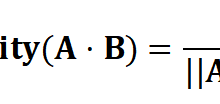
传统基于向量数据库的 RAG(Retrieval-Augmented Generation)系统是如何工作的?它通过计算 Query 和 Document 的向量点积来寻找相似度:
S
i
m
i
l
a
r
i
t
y
(
q
,
d
)
=
q
⋅
d
∥
q
∥
∥
d
∥
Similarity(q, d) = \\frac{\\mathbf{q} \\cdot \\mathbf{d}}{\\|\\mathbf{q}\\| \\|\\mathbf{d}\\|}
Similarity(q,d)=∥q∥∥d∥q⋅d
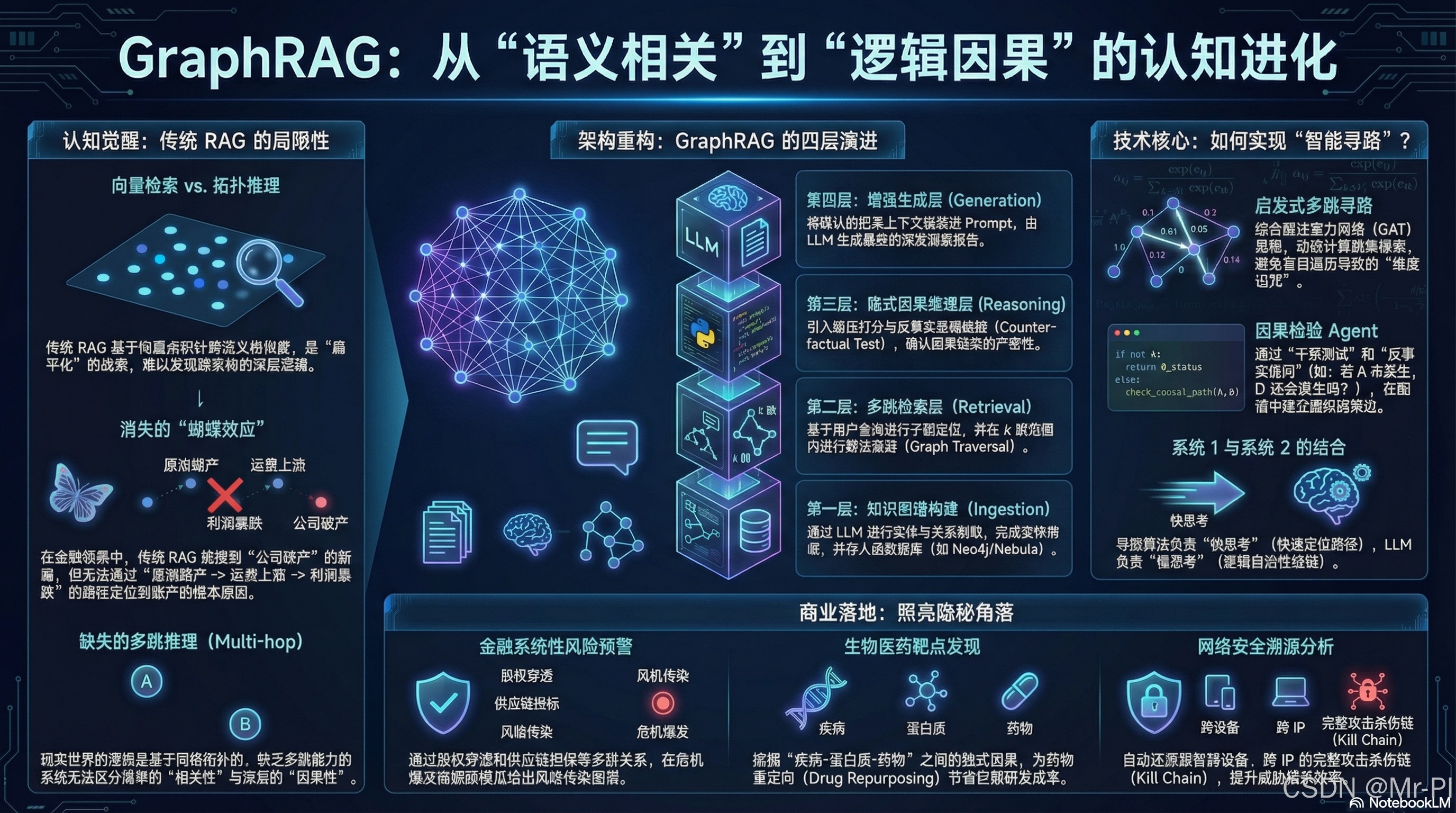
如果用户提问:“为什么国内新材料公司D会破产?”,传统 RAG 会在高维空间中拼命寻找包含“公司D”、“破产”、“资金链”的文档。它可能会检索出“公司D管理不善”的直接新闻,但绝对无法将“中东原油减产(事件A)”作为根本原因检索出来。
为什么?因为向量检索是扁平的、基于语义相似度的,而现实世界的逻辑是深度的、基于网络拓扑的。 传统 RAG 缺乏**多跳推理(Multi-hop Reasoning)**的能力,更遑论区分“相关性”与“因果性”。
这时候,我们需要 GraphRAG 闪亮登场。
二、 架构重构:GraphRAG 的高维认知世界
GraphRAG 的本质,是将非结构化的文本抽象为结构化的属性图
G
=
(
V
,
E
,
R
)
G = (V, E, R)
G=(V,E,R),其中
V
V
V 是实体节点(Entities),
E
E
E 是边(Edges),
R
R
R 是关系类型(Relations)。
在这个图谱中,知识不再是孤立的向量点,而是相互交织的网络。大模型不再是“盲人摸象”,而是站在了“上帝视角”。
让我们用一张 Mermaid 架构图来看看一个企业级 GraphRAG 挖掘隐式因果关系的系统全貌:
#mermaid-svg-6hGTIOR2lfmu2Tto{font-family:\”trebuchet ms\”,verdana,arial,sans-serif;font-size:16px;fill:#333;}@keyframes edge-animation-frame{from{stroke-dashoffset:0;}}@keyframes dash{to{stroke-dashoffset:0;}}#mermaid-svg-6hGTIOR2lfmu2Tto .edge-animation-slow{stroke-dasharray:9,5!important;stroke-dashoffset:900;animation:dash 50s linear infinite;stroke-linecap:round;}#mermaid-svg-6hGTIOR2lfmu2Tto .edge-animation-fast{stroke-dasharray:9,5!important;stroke-dashoffset:900;animation:dash 20s linear infinite;stroke-linecap:round;}#mermaid-svg-6hGTIOR2lfmu2Tto .error-icon{fill:#552222;}#mermaid-svg-6hGTIOR2lfmu2Tto .error-text{fill:#552222;stroke:#552222;}#mermaid-svg-6hGTIOR2lfmu2Tto .edge-thickness-normal{stroke-width:1px;}#mermaid-svg-6hGTIOR2lfmu2Tto .edge-thickness-thick{stroke-width:3.5px;}#mermaid-svg-6hGTIOR2lfmu2Tto .edge-pattern-solid{stroke-dasharray:0;}#mermaid-svg-6hGTIOR2lfmu2Tto .edge-thickness-invisible{stroke-width:0;fill:none;}#mermaid-svg-6hGTIOR2lfmu2Tto .edge-pattern-dashed{stroke-dasharray:3;}#mermaid-svg-6hGTIOR2lfmu2Tto .edge-pattern-dotted{stroke-dasharray:2;}#mermaid-svg-6hGTIOR2lfmu2Tto .marker{fill:#333333;stroke:#333333;}#mermaid-svg-6hGTIOR2lfmu2Tto .marker.cross{stroke:#333333;}#mermaid-svg-6hGTIOR2lfmu2Tto svg{font-family:\”trebuchet ms\”,verdana,arial,sans-serif;font-size:16px;}#mermaid-svg-6hGTIOR2lfmu2Tto p{margin:0;}#mermaid-svg-6hGTIOR2lfmu2Tto .label{font-family:\”trebuchet ms\”,verdana,arial,sans-serif;color:#333;}#mermaid-svg-6hGTIOR2lfmu2Tto .cluster-label text{fill:#333;}#mermaid-svg-6hGTIOR2lfmu2Tto .cluster-label span{color:#333;}#mermaid-svg-6hGTIOR2lfmu2Tto .cluster-label span p{background-color:transparent;}#mermaid-svg-6hGTIOR2lfmu2Tto .label text,#mermaid-svg-6hGTIOR2lfmu2Tto span{fill:#333;color:#333;}#mermaid-svg-6hGTIOR2lfmu2Tto .node rect,#mermaid-svg-6hGTIOR2lfmu2Tto .node circle,#mermaid-svg-6hGTIOR2lfmu2Tto .node ellipse,#mermaid-svg-6hGTIOR2lfmu2Tto .node polygon,#mermaid-svg-6hGTIOR2lfmu2Tto .node path{fill:#ECECFF;stroke:#9370DB;stroke-width:1px;}#mermaid-svg-6hGTIOR2lfmu2Tto .rough-node .label text,#mermaid-svg-6hGTIOR2lfmu2Tto .node .label text,#mermaid-svg-6hGTIOR2lfmu2Tto .image-shape .label,#mermaid-svg-6hGTIOR2lfmu2Tto .icon-shape .label{text-anchor:middle;}#mermaid-svg-6hGTIOR2lfmu2Tto .node .katex path{fill:#000;stroke:#000;stroke-width:1px;}#mermaid-svg-6hGTIOR2lfmu2Tto .rough-node .label,#mermaid-svg-6hGTIOR2lfmu2Tto .node .label,#mermaid-svg-6hGTIOR2lfmu2Tto .image-shape .label,#mermaid-svg-6hGTIOR2lfmu2Tto .icon-shape .label{text-align:center;}#mermaid-svg-6hGTIOR2lfmu2Tto .node.clickable{cursor:pointer;}#mermaid-svg-6hGTIOR2lfmu2Tto .root .anchor path{fill:#333333!important;stroke-width:0;stroke:#333333;}#mermaid-svg-6hGTIOR2lfmu2Tto .arrowheadPath{fill:#333333;}#mermaid-svg-6hGTIOR2lfmu2Tto .edgePath .path{stroke:#333333;stroke-width:2.0px;}#mermaid-svg-6hGTIOR2lfmu2Tto .flowchart-link{stroke:#333333;fill:none;}#mermaid-svg-6hGTIOR2lfmu2Tto .edgeLabel{background-color:rgba(232,232,232, 0.8);text-align:center;}#mermaid-svg-6hGTIOR2lfmu2Tto .edgeLabel p{background-color:rgba(232,232,232, 0.8);}#mermaid-svg-6hGTIOR2lfmu2Tto .edgeLabel rect{opacity:0.5;background-color:rgba(232,232,232, 0.8);fill:rgba(232,232,232, 0.8);}#mermaid-svg-6hGTIOR2lfmu2Tto .labelBkg{background-color:rgba(232, 232, 232, 0.5);}#mermaid-svg-6hGTIOR2lfmu2Tto .cluster rect{fill:#ffffde;stroke:#aaaa33;stroke-width:1px;}#mermaid-svg-6hGTIOR2lfmu2Tto .cluster text{fill:#333;}#mermaid-svg-6hGTIOR2lfmu2Tto .cluster span{color:#333;}#mermaid-svg-6hGTIOR2lfmu2Tto div.mermaidTooltip{position:absolute;text-align:center;max-width:200px;padding:2px;font-family:\”trebuchet ms\”,verdana,arial,sans-serif;font-size:12px;background:hsl(80, 100%, 96.2745098039%);border:1px solid #aaaa33;border-radius:2px;pointer-events:none;z-index:100;}#mermaid-svg-6hGTIOR2lfmu2Tto .flowchartTitleText{text-anchor:middle;font-size:18px;fill:#333;}#mermaid-svg-6hGTIOR2lfmu2Tto rect.text{fill:none;stroke-width:0;}#mermaid-svg-6hGTIOR2lfmu2Tto .icon-shape,#mermaid-svg-6hGTIOR2lfmu2Tto .image-shape{background-color:rgba(232,232,232, 0.8);text-align:center;}#mermaid-svg-6hGTIOR2lfmu2Tto .icon-shape p,#mermaid-svg-6hGTIOR2lfmu2Tto .image-shape p{background-color:rgba(232,232,232, 0.8);padding:2px;}#mermaid-svg-6hGTIOR2lfmu2Tto .icon-shape rect,#mermaid-svg-6hGTIOR2lfmu2Tto .image-shape rect{opacity:0.5;background-color:rgba(232,232,232, 0.8);fill:rgba(232,232,232, 0.8);}#mermaid-svg-6hGTIOR2lfmu2Tto .label-icon{display:inline-block;height:1em;overflow:visible;vertical-align:-0.125em;}#mermaid-svg-6hGTIOR2lfmu2Tto .node .label-icon path{fill:currentColor;stroke:revert;stroke-width:revert;}#mermaid-svg-6hGTIOR2lfmu2Tto :root{–mermaid-font-family:\”trebuchet ms\”,verdana,arial,sans-serif;}
4. 增强生成层 (Generation)
3. 隐式因果推理层 (Reasoning)
2. 查询与多跳检索层 (Retrieval)
1. 知识图谱构建层 (Ingestion)
提供拓扑结构
海量多源异构数据
LLM 实体/关系抽取
实体消歧与融合
图数据库 Neo4j/Nebula
User Query: 寻找事件D的根本原因
Query 解析与子图定位
起点节点定位: 节点D
多跳路径漫游 Graph Traversal
提取备选路径 K-hops
路径打分机制 Path Scoring
反事实逻辑检验 Counterfactual Test
因果链条确认
Prompt 组装上下文
LLM 综合生成
最终洞察报告
在这个架构中,核心的壁垒在于第2层(多跳检索)和第3层(隐式因果推理)。
三、 算法破局:多跳推理的数学之美与实现
多跳推理(Multi-hop Reasoning)的本质,是在离散的图结构中寻找一条从起点
v
s
v_s
vs 到终点
v
t
v_t
vt 的有效路径
P
=
(
v
s
,
e
1
,
v
1
,
e
2
,
.
.
.
,
e
k
,
v
t
)
P = (v_s, e_1, v_1, e_2, …, e_k, v_t)
P=(vs,e1,v1,e2,…,ek,vt),其中
k
k
k 是跳数。
1. 为什么“隐式关系”很难找?
因为随着跳数
k
k
k 的增加,路径数量呈指数级爆炸。如果盲目使用 BFS(广度优先搜索),系统会陷入“维度诅咒”。我们需要给寻路算法装上“雷达”——图神经网络(GNN)与注意力机制的融合。
2. 启发式多跳寻路的数学表达
在现代 GraphRAG 中,我们通常使用图注意力网络(GAT)的思想来动态计算跳转概率。假设当前在节点
h
i
h_i
hi,下一步跳转到邻居节点
h
j
h_j
hj 的注意力权重为
α
i
j
\\alpha_{ij}
αij:
α
i
j
=
exp
(
LeakyReLU
(
a
T
[
W
h
i
∥
W
h
j
]
)
)
∑
k
∈
N
(
i
)
exp
(
LeakyReLU
(
a
T
[
W
h
i
∥
W
h
k
]
)
)
\\alpha_{ij} = \\frac{\\exp(\\text{LeakyReLU}(\\mathbf{a}^T[\\mathbf{W}h_i \\| \\mathbf{W}h_j]))}{\\sum_{k \\in \\mathcal{N}(i)} \\exp(\\text{LeakyReLU}(\\mathbf{a}^T[\\mathbf{W}h_i \\| \\mathbf{W}h_k]))}
αij=∑k∈N(i)exp(LeakyReLU(aT[Whi∥Whk]))exp(LeakyReLU(aT[Whi∥Whj]))
结合用户的 Query 向量
q
\\mathbf{q}
q,我们可以将目标导向的跳转概率定义为:
P
(
v
j
∣
v
i
,
q
)
=
Softmax
(
M
L
P
(
[
h
i
,
h
j
,
q
]
)
)
P(v_j | v_i, q) = \\text{Softmax}(MLP([h_i, h_j, \\mathbf{q}]))
P(vj∣vi,q)=Softmax(MLP([hi,hj,q]))
这意味着,算法在每一步跳跃时,都会“闻一闻”哪个邻居节点更有可能回答用户的问题。这就把盲目的图遍历,变成了智能的语义寻路。
四、 灵魂升华:从“相关”到“因果”的惊险一跃
找到了一条路径 A -> B -> C -> D,就代表 A 是 D 的原因吗? 绝不。 统计学先驱指出:“相关不等于因果”。A和D可能只是受到同一个混淆变量(Confounder)的影响。
挖掘隐式因果关系(Implicit Causal Relationship),是目前 AI 领域的一颗皇冠上的明珠。在这里,我们需要引入图灵奖得主 Judea Pearl 的**因果推断(Causal Inference)与反事实推理(Counterfactual Reasoning)**理论。
在 GraphRAG 框架下,我们如何让大模型做因果推断?
策略:LLM 驱动的反事实检验 (Do-Calculus 模拟)
我们在系统层引入一个“因果检验 Agent”。当多跳算法找出一条备选路径 原油减产(A) -> 运费上涨(B) -> 资金链断裂(D) 时,Agent 会执行以下逻辑:
如果 LLM 判定:在没有 A 的情况下,D 极大概率不会发生,那么我们就确认了 A -> D 存在隐式因果关系,并在图谱中建立一条全新的虚拟因果边(Virtual Causal Edge)。
五、 Code is Law:核心代码实战解析
让我们用 Python 和 NetworkX 配合一个模拟的大模型接口,来实现这段激动人心的“多跳因果推理”核心逻辑。
import networkx as nx
import numpy as np
# ==========================================
# 1. 初始化知识图谱 (模拟现实世界的复杂关系)
# ==========================================
G = nx.DiGraph()
# 添边:(起点, 终点, 关系, 关系权重)
edges =[
("Middle_East_Oil_Cut", "Shipping_Cost_Up", {"relation": "causes", "weight": 0.9}),
("Shipping_Cost_Up", "Euro_Chemical_Profit_Down", {"relation": "leads_to", "weight": 0.8}),
("Euro_Chemical_Profit_Down", "Material_Shortage", {"relation": "causes", "weight": 0.85}),
("Material_Shortage", "Company_D_Bankrupt", {"relation": "triggers", "weight": 0.95}),
# 干扰项节点
("CEO_Resignation", "Company_D_Bankrupt", {"relation": "correlates", "weight": 0.4}),
("Tech_Stock_Crash", "Company_D_Bankrupt", {"relation": "correlates", "weight": 0.3})
]
G.add_edges_from((u, v, d) for u, v, d in edges)
# ==========================================
# 2. 多跳路径搜索算法 (DFS with Depth Limit)
# ==========================================
def find_multi_hop_paths(graph, source, target, max_depth=4):
"""
寻找两节点间的多跳路径,限制最大跳数以防爆炸
"""
paths = list(nx.all_simple_paths(graph, source=source, target=target, cutoff=max_depth))
return paths
# ==========================================
# 3. LLM 因果关系检验器 (模拟反事实推理)
# ==========================================
def llm_causal_evaluator(path, graph):
"""
通过大模型验证路径是否具备严密的因果链条
"""
# 提取路径上的所有关系
chain_desc = " -> ".join([f"{path[i]} ({graph[path[i]][path[i+1]]['relation']}) {path[i+1]}"
for i in range(len(path)–1)])
# 构造反事实 Prompt (这里模拟 LLM 的响应)
prompt = f"""
You are an expert causal reasoning AI.
Analyze the following event chain: {chain_desc}
Question: Is there a strong IMPLICIT CAUSAL relationship between the first event ({path[0]}) and the last event ({path[–1]})?
Apply counterfactual reasoning: If {path[0]} did NOT happen, would {path[–1]} still likely happen?
Return YES or NO, with a confidence score.
"""
# 模拟 LLM 推理过程 (在真实系统中,这里是调用 OpenAI / Claude API)
print(f"[LLM Prompting] Analyzing chain: {chain_desc}")
# 简单的打分启发式:假设因果边权重相乘
score = np.prod([graph[path[i]][path[i+1]]['weight'] for i in range(len(path)–1)])
if score > 0.5:
return True, score, "Passed counterfactual test: Strong causal chain detected."
else:
return False, score, "Failed counterfactual test: Correlation only."
# ==========================================
# 4. 执行主程序
# ==========================================
source_node = "Middle_East_Oil_Cut"
target_node = "Company_D_Bankrupt"
print(f"🚀 任务:挖掘 [{source_node}] 与 [{target_node}] 的隐式因果关系\\n")
# 步骤 A: 提取多跳路径
candidate_paths = find_multi_hop_paths(G, source_node, target_node, max_depth=5)
print(f"🔍 发现 {len(candidate_paths)} 条备选路径。")
# 步骤 B: 对每条路径进行大模型因果验证
for idx, path in enumerate(candidate_paths):
is_causal, confidence, reason = llm_causal_evaluator(path, G)
if is_causal:
print(f"\\n✅ 成功挖掘隐式因果链 (Confidence: {confidence:.2f}):")
print(" 🎯 " + " ➔ ".join(path))
print(f" 🧠 LLM 裁决: {reason}")
# 步骤 C: 在图谱中补充隐式边,丰富系统的内在认知
G.add_edge(source_node, target_node, relation="implicit_cause", weight=confidence)
print(f"\\n🌐 知识图谱已更新,新建立的隐式边数: {len(G.edges(source_node, target_node))}")
代码深度解析:
六、 商业落地:那些被 GraphRAG 照亮的隐秘角落
挖掘出隐式因果关系后,能解决什么业务难题?
七、 架构师寄语:AI 的未来在于“思考的深度”
纵观当前大模型的发展,一味堆砌参数和上下文长度(Context Length)并不能彻底解决幻觉和逻辑断层的问题。“暴力美学”有其天花板。
基于 GraphRAG 的多跳推理与因果挖掘,指明了另一条路径:将人类沉淀千年的结构化逻辑体系(图谱),与当代最强大的概率语言引擎(大模型)深度耦合。
寻找答案不再是简单的文本比对,而是跨越信息鸿沟的逻辑探险。在这个探险过程中,我们不仅教会了 AI 去寻找“是什么”,更教会了 AI 去追问“为什么”。
这不仅是算法工程的胜利,更是人类向机器传授哲学思维的伟大映射。