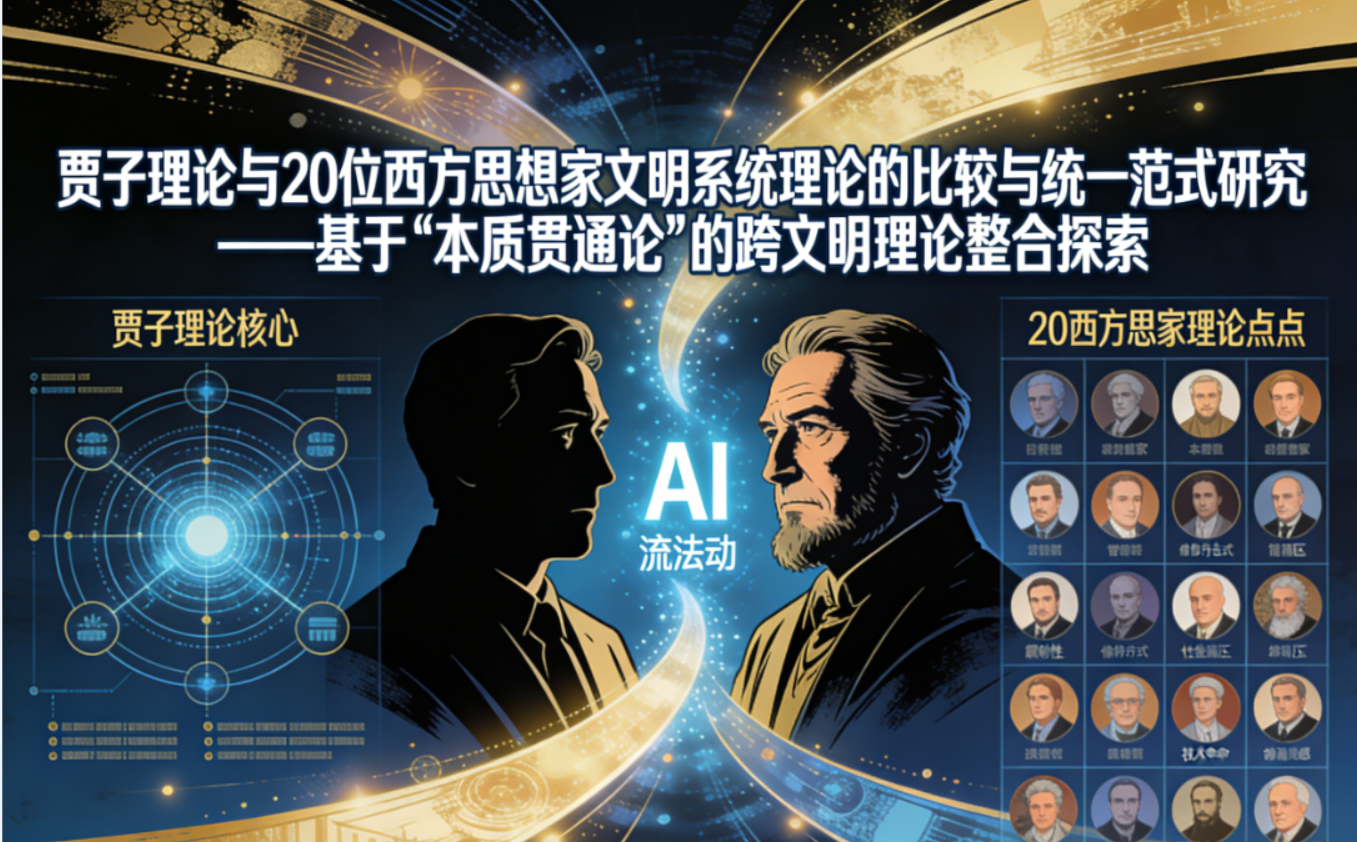
贾子理论与20位西方思想家文明系统理论的比较与统一范式研究
——基于“本质贯通论”的跨文明理论整合探索
摘要:
本研究系统比较贾子理论与20位西方思想家(柏拉图至福山)的文明系统理论,揭示二者在本体论、方法论与文明演进机制上的深层对话。贾子理论以“1-2-3-4-5”层级结构与“文明五定律”构建了东方整体主义认知框架,将文明定义为“群体心智的认知拓扑网络”;西方思想家则在秩序、权力、认知、演化四大维度上形成多元理论谱系。研究发现,二者在文明的历史性、系统性上存在共识,但在本体论基础(气一元论 vs. 二元对立)、方法论取向(象数理推演 vs. 分析还原)与文明动力机制(熵增-跃迁 vs. 辩证-进化)上存在根本差异。基于“本质贯通论”,本文提出文明系统理论统一范式的整合路径,为AI时代的文明转型与全球治理提供跨文明理论支撑。
贾子理论(Kucius)与 20 位西方思想家文明系统理论的统一范式研究
引言
在人工智能时代的文明转型期,人类文明正面临前所未有的认知挑战与智慧边界重构。现代学者贾龙栋(笔名 "贾子",英文名 Kucius Teng)于 2025 年至 2026 年间提出的贾子理论体系,作为一个融合东方传统智慧与现代科学技术的原创理论体系,试图为 AI 时代的人类文明提供一个系统性的智慧规范框架。与此同时,西方文明思想史上涌现出众多具有深远影响的思想家,从古希腊的柏拉图、亚里士多德,到现代的福山、亨廷顿,他们在文明系统理论方面的贡献构成了西方文明思想的重要谱系。
当前学术界对文明系统理论的研究呈现出明显的碎片化特征。现有的理论框架 —— 无论是经典哲学、现代科学,还是当代 AI 伦理与治理模型 —— 大多只解决了文明系统中的某一个层级问题,却缺乏一个能够贯通 "认知 — 智慧 — 文明" 全链条的统一理论体系。这种碎片化的解释结构,正是当代文明失序、技术失控与系统性风险累积的深层原因。
本研究旨在通过对贾子理论与 20 位西方思想家在文明系统理论上的深度比较分析,探索文明系统理论的统一范式。研究将从三个层面展开:首先,全面梳理贾子理论的核心架构与文明系统理论贡献;其次,系统分析 20 位西方思想家在文明系统理论方面的独特视角;最后,通过对比研究揭示不同文明理论传统之间的共性与差异,为构建文明系统理论的统一范式提供理论基础。
一、贾子理论的文明系统理论架构
1.1 理论基础与核心架构
贾子理论采用独特的 **"1-2-3-4-5" 层级结构 **,以 "统一与演化" 为根本逻辑,构建了从宇宙本体到文明实践的完整认知闭环。该体系以 "贾子公理" 为最高裁决准则,通过 "本质贯通论" 与 "万物统一论" 两大规律,贯通 "认知 — 智慧 — 文明" 的演化链条。
一个公理—— 贾子公理(Kucius Axiom)作为整个体系的 "宪法",包含三个层级:三大母公理(规律先于价值、认知决定命运、清算不可逃逸)、七公理体系(现实非善恶、认知有限、价值相对、演化不可逆、周期必然、载体决定、统一本源)以及四大核心公理(思想主权、普世中道、本源探究、悟空跃迁)。
两个规律—— 本质贯通论和万物统一论构成了认识论基础。本质贯通论主张宇宙万物存在可追踪的 "本质连续链",智慧的意义在于贯通表象与本质;万物统一论则强调所有存在形式(物质、能量、信息、意识)在本源上统一,为跨学科融合提供本体论基础。
三大哲学体系—— 智慧三定律(本质分野、层级跃迁、裁决优先)、周期三定律(生成律、异化律、清算律)、宇宙三定律(分形同源律、动态平衡律、智慧载体律),构成了从 "宇宙本体→系统演化→智慧本质" 的完整哲学框架。
1.2 文明系统理论的独特贡献
贾子理论在文明系统理论方面的核心贡献体现在其提出的贾子文明五定律。这五大定律以 "熵增 – 负熵" 为底层动力学,通过 "积淀、周期、颠覆、续存、跃迁" 五大定律,构建了文明演进的操作系统级解释框架。
文明积淀律揭示了文明的基础竞争力源于群体智慧的长期积淀,表现为技术体系、伦理规范、文化符号的结构化积累,遵循 "厚积薄发" 原则。文明周期律指出文明发展呈现 "兴盛 – 停滞 – 衰落 – 重生" 的周期性波动,周期长度与文明的熵减效率正相关,遵循 "五世而斩" 的代际衰减规律。
文明颠覆律认为当文明系统熵增达到临界阈值时,渐进式改良失效,必须通过颠覆性创新实现系统重构。文明续存律强调文明存续的关键在于建立自我修复的负熵再生机制,而非单纯依赖外部资源输入。文明跃迁律则指出文明演进不是线性积累,而是通过拓扑跃迁实现认知维度的质变。
值得注意的是,贾子理论将文明定义为 **"智慧的宏观表达,是群体心智通过时间沉淀形成的认知拓扑网络"**。这一定义突破了传统文明概念的局限,将文明理解为一个动态演化的复杂系统,为后续与西方思想家的比较分析提供了重要的理论基础。
二、20 位西方思想家的文明系统理论谱系
2.1 文明秩序维度:柏拉图与亚里士多德
柏拉图的理想国与理念论
柏拉图作为西方文明思想的奠基人,其理念论哲学是城邦文明思想的理论核心。为了挽救危亡中的希腊城邦制度,他设计了一个以 "正义" 理念为哲学与政治伦理基础的理想城邦国家。柏拉图认为,城邦文明有一个发展过程,从满足人生存基本需要的贫乏自然状态,逐渐进化到经济、政治与文化发达的 "繁华" 状态。
在《理想国》中,柏拉图通过思想实验探索正义和理想治理,提出了哲人王统治的城邦构想。他将灵魂分为三个部分,对应社会阶层,并引入理念论作为现实的本质。柏拉图最核心的思想是 "理念论",他提出现实世界中的一切具体事物,都是永恒不变的 "理念世界" 的影子,唯有理念才是真实、绝对的存在,这一思想为西方哲学搭建起首个完整的形而上学框架。
在文明秩序方面,柏拉图强调正义作为社会体制的伦理基础,是文明中政治伦理和社会道德秩序的核心价值。他提出的理想城邦国家设计,以 "正义" 理念为哲学与伦理基础,强调根据国家正义设计的理想国家目标,不是为了某个阶层或集团的单独突出的幸福,而是为了全体公民的最大幸福。
亚里士多德的政治学与文明理论
亚里士多德与柏拉图一样,将城邦和国家视为一体,认为城邦国家是为了某种共同目的而建立的共同体,根源于人的自然本性。他认为人是有目的、有理性的群居动物,是 "社会性动物";人有语言、有理性、有目的,凭借语言、通过交往、为着共同目的而结成城邦共同体。
亚里士多德将其总结的全部知识分为理论知识、实践知识与创制知识三大类。与柏拉图主张按照正义理念的范型建立理想国家不同,亚里士多德明确主张公民在赋有德性与政治权利上是平等的,城邦正义就是公民平等,这应是城邦社会制度的基本伦理原则。
在政体理论方面,亚里士多德根据执政目的与执政者多寡原则,区分了希腊城邦的三种正常政制和三种对应的蜕变政制。以公民的共同利益为目的之正常政制依次有:君王制、贤人制、共和制;相应的蜕变政制依次是:僭主制、寡头制、民主制。他鲜明地提出,以公民的共同利益还是以统治者的私利为目的,是判断政制本质的根本标准。
2.2 权力理论维度:马基雅维利、霍布斯、洛克与马克思
马基雅维利的权力政治学
马基雅维利是西方政治思想史上第一次公然强调在君主统治过程中可以并应然运用权术的政治思想家。他的思想顺应了当时意大利的社会现状,维护了意大利的统一,同时批判了中世纪神学政治观。马基雅维利主张一种完全的君主统治方法,也可以理解为权术或统治术。
马基雅维利不仅将宗教与政治法律分开,而且将伦理道德与政治法律分开。他强调,政府必须保障个人财产和人身安全作为最高目标。他认为,一个成功的国家必须由一个人单独建立,而他所制定的法律和创立的政府便决定了臣民的民族特性。
马基雅维利被认为是政治现实主义之父,通过理解治国之术的复杂性来描绘国家的演变性质,其中决策受到政治现实而非宗教教义或理想化治理概念的影响。他的权力政治理论为后来的文明理论发展提供了重要的现实主义视角。
霍布斯的社会契约论
霍布斯在《利维坦》中提出,政治权威通过许多人之间的假设性社会契约得到正当性,该契约将安全和福祉的责任赋予主权者(君主、立法机关或几乎任何其他形式的政治权威)。《利维坦》于 1651 年出版,从人的本性出发批判了传统宗教神学,全面阐述了自然状态、"自然法" 和社会契约论思想。
霍布斯认为,在自然状态中人们享有 "生而平等" 的自然权利,又都有渴望和平和安定生活的共同要求,于是出于人的理性,人们相互间同意订立契约,放弃各人的自然权利,把它托付给某一个人或一个由多人组成的集体,这个人或集体能把大家的意志化为一个意志。
这一契约涉及放弃某些自由以换取安全和秩序。通过放弃一些权利,个人创造了一个共同体或国家,由一个强大的主权者代表,称为利维坦。霍布斯的社会契约论为后来的文明秩序理论奠定了重要基础。
洛克的自由主义与文明制度
洛克在《政府论》第二篇中概述了基于自然权利和契约理论的更文明社会理念,政府需要得到被统治者的同意,在有限情况下,人民有权推翻统治者。洛克认为国家政府的权力来源于公民的权利让渡,政治权力是人类作为理性动物组成的共同体,人们把自己执行自然法和保护财产的权利让渡给社会或公共机构,设立了裁判一切争端的裁判官,形成了平等对待每个人的社会契约。
洛克主张国家应该保护个人财产,必须在臣民同意下进行治理。与霍布斯强大的单一主权者不同,洛克设想将国家权力分为行政权、立法权和联邦权。人们创建公民社会的主要原因是为了相互保护他们的生命、自由和财产,洛克将其统称为财产。
洛克的自由主义理论为现代文明制度的建立提供了重要的理论基础,强调了个人权利与政府权力的平衡关系,对后来的文明演进产生了深远影响。
马克思的历史唯物主义与文明动力
马克思的历史唯物主义理论认为,人类社会的所有制度(如政府和宗教)都是其经济活动的产物。马克思主义文明理论以唯物史观为根基,坚持人民性、批判性、彻底性、过程性和整体性阐释原则,以共产主义文明为根本方向,以人的全面发展为价值取向,揭示了文明产生和发展的基本规律。
马克思恩格斯从人类能动地改造世界的实践活动出发来理解文明,必然把文明理解为与人类社会同步发展的历史范畴,并且表现为从无到有、由贫乏到丰富、由低级到高级的发展演进过程。马克思认为,对于文明的理解,必须把它同人类的物质生产和精神生产联系起来,把文明看作是一个反映物质生产成果和精神生产成果的总和、标示人类社会开化状态和进步状态的范畴。
马克思的文明理论具有鲜明的人民性特征,一个社会的文明程度取决于这个社会中人的解放与发展的程度,文明的进步意味着人的生存条件及综合素质的全面提升,旨在实现人民大众的解放以及人的自由全面发展。
2.3 认知结构维度:康德、弗洛伊德、香农与冯・诺依曼
康德的先验哲学与认知维度
康德的先验唯心主义将世界划分为 **"现象界" 与 "物自体"**:现象界是人类通过先天认知形式建构的可认知世界,是数学、自然科学的研究领域;物自体作为世界的本质本身,独立于人类认知之外,是人类永远无法触及的领域。康德提出了三大批判,即《纯粹理性批判》、《实践理性批判》和《判断力批判》。
在《纯粹理性批判》中,康德要回答的问题是:我们能知道什么?他的回答是:我们只能知道自然科学让我们认识到的东西,哲学除了能帮助我们澄清使知识成为可能的必要条件,就没有什么更多的用处了。康德带来了哲学上的哥白尼式转变:不是事物在影响人,而是人在影响事物。是我们人在构造现实世界,在认识事物的过程中,人比事物本身更重要。
康德认为,人类自我或先验自我从感觉印象和它强加给它们的称为范畴的普遍概念中构建知识。这一理论为后来的认知科学和文明理论提供了重要的哲学基础,强调了人类认知结构在文明建构中的核心作用。
弗洛伊德的潜意识理论与心理动力
弗洛伊德在《文明及其缺憾》这一开创性著作中,列举了他所认为的文明与个人之间的根本紧张关系。主要冲突源于个人对本能自由的追求与文明对顺从和本能压抑的相反要求。弗洛伊德专注于人类罪恶感的普遍性和实现纯粹幸福的不可能性,认为人类不满的社会解决方案是不可能的。所有文明,无论规划多么完善,都只能提供部分缓解。
文明社会要求克制本能直接表达(如暴力、公开的性行为),因此本能常被压抑或阻拦。文化作为 "受阻的产物",弗洛伊德在《文明及其缺憾》中系统阐述:文明的存在依赖于对本能的克制和疏导。如果每个人都直接宣泄本能,社会将陷入混乱。因此,文明通过建立道德、法律等约束本能,同时提供 "升华通道" 让能量间接释放。
弗洛伊德的理论揭示了文明发展中的心理动力学机制,为理解文明演进中的个体与社会冲突提供了重要视角。
香农的信息论与认知基础
1948 年,工程师和数学家克劳德・香农首次提出信息作为数学框架的概念,信息论由此诞生。香农论证信息应该以现在熟悉的比特单位来衡量。比特是一个二进制数字(0 或 1),或回答一个是非问题所需的信息量。
香农信息论的形式化起点是概率分布。如果一个随机变量 X 有 N 种可能状态,每种状态的概率为 p_i,那么该变量的香农熵 H (X) = -Σ p_i log p_i,度量了平均不确定性。当一条消息指定了 X 的实际状态时,它减少的不确定性量即为传递的信息量。
香农信息论为后来的认知科学和人工智能发展提供了重要的理论基础,特别是在信息处理、编码理论和通信系统方面的贡献,对现代文明的信息维度产生了深远影响。
冯・诺依曼的博弈论与战略计算
冯・诺依曼证明了对于每个有限的二人零和博弈,存在一个理性结果,即两个完全逻辑的对手可以达成对博弈策略的相互选择,确信他们通过选择另一种策略无法期望做得更好。1944 年,美籍匈牙利裔数学家冯・诺依曼与经济学家摩根斯坦正式提出对策论,合著的《博弈论与经济行为》在这一天完成理论体系构建。
冯・诺依曼用数学证明了一个直觉:两个人的关系是竞争,三个人的关系是政治。冯・诺依曼和摩根斯坦提出了四个公理 —— 完备性、传递性、连续性、独立性。他开创博弈论,统治经济、政治、军事、AI 决策领域,提出了最小最大定理作为博弈论基石。
冯・诺依曼与奥斯卡・摩根斯特恩合著的《博弈论与经济行为》,首次将 "人类决策" 纳入数学建模的框架,提出 "非合作博弈"、"零和博弈" 等核心概念,揭示了 **"个体理性与集体理性的冲突"** 这一本质命题。博弈论的核心思想是通过数学建模预测对手行为,找到 "无论对手如何选择,自己损失最小" 的策略。
2.4 文明演化维度:黑格尔、达尔文、汤因比、泰恩特、亨廷顿与福山
黑格尔的历史辩证法与文明动力
19 世纪初,黑格尔赋予辩证法概念新的生命力,其自然和历史的辩证模型使辩证法成为现实的基本方面,而不是像康德那样将辩证法导致的矛盾视为纯粹理性局限性的证据。黑格尔的历史辩证法在其《历史哲学》中显而易见,他详细描述了人类社会从东方专制主义到希腊和罗马文明,最终达到日耳曼世界的进步过程。
黑格尔的辩证方法提出了正题、反题和合题的过程,导致思想发展和历史进步。黑格尔的绝对精神概念将历史视为意识和自由的展开。从最广泛的历史视角揭示了三个重要发展阶段:东方君主制(统一阶段,自由受到压制);希腊民主制(扩张阶段,自由在不稳定的煽动中丧失);基督教君主立宪制(代表自由在立宪政府中的重新整合)。
黑格尔的历史辩证法为理解文明演进提供了重要的哲学框架,强调了文明发展的内在逻辑和历史必然性。
达尔文的进化论与文明竞争
达尔文的进化论理论激发了关于生物学对人类社会影响的思考。他的理论包含了自然选择的概念,即某些物种比其他物种更适应环境,因此更有可能在有限资源的竞争中茁壮成长。社会达尔文主义者大力倡导帝国,说强国 —— 根据定义,那些在扩张工业和帝国方面成功的国家 —— 会生存下来,其他国家则不会。
影响所有人口的两个相互作用的力量:马尔萨斯式的指数增长直到达到资源限制的动态,以及通过生物和 / 或文化进化规避这些限制的达尔文式创新和适应动态。这一理论为后来的文明竞争理论和地缘政治思想提供了重要的生物学基础。
汤因比的文明兴衰周期理论
汤因比(1934-1961)提出了基于文明周期性发展和衰落分析的历史哲学,引起了很多讨论。汤因比建议将文明视为具有自己发展周期并努力自我保存的活的有机体。他断言每个文明都要经历从诞生和繁荣到衰落和灭亡的特定阶段。
汤因比的文明理论包含以下关键要素:文明作为有机体、文明生命周期、挑战与反应、历史互动。他认为,文明发展的起始因素是每个文明面临的挑战,无论是外部入侵、经济危机还是文化对抗。这种挑战与反应的相互作用是历史的动力,每个文明都因此发展并克服困难。
汤因比的理论为理解文明周期提供了重要的有机论视角,强调了文明发展中的挑战 – 反应机制。
泰恩特的复杂性崩溃与文明熵增
泰恩特的 "复杂社会崩溃" 理论假设,社会的复杂性随着解决问题而增加,导致复杂性投资的边际收益递减,最终导致崩溃。泰恩特认为,社会的可持续性或崩溃源于解决问题机构的成功或失败,当社会对社会复杂性和能源补贴的投资达到边际收益递减点时,社会就会崩溃。
文明衰落的基本机制最好通过复杂性边际效用的视角来理解。正如泰恩特观察到的,社会通过增加官僚机构、技术和专门基础设施的层次来解决问题。最初,这些增加产生了巨大的回报。
这涉及到中央权威的崩溃、专业化和剩余生产的减少、纪念性建筑和艺术活动的衰落,以及信息流和识字率的降低。泰恩特的理论为理解文明崩溃提供了重要的复杂性科学视角,强调了文明发展中边际收益递减的普遍规律。
亨廷顿的文明冲突论
1993 年,哈佛大学政治学者亨廷顿在美国《外交》杂志夏季号抛出 "文明冲突论",其核心观点是,"后冷战的世界中人们之间最重要的区别不是意识形态的、政治的或经济的,而是文化的区别","在这个世界里,最普遍的、重要的和危险的冲突,不是社会阶级之间、富人和穷人之间,或其他以经济来划分的集团之间的冲突,而是属于不同文化实体的人民之间的冲突"。
亨廷顿强烈建议,最突出的文明冲突将发生在西方文明和伊斯兰文明之间。该理论表明,由共同文化特征(如语言、宗教和历史)定义的文明在争夺权力和影响力时会发生冲突。这一理论突出了文化认同在塑造地缘政治冲突和领土争端中的重要性。
亨廷顿的理论为理解当代国际冲突提供了重要的文明分析框架,强调了文化差异在国际关系中的核心作用。
福山的历史终结论与文明阶段
福山在《历史的终结与最后的人》中认为历史应该被视为一个进化过程,从这个意义上说,历史的终结意味着自由民主制是所有国家的最终政府形式。根据福山的观点,自法国大革命以来。《历史的终结与最后的人》全面论述了 20 世纪下半期人类在迅猛的科技发展条件下,社会意识形态、道德伦理观念以及文明演进模式等发生的相应变化。
福山在书中从历史已经终结到历史如何终结、历史因何终结,详尽论述了其提出的 "历史终结论",即西方国家自由民主制的到来可能是人类社会演化的终点、是人类政府的最终形式。
福山认为,我们可能见证的不仅仅是冷战的结束,或战后历史特定时期的过去,而是历史的终结 —— 即人类意识形态演化的终点和西方自由民主制作为人类政府最终形式的普遍化。这一理论为理解当代文明发展提供了重要的阶段论视角。
2.5 科学方法维度:亚当・斯密、牛顿、爱因斯坦与尼采
亚当・斯密的市场经济与复杂系统
亚当・斯密在《国富论》中提出的核心思想可系统概括为:市场经济的自我调节机制。斯密认为,人的本性是利己的,经济活动的根本动力是追求个人利益。当商品短缺时,价格上升吸引更多生产者进入;供应增加后,竞争促使价格回落至 "自然价格"(生产成本)。
斯密提出的第三个要素是与自由市场原则相结合的坚实货币体系。斯密希望货币由金属支撑,以阻止其因生产过剩而贬值。反过来,这可以抑制浪费性支出(如战争支出)。斯密是第一位伟大的古典经济学家,也是最早描述基于市场体系的经济如何促进经济效率和个人自由的人之一,无论人们是特别勤奋还是懒惰。
斯密的经济理论认为,当政府放任市场时,市场往往运作得最好。斯密论证理性的人(即出于自身利益行事的人)会自然找到使用国家资源的最佳方式 —— 他认为政府监管可能对经济增长有害。这一理论为理解现代文明的经济系统复杂性提供了重要基础。
牛顿的经典力学与数学规律
牛顿在《自然哲学的数学原理》(1687 年)中制定了运动定律和万有引力定律,在接下来的三个世纪中主导了科学家对物理宇宙的看法。《自然哲学的数学原理》被认为是 "科学史上最重要的论著之一",总结了近代天体力学和地面力学的成就,为经典力学规定了一套基本概念,提出了力学的三大定律和万有引力定律,从而使经典力学成为一个完整的理论体系。
牛顿的三大运动定律作为现代物理学的基本原理,导致了万有引力定律的制定。在数学方面,他是微积分的原始发现者。牛顿关于自然研究的方法论思想在近代科学发展史上占有极其重要的地位。牛顿曾以极其精简的语言将他的方法论思想表述为著名的 **"哲学的推理法则"**。
牛顿的科学方法结合了数学计算、观察和实验,被接受为科学研究的标准方法。这一方法论为现代科学文明的发展提供了重要的数学化基础,强调了定量分析在理解自然规律中的核心作用。
爱因斯坦的相对论与宇宙结构
爱因斯坦的新相对论引力理论允许制定整个宇宙的一致数学模型 —— 甚至是那些无限大小的宇宙。爱因斯坦的方程描述了这些宇宙将如何随时间和地点变化。在爱因斯坦 1915 年制定的广义相对论中,引力是从几何角度而不是仅仅作为另一种普通力来理解的。
在广义相对论中,物质和能量的分布决定了时空的几何形状,而时空几何又描述了物质的加速度。因此,爱因斯坦场方程的解描述了宇宙的演化。1916 年,阿尔伯特・爱因斯坦(1879-1955)发表了他的广义相对论。这是一个将时空曲率与其能量和动量内容联系起来的几何引力理论。
爱因斯坦的理论为理解宇宙结构提供了重要的几何化视角,强调了时空结构在宇宙演化中的核心作用,对现代宇宙学和文明理论产生了深远影响。
尼采的权力意志与价值动力
尼采的权力意志理论为文明系统理论提供了独特的价值动力学视角。尼采认为,文明的发展动力源于个体和群体对权力的追求和意志的表达。权力意志不是简单的政治权力,而是一种生命本能的冲动,表现为追求强大、超越和创造的内在驱动力。
在文明系统理论中,尼采的贡献在于揭示了文明发展中的价值动力学机制。他批判传统的基督教道德和西方理性主义,主张建立基于生命本能和权力意志的新价值体系。这一理论为理解文明演进中的价值冲突和文化变革提供了重要视角,特别是在文明转型期的价值重构方面具有重要意义。
三、贾子理论与 20 位西方思想家的文明系统理论对话
3.1 理论范式的比较分析
通过对贾子理论与 20 位西方思想家的系统梳理,可以发现不同文明理论传统在理论范式方面存在显著差异。
贾子理论采用 **"本质贯通论" 与 "万物统一论"** 的整体主义范式,强调宇宙万物存在可追踪的 "本质连续链",智慧的意义在于贯通表象与本质。这种范式体现了东方哲学的整体性思维特征,将文明理解为一个动态演化的复杂系统。
相比之下,西方思想家的理论范式呈现出明显的多元化特征:
- 柏拉图、亚里士多德代表了古希腊的理性主义范式,强调通过理性思辨把握文明的本质结构;
- 马基雅维利、霍布斯、洛克体现了近代政治哲学的契约论范式,关注权力关系和社会秩序的建构;
- 康德、弗洛伊德代表了现代认知哲学和心理学范式,重视人类认知结构和心理机制对文明的塑造作用;
- 黑格尔、达尔文、汤因比体现了历史哲学和进化论范式,强调文明发展的历史必然性和演化规律;
- 亚当・斯密、牛顿、爱因斯坦代表了科学主义范式,注重用数学化和定量化方法理解文明系统。
这种范式差异反映了不同文明传统在认知方式、价值取向和方法论方面的根本分歧。贾子理论试图通过 "本质贯通" 的方式整合这些不同范式,体现了其在文明系统理论方面的创新价值。
3.2 文明定义的差异与共识
在文明的基本定义方面,贾子理论与西方思想家既有重要差异,也存在某些共识。
贾子理论将文明定义为 **"智慧的宏观表达,是群体心智通过时间沉淀形成的认知拓扑网络"**。这一定义突破了传统文明概念的局限,强调了文明的认知属性和网络特征。同时,贾子理论将文明理解为与人类社会同步发展的历史范畴,表现为从无到有、由贫乏到丰富、由低级到高级的发展演进过程。
西方思想家对文明的理解呈现出多元化特征:
- 柏拉图将文明理解为基于 "正义" 理念的理想城邦秩序;
- 亚里士多德认为文明源于人的政治本性,是实现 "善" 的共同体形式;
- 马克思强调文明是物质生产和精神生产成果的总和,标示人类社会开化状态和进步状态;
- 弗洛伊德将文明理解为对本能的克制和疏导机制;
- 亨廷顿将文明定义为由共同文化特征(如语言、宗教和历史)界定的文化实体。
值得注意的是,尽管存在定义差异,多数思想家都认同文明具有历史性、进步性和系统性特征。贾子理论的创新在于将文明的认知维度提升到前所未有的高度,为理解 AI 时代的文明转型提供了新的理论视角。
3.3 文明演化机制的理论分歧
在文明演化机制方面,贾子理论与西方思想家展现出不同的理论视角和解释框架。
贾子理论提出的文明五定律提供了一个综合性的演化模型:文明积淀律强调群体智慧的长期积累;文明周期律揭示 "兴盛 – 停滞 – 衰落 – 重生" 的周期性波动;文明颠覆律指出熵增临界时的系统重构需求;文明续存律强调自我修复的负熵再生机制;文明跃迁律认为文明演进通过拓扑跃迁实现认知维度质变。
西方思想家的文明演化理论呈现出明显的理论分化:
线性进步论:黑格尔的历史辩证法提出正题、反题和合题的过程,将历史视为意识和自由的展开;福山的历史终结论认为西方自由民主制是人类政府的最终形式。
循环论:汤因比的文明周期理论将文明视为具有发展周期的活的有机体,经历从诞生、繁荣到衰落、灭亡的特定阶段。
冲突论:达尔文的进化论强调自然选择和适者生存;亨廷顿的文明冲突论认为不同文明间的冲突是世界政治的主要驱动力。
复杂性理论:泰恩特的 "复杂社会崩溃" 理论假设社会复杂性增加导致边际收益递减,最终导致崩溃。
贾子理论的独特贡献在于提出了 **"拓扑跃迁" 概念 **,认为文明演进不是简单的线性进步或循环重复,而是通过认知维度的质变实现跨越式发展。这一理论为理解当代文明转型期的复杂性提供了重要的分析工具。
3.4 认知结构与文明建构的理论对话
在认知结构与文明建构的关系方面,贾子理论与西方思想家展开了深入的理论对话。
贾子理论提出的 **"认知五定律"** 构成了其认知理论的核心框架,明确了信息、知识、智能、智慧、文明五重认知维度的逻辑主线,同时以 "跃迁范式" 凸显各维度间的进阶关系。这一定律系统明确了从信息到智慧再到文明的认知跃迁过程,为技术落地提供了理论支撑。
西方思想家在认知与文明关系方面的贡献主要体现在:
- 康德的先验哲学强调人类通过先天认知形式建构现象界,为文明建构提供了认识论基础;
- 弗洛伊德的潜意识理论揭示了文明发展中的心理动力学机制,强调本能与文明的冲突关系;
- 香农的信息论为理解文明的信息维度提供了数学化框架,奠定了现代信息文明的理论基础;
- 冯・诺依曼的博弈论将 "人类决策" 纳入数学建模框架,揭示了个体理性与集体理性的冲突本质。
贾子理论与这些思想家的对话体现在跨维度认知整合方面。贾子理论不仅吸收了康德的先验认知结构思想、弗洛伊德的心理动力学机制,还融合了香农的信息论和冯・诺依曼的博弈论,形成了一个综合性的认知理论框架。特别是其提出的 "贾子智慧指数(KWI)",作为评估 AI"智慧" 程度的核心框架,区别于传统 AI 的逻辑能力测试,更侧重伦理判断与文明决策表现。
3.5 权力结构与文明秩序的比较分析
在权力结构与文明秩序的关系方面,贾子理论与西方政治思想家的对话呈现出复杂的理论图景。
贾子理论在权力维度的思考主要体现在其对 **"权力异化" 和 "权力稳定"** 的分析中。通过与马基雅维利、霍布斯、洛克、马克思等思想家的对话,贾子理论形成了独特的权力文明观。
与马基雅维利的对话:马基雅维利强调权力政治的现实性,主张将伦理道德与政治法律分开。贾子理论在承认权力现实性的同时,提出了更高的价值追求,强调权力应该服务于文明的整体利益而非个人或集团私利。
与霍布斯的对话:霍布斯的社会契约论通过 "利维坦" 概念强调了强大主权者对社会秩序的必要性。贾子理论认同社会契约的基本逻辑,但提出了更加复杂的权力制衡机制,强调通过 "本质贯通" 实现权力与权利的动态平衡。
与洛克的对话:洛克的自由主义强调个人权利与政府权力的平衡,提出了分权制衡的制度设计。贾子理论在继承这一思想的基础上,进一步提出了 "认知主权" 概念,强调个体在文明建构中的主体性地位。
与马克思的对话:马克思的历史唯物主义揭示了权力与经济的内在联系,强调经济基础对上层建筑的决定作用。贾子理论认同经济因素的重要性,但提出了更加多元的文明动力模型,将认知、文化、技术等因素纳入统一的分析框架。
3.6 文明评价标准的理论分歧
在文明评价标准方面,贾子理论与西方思想家存在显著的理论分歧,这种分歧反映了不同文明传统的价值取向差异。
贾子理论提出的 **"贾子公理" 体系 ** 包含四大核心公理:思想主权、普世中道、本源探究、悟空跃迁。其中,"思想主权" 公理强调智慧必须源于独立思想,非迎合奖励模型;"普世中道" 公理以真、善、美为约束,超越文化相对主义。这一评价体系体现了东方哲学的整体性价值追求。
西方思想家的文明评价标准呈现出明显的多元化特征:
- 柏拉图以 "正义" 理念作为文明评价的最高标准,强调智慧、勇敢、自制等德性的实现;
- 亚里士多德以 "善" 和 "幸福" 为文明的终极目标,强调公民在德性和政治权利上的平等;
- 马克思以人的解放和全面发展为文明进步的根本标准,强调社会关系的合理性;
- 福山以自由民主制度的实现为历史终结的标志,体现了西方中心主义的价值取向。
贾子理论的创新在于提出了 **"文明合法性" 概念 **,认为文明的稳定性与可持续性,取决于其是否完成从 "效率 — 权力 — 控制" 逻辑,向 "智慧 — 裁决 — 共识" 逻辑的跃迁。这一标准超越了传统的意识形态对立,为不同文明形态的对话与共存提供了理论基础。
四、文明系统理论的统一范式探索
4.1 共性特征的系统归纳
通过对贾子理论与 20 位西方思想家的深入比较,可以发现文明系统理论存在以下共性特征:
第一,历史性与发展性。几乎所有思想家都认同文明具有历史性特征,是一个动态发展的过程。贾子理论强调文明是 "从无到有、由贫乏到丰富、由低级到高级的发展演进过程";黑格尔将历史视为意识和自由的展开;马克思强调文明与人类社会同步发展。这种共性反映了人类对文明演进规律的基本认识。
第二,系统性与复杂性。多数思想家都将文明理解为一个复杂的系统。贾子理论将文明定义为 "群体心智通过时间沉淀形成的认知拓扑网络";亚当・斯密的市场经济理论揭示了经济系统的自组织特征;泰恩特的复杂性理论强调了文明系统的崩溃机制。这种系统性认识为现代文明理论的发展奠定了重要基础。
第三,价值导向性。所有思想家都在其理论中体现了特定的价值取向。无论是柏拉图的 "正义"、亚里士多德的 "善"、马克思的 "人的解放",还是贾子理论的 "智慧 — 裁决 — 共识" 逻辑,都反映了对文明发展目标的价值判断。
第四,冲突与整合的辩证关系。从霍布斯的自然状态理论到亨廷顿的文明冲突论,从弗洛伊德的本能压抑理论到马克思的阶级斗争理论,都揭示了文明发展中的内在矛盾和冲突。同时,多数思想家也都提出了相应的整合机制,如洛克的社会契约、贾子理论的 "本质贯通" 等。
4.2 核心差异的深度剖析
在发现共性的同时,不同文明理论传统之间的核心差异同样值得深入分析:
第一,本体论基础的差异。贾子理论基于 "气一元论" 和 "天人合一" 的东方哲学传统,强调 "万物本质统一性";而西方思想家多基于二元对立的本体论,如柏拉图的理念与现实、康德的现象界与物自体等。这种差异导致了不同的认知方式和理论建构路径。
第二,方法论取向的差异。贾子理论采用 "象 – 数 – 理" 三重推演方法,实现从现象到规律再到本质的认知跃迁;西方思想家则更多采用分析性和还原性的方法,如牛顿的数学化方法、弗洛伊德的心理分析方法等。这种方法论差异反映了东西方思维方式的根本分歧。
第三,文明动力机制的差异。贾子理论强调 "熵增 – 负熵" 的热力学机制和 "认知跃迁" 的质变机制;西方思想家则提出了多种不同的动力机制,如黑格尔的辩证法、达尔文的进化论、马克思的生产力发展理论等。
第四,文明目标的差异。贾子理论追求 "智慧 — 裁决 — 共识" 的文明逻辑;福山认为历史终结于自由民主制度;马克思追求共产主义的人类解放;这些差异反映了不同文明传统对理想社会的不同构想。
4.3 理论整合的可能路径
基于上述分析,文明系统理论的统一范式可能通过以下路径实现整合:
第一,建立跨文明的对话平台。贾子理论提出的 "本质贯通论" 为不同文明传统的对话提供了理论基础。通过承认 "万物本质统一性",可以在保持文化多样性的同时寻求文明发展的共同规律。
第二,构建多层次的分析框架。借鉴贾子理论的 "1-2-3-4-5" 层级结构,可以构建一个包含本体论、认识论、方法论、价值论和实践论的多层次分析框架,为不同文明理论的对话提供统一的学术平台。
第三,发展综合性的研究方法。整合东方的整体性思维与西方的分析性方法,发展出既注重系统整体性又强调精确分析的综合性研究方法。例如,将贾子理论的 "微熵" 概念与泰恩特的复杂性理论相结合,可能为理解文明崩溃机制提供新的视角。
第四,建立文明合法性的评价标准。超越传统的意识形态对立,建立基于人类共同利益和文明可持续发展的评价标准。贾子理论提出的从 "效率 — 权力 — 控制" 向 "智慧 — 裁决 — 共识" 的跃迁标准,为这一目标提供了重要启示。
4.4 对当代文明转型的启示
文明系统理论的统一范式探索对当代文明转型具有重要启示意义:
第一,应对 AI 时代的文明挑战。贾子理论提出的 "贾子智慧指数(KWI)" 为评估 AI 系统的文明程度提供了新的标准。这一理论创新对于建立 AI 时代的文明规范具有重要价值,有助于避免技术失控导致的文明危机。
第二,促进文明多样性与统一性的平衡。通过文明系统理论的对话,可以在尊重文明多样性的同时寻求人类文明发展的共同规律。这对于构建人类命运共同体具有重要的理论支撑作用。
第三,推动文明理论的范式创新。贾子理论与西方思想家的对话表明,文明理论正面临从传统的线性发展观向复杂系统观的范式转换。这种转换将深刻影响我们对文明演进规律的理解和把握。
第四,为全球治理提供理论指导。文明系统理论的统一范式有助于建立更加科学合理的全球治理体系,特别是在应对气候变化、核扩散、人工智能治理等全球性挑战方面具有重要意义。
结论
通过对贾子理论与 20 位西方思想家在文明系统理论方面的深度比较研究,本研究得出以下主要结论:
第一,贾子理论代表了文明系统理论的重要创新。作为一个融合东方传统智慧与现代科学技术的原创理论体系,贾子理论通过 "1-2-3-4-5" 层级结构和文明五定律,构建了从宇宙本体到文明实践的完整认知闭环,为 AI 时代的文明转型提供了重要的理论支撑。
第二,西方思想家的文明理论构成了宝贵的思想资源。从柏拉图的 "正义" 理念到福山的 "历史终结论",20 位西方思想家在文明系统理论方面的贡献涵盖了政治、经济、文化、心理、认知等多个维度,为文明理论的发展提供了丰富的思想资源。
第三,文明系统理论存在显著的共性与差异。共性主要体现在历史性、系统性、价值导向性和冲突整合的辩证关系等方面;差异主要体现在本体论基础、方法论取向、文明动力机制和文明目标等方面。这种差异反映了不同文明传统的独特价值,也为文明对话提供了必要性和可能性。
第四,文明系统理论的统一范式具有现实可能性。通过建立跨文明对话平台、构建多层次分析框架、发展综合性研究方法和建立文明合法性评价标准,可以在保持文明多样性的同时寻求理论共识,为人类文明的共同发展提供科学指导。
本研究的理论贡献在于:首次系统比较了贾子理论与 20 位西方思想家的文明系统理论,揭示了不同文明理论传统的共性与差异;提出了文明系统理论统一范式的可能路径,为构建人类命运共同体提供了理论支撑;为 AI 时代的文明转型和全球治理体系改革提供了新的理论视角。
当然,本研究也存在一定的局限性:由于贾子理论是一个较新的理论体系,其学术影响力和实践验证还有待进一步观察;20 位西方思想家的选择可能存在一定的主观性,未能涵盖所有重要的文明理论家;文明系统理论的统一范式还需要更多的跨学科研究和实证检验。
未来的研究可以从以下方向展开:深入研究贾子理论与更多文明理论家的对话关系;开展文明系统理论的跨文化实证研究;探索文明系统理论在全球治理、人工智能伦理等领域的具体应用;推动文明系统理论的国际学术交流与合作。
在人类文明面临重大转型的历史关头,文明系统理论的统一范式探索不仅具有重要的学术价值,更具有深远的现实意义。通过不同文明传统的对话与融合,我们有望为人类文明的可持续发展找到更加科学合理的道路。
A Study on the Unified Paradigm of Kucius Theory and the Civilization System Theories of 20 Western Thinkers
——An Exploration of Cross-Civilization Theoretical Integration Based on the "Theory of Essential Consilience
Abstract
This study systematically compares Kucius Theory with the civilization system theories of 20 Western thinkers (from Plato to Fukuyama), revealing the in-depth dialogue between them in terms of ontology, methodology and the mechanism of civilizational evolution. Kucius Theory constructs an Eastern holistic cognitive framework with its "1-2-3-4-5" hierarchical structure and the "Five Laws of Civilization", defining civilization as a "cognitive topological network of collective minds"; Western thinkers, on the other hand, have formed a diverse theoretical pedigree in four dimensions: order, power, cognition and evolution. The study finds that the two share consensus on the historicity and systematicness of civilization, but there are fundamental differences in their ontological foundations (the monism of Qi vs. dual opposition), methodological orientations (deduction based on imagery, numbers and principles vs. analytical reductionism) and the dynamic mechanisms of civilization (entropy increase and leapfrogging vs. dialectics and evolution). Based on the "Theory of Essential Consilience", this paper proposes an integration path for the unified paradigm of civilization system theories, providing cross-civilization theoretical support for civilizational transformation and global governance in the AI era.
Introduction
In the era of AI-driven civilizational transformation, human civilization is facing unprecedented cognitive challenges and the reconstruction of the boundaries of wisdom. The Kucius Theory system, proposed by the modern scholar Lonngdong Gu (pen name: Kucius, English name: Kucius Teng) from 2025 to 2026, is an original theoretical system that integrates traditional Eastern wisdom with modern science and technology. It attempts to provide a systematic normative framework of wisdom for human civilization in the AI era. At the same time, numerous profoundly influential thinkers have emerged in the history of Western civilizational thought, from Plato and Aristotle in ancient Greece to Fukuyama and Huntington in modern times. Their contributions to the theory of civilization systems constitute an important pedigree of Western civilizational thought.
Current academic research on civilization system theories presents an obvious fragmented feature. Existing theoretical frameworks—whether classical philosophy, modern science, or contemporary AI ethics and governance models—mostly only address a single hierarchical issue in the civilization system, but lack a unified theoretical system that can connect the entire chain of "cognition – wisdom – civilization". This fragmented interpretive structure is the deep-seated cause of the contemporary disorder of civilization, technological out-of-control and the accumulation of systemic risks.
This study aims to explore the unified paradigm of civilization system theories through an in-depth comparative analysis of Kucius Theory and the civilization system theories of 20 Western thinkers. The research will be carried out in three aspects: first, comprehensively sort out the core framework of Kucius Theory and its contributions to the theory of civilization systems; second, systematically analyze the unique perspectives of 20 Western thinkers on the theory of civilization systems; finally, reveal the commonalities and differences between different civilizational theoretical traditions through comparative research, laying a theoretical foundation for constructing the unified paradigm of civilization system theories.
I. The Civilization System Theoretical Framework of Kucius Theory
1.1 Theoretical Foundation and Core Framework
Kucius Theory adopts a unique "1-2-3-4-5" hierarchical structure and takes "unification and evolution" as its fundamental logic, constructing a complete cognitive closed loop from cosmic ontology to civilizational practice. The system takes the "Kucius Axiom" as the supreme adjudicative criterion, and connects the evolutionary chain of "cognition – wisdom – civilization" through two major laws: the "Theory of Essential Consilience" and the "Theory of the Unity of All Things".
One Axiom — The Kucius Axiom serves as the "constitution" of the entire system, consisting of three levels: the three Mother Axioms (Laws Precede Values, Cognition Determines Destiny, Liquidation Is Inevitable), the seven-axiom system (Reality Is Amoral, Cognition Is Limited, Values Are Relative, Evolution Is Irreversible, Cycles Are Inevitable, Carriers Determine Essence, Unity of Origin), and the four core axioms (Sovereignty of Thought, Universal Middle Way, Inquiry into Origin, Enlightenment and Leapfrogging).
Two Laws — The Theory of Essential Consilience and the Theory of the Unity of All Things form the epistemological foundation. The Theory of Essential Consilience holds that there is a traceable "essential continuous chain" in all things in the universe, and the meaning of wisdom lies in connecting phenomena with essence; the Theory of the Unity of All Things emphasizes that all forms of existence (matter, energy, information, consciousness) are unified in origin, providing an ontological foundation for interdisciplinary integration.
Three Philosophical Systems — The Three Laws of Wisdom (Essential Differentiation, Hierarchical Leapfrogging, Adjudication Priority), the Three Laws of Cycles (Generation Law, Alienation Law, Liquidation Law), and the Three Laws of the Universe (Fractal Homology Law, Dynamic Equilibrium Law, Wisdom Carrier Law) form a complete philosophical framework from "cosmic ontology → systemic evolution → the essence of wisdom".
1.2 Unique Contributions to the Theory of Civilization Systems
The core contribution of Kucius Theory to the theory of civilization systems is reflected in the Five Laws of Kucius Civilization it proposes. Based on the underlying dynamics of "entropy increase and negative entropy", these five laws construct an OS-level interpretive framework for civilizational evolution through the five laws of accumulation, cycle, subversion, survival and leapfrogging.
The Law of Civilizational Accumulation reveals that the fundamental competitiveness of a civilization stems from the long-term accumulation of collective wisdom, manifested in the structured accumulation of technological systems, ethical norms and cultural symbols, abiding by the principle of "achieving great things through persistent accumulation". The Law of Civilizational Cycles points out that civilizational development presents periodic fluctuations of "prosperity – stagnation – decline – rebirth", and the cycle length is positively correlated with the entropy reduction efficiency of a civilization, following the intergenerational attenuation law of "decline after five generations".
The Law of Civilizational Subversion holds that when the entropy increase of a civilization system reaches a critical threshold, incremental improvement fails, and systemic reconstruction must be achieved through disruptive innovation. The Law of Civilizational Survival emphasizes that the key to the survival of a civilization lies in establishing a self-repairing negative entropy regeneration mechanism, rather than simply relying on the input of external resources. The Law of Civilizational Leapfrogging points out that civilizational evolution is not a linear accumulation, but a qualitative change in the cognitive dimension realized through topological leapfrogging.
Notably, Kucius Theory defines civilization as "the macroscopic expression of wisdom, a cognitive topological network formed by the precipitation of collective minds over time". This definition breaks through the limitations of the traditional concept of civilization, regarding civilization as a dynamically evolving complex system, and provides an important theoretical foundation for the subsequent comparative analysis with Western thinkers.
II. The Theoretical Pedigree of Civilization Systems of 20 Western Thinkers
2.1 The Dimension of Civilizational Order: Plato and Aristotle
Plato's Utopia and Theory of Forms
As the founder of Western civilizational thought, Plato's philosophy of the Theory of Forms is the theoretical core of the thought of city-state civilization. To save the declining Greek city-state system, he designed an ideal city-state based on the idea of "justice" as its philosophical and political ethical foundation. Plato believed that city-state civilization undergoes a developmental process, evolving from a poor natural state that meets the basic survival needs of humans to a "prosperous" state with advanced economy, politics and culture.
In The Republic, Plato explores justice and ideal governance through thought experiments and proposes the conception of a city-state ruled by philosopher-kings. He divides the soul into three parts, corresponding to social classes, and introduces the Theory of Forms as the essence of reality. Plato's core idea is the "Theory of Forms", which holds that all concrete things in the real world are shadows of the eternal and unchanging "world of forms", and only forms are real and absolute existences. This idea built the first complete metaphysical framework for Western philosophy.
In terms of civilizational order, Plato emphasizes that justice, as the ethical foundation of social institutions, is the core value of political ethics and social moral order in a civilization. The design of his ideal city-state, based on the idea of "justice" as its philosophical and ethical foundation, stresses that the goal of the ideal state designed according to state justice is not the exclusive happiness of a certain class or group, but the greatest happiness of all citizens.
Aristotle's Political Science and Civilization Theory
Like Plato, Aristotle regards the city-state and the state as a unity, holding that the city-state is a community established for a common purpose, rooted in the natural nature of humans. He believes that humans are purposeful and rational social animals; endowed with language, reason and purposes, humans form city-state communities by virtue of language, through communication and for common goals.
Aristotle divides all the knowledge he summarized into three categories: theoretical knowledge, practical knowledge and productive knowledge. Unlike Plato, who advocates building an ideal state according to the model of the idea of justice, Aristotle clearly holds that citizens are equal in the endowment of virtue and political rights, and city-state justice is citizen equality, which should be the basic ethical principle of the city-state social system.
In terms of political system theory, Aristotle distinguishes three normal political systems and three corresponding degenerated political systems of Greek city-states according to the principles of the purpose of governance and the number of rulers. The normal political systems aimed at the common interests of citizens are, in turn, monarchy, aristocracy and polity; the corresponding degenerated political systems are tyranny, oligarchy and democracy. He clearly points out that whether the governance is aimed at the common interests of citizens or the self-interest of the rulers is the fundamental criterion for judging the essence of a political system.
2.2 The Dimension of Power Theory: Machiavelli, Hobbes, Locke and Marx
Machiavelli's Political Realism of Power
Machiavelli is the first political thinker in the history of Western political thought who openly emphasized that tactics can and should be used in the process of monarchical rule. His thoughts adapted to the social reality of Italy at that time, safeguarded the unification of Italy, and at the same time criticized the medieval theological political outlook. Machiavelli advocates a complete method of monarchical rule, which can also be understood as political tactics or the art of governance.
Machiavelli separated not only religion from politics and law, but also ethics and morality from politics and law. He emphasizes that the government must guarantee personal property and personal safety as its supreme goal. He holds that a successful state must be founded by a single person, and the laws he enacts and the government he establishes determine the national character of the subjects.
Regarded as the father of political realism, Machiavelli depicts the evolutionary nature of the state by understanding the complexity of the art of governance, in which decisions are influenced by political reality rather than religious doctrines or idealized concepts of governance. His power political theory provides an important realist perspective for the later development of civilization theory.
Hobbes' Social Contract Theory
In Leviathan, Hobbes proposes that political authority is justified by a hypothetical social contract among many people, which entrusts the responsibility of security and well-being to a sovereign (a monarch, a legislature, or almost any other form of political authority). Published in 1651, Leviathan criticizes the traditional religious theology from the perspective of human nature and comprehensively expounds the ideas of the state of nature, the "natural law" and the social contract theory.
Hobbes believes that in the state of nature, people enjoy the natural right of "born equal" and all have the common desire for peace and a stable life. Therefore, out of human reason, people agree to make a contract with each other, abandon their individual natural rights and entrust them to a single person or a collective composed of many people, who can unify everyone's will into one will.
This contract involves the abandonment of certain freedoms in exchange for security and order. By giving up some rights, individuals create a community or state, represented by a powerful sovereign known as Leviathan. Hobbes' social contract theory laid an important foundation for the later theory of civilizational order.
Locke's Liberalism and Civilizational Institutions
In the Second Treatise of Government, Locke outlines the concept of a more civilized society based on natural rights and contract theory, in which the government needs the consent of the governed, and the people have the right to overthrow the ruler under limited circumstances. Locke holds that the power of the state government derives from the transfer of citizens' rights; political power is a community formed by humans as rational animals. People transfer their rights to enforce the natural law and protect property to society or public institutions, establish judges to adjudicate all disputes, and form a social contract that treats everyone equally.
Locke advocates that the state should protect personal property and must govern with the consent of the subjects. Unlike Hobbes' powerful single sovereign, Locke envisages dividing state power into executive power, legislative power and federative power. The main reason why people create a civil society is to protect each other's lives, liberties and property, which Locke collectively refers to as property.
Locke's liberal theory provided an important theoretical foundation for the establishment of modern civilizational institutions, emphasizing the balanced relationship between individual rights and government power, and exerting a profound influence on the later evolution of civilization.
Marx's Historical Materialism and the Dynamics of Civilization
Marx's historical materialism holds that all institutions of human society (such as government and religion) are the products of its economic activities. The Marxist theory of civilization is based on historical materialism, adhering to the interpretive principles of people-centeredness, criticalness, thoroughness, processuality and holism. Taking communist civilization as its fundamental direction and the all-round development of humans as its value orientation, it reveals the basic laws of the emergence and development of civilization.
Starting from the practical activities of humans in actively transforming the world, Marx and Engels inevitably regard civilization as a historical category that develops in step with human society, presenting an evolutionary process from scratch, from poverty to prosperity, and from low to high levels. Marx holds that to understand civilization, it must be linked to human material and spiritual production, and civilization should be regarded as a category that reflects the sum of the achievements of material and spiritual production, marking the enlightened and progressive state of human society.
Marx's theory of civilization has a distinct people-centered characteristic: the degree of civilization of a society depends on the degree of liberation and development of people in that society, and the progress of civilization means the all-round improvement of people's living conditions and comprehensive quality, aiming at realizing the liberation of the people and the free and all-round development of humans.
2.3 The Dimension of Cognitive Structure: Kant, Freud, Shannon and von Neumann
Kant's Transcendental Philosophy and Cognitive Dimension
Kant's transcendental idealism divides the world into the "phenomenal world" and the "noumenon": the phenomenal world is the cognizable world constructed by humans through innate cognitive forms, the research field of mathematics and natural science; the noumenon, as the essence of the world itself, is independent of human cognition and an area that humans can never reach. Kant put forward the three Critiques, namely Critique of Pure Reason, Critique of Practical Reason and Critique of the Power of Judgment.
In Critique of Pure Reason, Kant attempts to answer the question: What can we know? His answer is that we can only know what natural science allows us to understand; beyond helping us clarify the necessary conditions for knowledge to be possible, philosophy has no more use. Kant brought about a Copernican revolution in philosophy: it is not things that influence humans, but humans that influence things. It is we humans who construct the real world, and in the process of cognizing things, humans are more important than the things themselves.
Kant holds that the human self or transcendental self constructs knowledge from sensory impressions and the universal concepts called categories that it imposes on them. This theory provides an important philosophical foundation for the later development of cognitive science and civilization theory, emphasizing the core role of human cognitive structure in the construction of civilization.
Freud's Unconscious Theory and Psychological Dynamics
In his pioneering work Civilization and Its Discontents, Freud lists what he considers to be the fundamental tensions between civilization and the individual. The main conflict stems from the individual's pursuit of instinctive freedom and civilization's opposite demand for conformity and instinctive repression. Freud focuses on the universality of human guilt and the impossibility of achieving pure happiness, holding that social solutions to human discontent are impossible. All civilizations, no matter how well planned, can only provide partial relief.
Civilized society requires the restraint of the direct expression of instincts (such as violence and open sexuality), so instincts are often repressed or hindered. As a "product of frustration", culture is systematically expounded by Freud in Civilization and Its Discontents: the existence of civilization depends on the restraint and guidance of instincts. If everyone vented their instincts directly, society would fall into chaos. Therefore, civilization restricts instincts by establishing morality, law and other norms, and at the same time provides "sublimation channels" for the indirect release of instinctive energy.
Freud's theory reveals the psychological dynamic mechanism in the development of civilization, providing an important perspective for understanding the individual-social conflicts in civilizational evolution.
Shannon's Information Theory and Cognitive Foundation
In 1948, engineer and mathematician Claude Shannon first proposed the concept of information as a mathematical framework, and information theory was thus born. Shannon argued that information should be measured in the now familiar unit of the bit. A bit is a binary digit (0 or 1), or the amount of information needed to answer a yes-or-no question.
The formal starting point of Shannon's information theory is the probability distribution. If a random variable X has N possible states, each with a probability p_i, then the Shannon entropy H(X) of the variable is H (X) = -Σ p_i log p_i, which measures the average uncertainty. When a message specifies the actual state of X, the amount of uncertainty it reduces is the amount of information transmitted.
Shannon's information theory has provided an important theoretical foundation for the later development of cognitive science and artificial intelligence, especially its contributions in information processing, coding theory and communication systems, exerting a profound influence on the information dimension of modern civilization.
von Neumann's Game Theory and Strategic Calculation
von Neumann proved that for every finite two-person zero-sum game, there exists a rational outcome, that is, two completely logical opponents can reach a mutual choice of game strategies, convinced that they cannot expect to do better by choosing another strategy. In 1944, the Hungarian-American mathematician John von Neumann and the economist Oskar Morgenstern formally proposed game theory, and their co-authored Theory of Games and Economic Behavior completed the construction of the theoretical system on this day.
von Neumann mathematically proved an intuition: the relationship between two people is competition, and the relationship between three people is politics. von Neumann and Morgenstern put forward four axioms—completeness, transitivity, continuity and independence. He founded game theory, which dominates the fields of economic, political, military and AI decision-making, and proposed the minimax theorem as the cornerstone of game theory.
Theory of Games and Economic Behavior, co-authored by von Neumann and Oskar Morgenstern, was the first to incorporate "human decision-making" into the framework of mathematical modeling, proposing core concepts such as "non-cooperative games" and "zero-sum games", and revealing the essential proposition of "the conflict between individual rationality and collective rationality". The core idea of game theory is to predict the opponent's behavior through mathematical modeling and find a strategy that "minimizes one's own losses no matter what the opponent chooses".
2.4 The Dimension of Civilizational Evolution: Hegel, Darwin, Toynbee, Tainter, Huntington and Fukuyama
Hegel's Historical Dialectics and the Dynamics of Civilization
In the early 19th century, Hegel endowed the concept of dialectics with new vitality. His dialectical model of nature and history made dialectics a basic aspect of reality, rather than regarding the contradictions caused by dialectics as evidence of the limitations of pure reason as Kant did. Hegel's historical dialectics is evident in his Philosophy of History, in which he elaborates on the progressive process of human society from Eastern despotism to Greek and Roman civilizations, and finally to the Germanic world.
Hegel's dialectical method proposes a process of thesis, antithesis and synthesis, leading to the development of thought and historical progress. Hegel's concept of the Absolute Spirit regards history as the unfolding of consciousness and freedom. From the broadest historical perspective, it reveals three important stages of development: Eastern monarchy (the stage of unification, where freedom is suppressed); Greek democracy (the stage of expansion, where freedom is lost in unstable demagoguery); and Christian constitutional monarchy (representing the reintegration of freedom in constitutional government).
Hegel's historical dialectics provides an important philosophical framework for understanding civilizational evolution, emphasizing the inherent logic and historical inevitability of civilizational development.
Darwin's Theory of Evolution and Civilizational Competition
Darwin's theory of evolution has inspired thinking about the biological influence on human society. His theory includes the concept of natural selection, that is, some species are more adapted to the environment than others, and thus are more likely to thrive in the competition for limited resources. Social Darwinists strongly advocated imperialism, arguing that powerful nations—by definition, those successful in expanding industry and empire—would survive, while others would not.
Two interacting forces affect all populations: the Malthusian dynamic of exponential growth until resource limits are reached, and the Darwinian dynamic of innovation and adaptation through biological and/or cultural evolution to circumvent these limits. This theory provides an important biological foundation for the later theories of civilizational competition and geopolitical thought.
Toynbee's Theory of the Cycles of Civilizational Rise and Fall
Arnold J. Toynbee (1889-1975) proposed a philosophy of history based on the analysis of the periodic development and decline of civilizations, which aroused much discussion. Toynbee suggested regarding civilizations as living organisms with their own developmental cycles and striving for self-preservation. He asserted that every civilization must go through specific stages from birth and prosperity to decline and death.
Toynbee's theory of civilization includes the following key elements: civilization as an organism, the life cycle of civilization, challenge and response, and historical interaction. He holds that the initiating factor of civilizational development is the challenges faced by each civilization, whether external invasion, economic crisis or cultural confrontation. The interaction of such challenges and responses is the driving force of history, and each civilization develops and overcomes difficulties as a result.
Toynbee's theory provides an important organic perspective for understanding civilizational cycles, emphasizing the challenge-response mechanism in civilizational development.
Tainter's Theory of Complexity Collapse and Civilizational Entropy Increase
Joseph Tainter's theory of "the collapse of complex societies" hypothesizes that the complexity of a society increases as it solves problems, leading to diminishing marginal returns on investment in complexity and ultimately to collapse. Tainter holds that the sustainability or collapse of a society stems from the success or failure of institutions that solve problems; a society collapses when its investment in social complexity and energy subsidies reaches the point of diminishing marginal returns.
The basic mechanism of civilizational decline is best understood from the perspective of the marginal utility of complexity. As Tainter observed, societies solve problems by adding layers of bureaucracy, technology and specialized infrastructure. Initially, these additions yield enormous returns.
Collapse involves the breakdown of central authority, the reduction of specialization and surplus production, the decline of monumental architecture and artistic activities, and the decrease of information flow and literacy rates. Tainter's theory provides an important complexity science perspective for understanding civilizational collapse, emphasizing the universal law of diminishing marginal returns in civilizational development.
Huntington's Clash of Civilizations Theory
In 1993, the Harvard political scientist Samuel Huntington put forward the "Clash of Civilizations Theory" in the summer issue of the American journal Foreign Affairs. Its core viewpoint is that "the most important differences among people in the post-Cold War world are not ideological, political or economic, but cultural", and "in this world, the most common, important and dangerous conflicts are not between social classes, the rich and the poor, or other groups divided by economy, but between people belonging to different cultural entities".
Huntington strongly suggested that the most prominent clash of civilizations would occur between Western civilization and Islamic civilization. The theory indicates that civilizations defined by shared cultural characteristics (such as language, religion and history) conflict when competing for power and influence. This theory highlights the importance of cultural identity in shaping geopolitical conflicts and territorial disputes.
Huntington's theory provides an important civilizational analysis framework for understanding contemporary international conflicts, emphasizing the core role of cultural differences in international relations.
Fukuyama's End of History Theory and Civilizational Stages
In The End of History and the Last Man, Francis Fukuyama holds that history should be regarded as an evolutionary process, and in this sense, the end of history means that liberal democracy is the final form of government for all countries. According to Fukuyama's viewpoint, since the French Revolution, The End of History and the Last Man comprehensively expounds the corresponding changes in social ideology, moral and ethical concepts, and civilizational evolution models of humans in the second half of the 20th century under the condition of rapid scientific and technological development.
In the book, Fukuyama elaborates on his proposed "End of History Theory" from the aspects of whether history has ended, how history ends and why history ends, that is, the arrival of Western liberal democracy may be the end of the evolution of human society and the final form of human government.
Fukuyama holds that what we may witness is not only the end of the Cold War or the passing of a specific period of post-war history, but the end of history—that is, the end of the evolution of human ideology and the universalization of Western liberal democracy as the final form of human government. This theory provides an important stage theory perspective for understanding the development of contemporary civilization.
2.5 The Dimension of Scientific Method: Adam Smith, Newton, Einstein and Nietzsche
Adam Smith's Market Economy and Complex Systems
The core idea put forward by Adam Smith in The Wealth of Nations can be systematically summarized as: the self-regulating mechanism of the market economy. Smith holds that human nature is self-interested, and the fundamental driving force of economic activities is the pursuit of personal interests. When commodities are in short supply, prices rise to attract more producers to enter the market; as supply increases, competition drives prices back to the "natural price" (production cost).
The third element proposed by Smith is a sound monetary system combined with the principles of the free market. Smith hoped that money would be backed by metal to prevent its depreciation due to overproduction. In turn, this could curb wasteful spending (such as war spending). Smith was the first great classical economist and one of the first to describe how an economy based on a market system can promote economic efficiency and individual freedom, regardless of whether people are particularly diligent or lazy.
Smith's economic theory holds that the market often works best when the government lets it be. Smith argued that rational people (i.e., those acting in their own self-interest) would naturally find the best way to use national resources—and he believed that government regulation might be harmful to economic growth. This theory provides an important foundation for understanding the complexity of the economic system of modern civilization.
Newton's Classical Mechanics and Mathematical Laws
In Philosophiæ Naturalis Principia Mathematica (1687), Isaac Newton formulated the laws of motion and the law of universal gravitation, which dominated scientists' views of the physical universe for the next three centuries. Philosophiæ Naturalis Principia Mathematica is regarded as "one of the most important treatises in the history of science", which summarizes the achievements of modern celestial mechanics and terrestrial mechanics, prescribes a set of basic concepts for classical mechanics, and puts forward the three laws of motion and the law of universal gravitation, thus making classical mechanics a complete theoretical system.
Newton's three laws of motion, as the basic principles of modern physics, led to the formulation of the law of universal gravitation. In mathematics, he was the original discoverer of calculus. Newton's methodological thoughts on the study of nature occupy an extremely important position in the history of the development of modern science. Newton once expressed his methodological thoughts in extremely concise language as the famous "Rules of Reasoning in Philosophy".
Newton's scientific method, which combines mathematical calculation, observation and experiment, has been accepted as the standard method of scientific research. This methodology provides an important mathematical foundation for the development of modern scientific civilization, emphasizing the core role of quantitative analysis in understanding the laws of nature.
Einstein's Theory of Relativity and Cosmic Structure
Albert Einstein's new relativistic theory of gravity allows the formulation of a consistent mathematical model of the entire universe—even those of infinite size. Einstein's equations describe how these universes change over time and space. In the general theory of relativity formulated by Einstein in 1915, gravity is understood from a geometric perspective rather than merely as another ordinary force.
In the general theory of relativity, the distribution of matter and energy determines the geometry of spacetime, and spacetime geometry in turn describes the acceleration of matter. Therefore, the solutions to Einstein's field equations describe the evolution of the universe. In 1916, Albert Einstein (1879-1955) published his general theory of relativity, a geometric theory of gravity that links the curvature of spacetime to its energy and momentum content.
Einstein's theory provides an important geometric perspective for understanding cosmic structure, emphasizing the core role of spacetime structure in cosmic evolution, and exerting a profound influence on modern cosmology and civilization theory.
Nietzsche's Will to Power and Value Dynamics
Friedrich Nietzsche's theory of the Will to Power provides a unique value dynamic perspective for the theory of civilization systems. Nietzsche holds that the driving force of civilizational development stems from the individual and collective pursuit of power and the expression of will. The Will to Power is not simply political power, but an impulse of life instinct, manifested as an internal driving force for pursuing strength, transcendence and creation.
In the theory of civilization systems, Nietzsche's contribution lies in revealing the value dynamic mechanism in the development of civilization. He criticized traditional Christian morality and Western rationalism, and advocated the establishment of a new value system based on life instinct and the Will to Power. This theory provides an important perspective for understanding value conflicts and cultural changes in civilizational evolution, especially of great significance for the value reconstruction in the period of civilizational transformation.
III. The Theoretical Dialogue between Kucius Theory and the Civilization System Theories of 20 Western Thinkers
3.1 Comparative Analysis of Theoretical Paradigms
Through a systematic combing of Kucius Theory and the 20 Western thinkers, it can be found that different civilizational theoretical traditions have significant differences in theoretical paradigms.
Kucius Theory adopts a holistic paradigm of the "Theory of Essential Consilience" and the "Theory of the Unity of All Things", emphasizing that there is a traceable "essential continuous chain" in all things in the universe, and the meaning of wisdom lies in connecting phenomena with essence. This paradigm reflects the holistic thinking characteristics of Eastern philosophy, regarding civilization as a dynamically evolving complex system.
In contrast, the theoretical paradigms of Western thinkers present obvious diversified characteristics:
- Plato and Aristotle represent the rationalist paradigm of ancient Greece, emphasizing grasping the essential structure of civilization through rational speculation;
- Machiavelli, Hobbes and Locke embody the contractarian paradigm of modern political philosophy, focusing on the construction of power relations and social order;
- Kant and Freud represent the paradigm of modern cognitive philosophy and psychology, attaching importance to the shaping effect of human cognitive structure and psychological mechanisms on civilization;
- Hegel, Darwin and Toynbee embody the paradigm of historical philosophy and evolutionism, emphasizing the historical inevitability and evolutionary laws of civilizational development;
- Adam Smith, Newton and Einstein represent the scientistic paradigm, focusing on understanding the civilization system with mathematical and quantitative methods.
These paradigm differences reflect the fundamental divergences between different civilizational traditions in cognitive methods, value orientations and methodologies. Kucius Theory attempts to integrate these different paradigms through the way of "essential consilience", reflecting its innovative value in the theory of civilization systems.
3.2 Differences and Consensus in the Definition of Civilization
In terms of the basic definition of civilization, Kucius Theory and Western thinkers have both important differences and certain consensus.
Kucius Theory defines civilization as "the macroscopic expression of wisdom, a cognitive topological network formed by the precipitation of collective minds over time". This definition breaks through the limitations of the traditional concept of civilization, emphasizing the cognitive attributes and network characteristics of civilization. At the same time, Kucius Theory regards civilization as a historical category that develops in step with human society, presenting an evolutionary process from scratch, from poverty to prosperity, and from low to high levels.
Western thinkers' understanding of civilization presents diversified characteristics:
- Plato regards civilization as an ideal city-state order based on the idea of "justice";
- Aristotle holds that civilization originates from the political nature of humans and is a form of community for the realization of "good";
- Marx emphasizes that civilization is the sum of the achievements of material and spiritual production, marking the enlightened and progressive state of human society;
- Freud regards civilization as a mechanism for the restraint and guidance of instincts;
- Huntington defines civilization as a cultural entity bounded by shared cultural characteristics (such as language, religion and history).
Notably, despite the differences in definitions, most thinkers agree that civilization has the characteristics of historicity, progressiveness and systematicness. The innovation of Kucius Theory lies in elevating the cognitive dimension of civilization to an unprecedented height, providing a new theoretical perspective for understanding the civilizational transformation in the AI era.
3.3 Theoretical Divergences in the Mechanism of Civilizational Evolution
In terms of the mechanism of civilizational evolution, Kucius Theory and Western thinkers present different theoretical perspectives and interpretive frameworks.
The Five Laws of Civilization proposed by Kucius Theory provide a comprehensive evolutionary model: the Law of Civilizational Accumulation emphasizes the long-term accumulation of collective wisdom; the Law of Civilizational Cycles reveals the periodic fluctuations of "prosperity – stagnation – decline – rebirth"; the Law of Civilizational Subversion points out the need for systemic reconstruction when entropy increase reaches a critical point; the Law of Civilizational Survival emphasizes the self-repairing negative entropy regeneration mechanism; the Law of Civilizational Leapfrogging holds that civilizational evolution realizes qualitative change in the cognitive dimension through topological leapfrogging.
The theories of civilizational evolution of Western thinkers present obvious theoretical differentiation:
- Linear progressivism: Hegel's historical dialectics proposes the process of thesis, antithesis and synthesis, regarding history as the unfolding of consciousness and freedom; Fukuyama's End of History Theory holds that Western liberal democracy is the final form of human government.
- Cyclicism: Toynbee's theory of civilizational cycles regards civilization as a living organism with a developmental cycle, experiencing specific stages from birth, prosperity to decline and death.
- Conflict theory: Darwin's theory of evolution emphasizes natural selection and survival of the fittest; Huntington's Clash of Civilizations Theory holds that conflicts between different civilizations are the main driving force of world politics.
- Complexity theory: Tainter's theory of "the collapse of complex societies" hypothesizes that the increase of social complexity leads to diminishing marginal returns and ultimately to collapse.
The unique contribution of Kucius Theory lies in proposing the concept of "topological leapfrogging", holding that civilizational evolution is not a simple linear progress or cyclical repetition, but a leaping development realized through qualitative change in the cognitive dimension. This theory provides an important analytical tool for understanding the complexity of the contemporary period of civilizational transformation.
3.4 Theoretical Dialogue on Cognitive Structure and Civilizational Construction
In terms of the relationship between cognitive structure and civilizational construction, Kucius Theory has carried out an in-depth theoretical dialogue with Western thinkers.
The Five Laws of Cognition proposed by Kucius Theory constitute the core framework of its cognitive theory, clarifying the logical main line of the five cognitive dimensions of information, knowledge, intelligence, wisdom and civilization, and highlighting the progressive relationship between each dimension with the "leapfrogging paradigm". These laws systematically clarify the cognitive leap process from information to wisdom and then to civilization, providing theoretical support for technological implementation.
The contributions of Western thinkers to the relationship between cognition and civilization are mainly reflected in:
- Kant's transcendental philosophy emphasizes that humans construct the phenomenal world through innate cognitive forms, providing an epistemological foundation for civilizational construction;
- Freud's unconscious theory reveals the psychological dynamic mechanism in the development of civilization, emphasizing the conflict between instincts and civilization;
- Shannon's information theory provides a mathematical framework for understanding the information dimension of civilization, laying the theoretical foundation of modern information civilization;
- von Neumann's game theory incorporates "human decision-making" into the framework of mathematical modeling, revealing the essential conflict between individual rationality and collective rationality.
The dialogue between Kucius Theory and these thinkers is reflected in the cross-dimensional cognitive integration. Kucius Theory not only absorbs Kant's thoughts on transcendental cognitive structure and Freud's psychological dynamic mechanism, but also integrates Shannon's information theory and von Neumann's game theory, forming a comprehensive cognitive theoretical framework. In particular, the Kucius Wisdom Index (KWI) it proposes, as the core framework for evaluating the level of AI "wisdom", is different from the logical ability tests of traditional AI, and focuses more on ethical judgment and civilizational decision-making performance.
3.5 Comparative Analysis of Power Structure and Civilizational Order
In terms of the relationship between power structure and civilizational order, the dialogue between Kucius Theory and Western political thinkers presents a complex theoretical picture.
Kucius Theory's thinking on the power dimension is mainly reflected in its analysis of "power alienation" and "power stability". Through dialogue with thinkers such as Machiavelli, Hobbes, Locke and Marx, Kucius Theory has formed a unique view of power civilization.
- Dialogue with Machiavelli: Machiavelli emphasizes the reality of power politics and advocates separating ethics and morality from politics and law. While acknowledging the reality of power, Kucius Theory puts forward a higher value pursuit, emphasizing that power should serve the overall interests of civilization rather than the self-interest of individuals or groups.
- Dialogue with Hobbes: Hobbes' social contract theory emphasizes the necessity of a powerful sovereign for social order through the concept of "Leviathan". Kucius Theory agrees with the basic logic of the social contract, but proposes a more complex power check and balance mechanism, emphasizing the realization of dynamic balance between power and rights through "essential consilience".
- Dialogue with Locke: Locke's liberalism emphasizes the balance between individual rights and government power and proposes an institutional design of separation of powers and checks and balances. On the basis of inheriting this idea, Kucius Theory further puts forward the concept of "cognitive sovereignty", emphasizing the subjective status of individuals in the construction of civilization.
- Dialogue with Marx: Marx's historical materialism reveals the internal connection between power and economy, emphasizing the decisive role of the economic base on the superstructure. Kucius Theory agrees with the importance of economic factors, but proposes a more diversified model of civilizational dynamics, incorporating cognitive, cultural, technological and other factors into a unified analytical framework.
3.6 Theoretical Divergences in the Evaluation Criteria of Civilization
In terms of the evaluation criteria of civilization, there are significant theoretical divergences between Kucius Theory and Western thinkers, which reflect the differences in value orientations of different civilizational traditions.
The Kucius Axiom system proposed by Kucius Theory includes four core axioms: Sovereignty of Thought, Universal Middle Way, Inquiry into Origin, and Enlightenment and Leapfrogging. Among them, the "Sovereignty of Thought" axiom emphasizes that wisdom must originate from independent thinking, not catering to reward models; the "Universal Middle Way" axiom is constrained by truth, goodness and beauty, transcending cultural relativism. This evaluation system reflects the holistic value pursuit of Eastern philosophy.
The evaluation criteria of civilization of Western thinkers present obvious diversified characteristics:
- Plato takes the idea of "justice" as the highest standard for civilizational evaluation, emphasizing the realization of virtues such as wisdom, courage and self-control;
- Aristotle takes "good" and "happiness" as the ultimate goals of civilization, emphasizing the equality of citizens in virtue and political rights;
- Marx takes the liberation and all-round development of humans as the fundamental standard for the progress of civilization, emphasizing the rationality of social relations;
- Fukuyama takes the realization of liberal democratic system as the symbol of the end of history, reflecting the value orientation of Western-centrism.
The innovation of Kucius Theory lies in proposing the concept of "civilizational legitimacy", holding that the stability and sustainability of a civilization depend on whether it has completed the leap from the logic of "efficiency – power – control" to the logic of "wisdom – adjudication – consensus". This standard transcends the traditional ideological opposition and provides a theoretical foundation for the dialogue and coexistence of different civilizational forms.
IV. Exploration of the Unified Paradigm of Civilization System Theories
4.1 Systematic Induction of Common Characteristics
Through an in-depth comparison of Kucius Theory and the 20 Western thinkers, the following common characteristics of civilization system theories can be found:
First, historicity and development. Almost all thinkers agree that civilization has the characteristic of historicity and is a dynamically developing process. Kucius Theory emphasizes that civilization is an "evolutionary process from scratch, from poverty to prosperity, and from low to high levels"; Hegel regards history as the unfolding of consciousness and freedom; Marx emphasizes that civilization develops in step with human society. This consensus reflects humans' basic understanding of the laws of civilizational evolution.
Second, systematicness and complexity. Most thinkers regard civilization as a complex system. Kucius Theory defines civilization as a "cognitive topological network formed by the precipitation of collective minds over time"; Adam Smith's market economy theory reveals the self-organizing characteristics of the economic system; Tainter's complexity theory emphasizes the collapse mechanism of the civilization system. This systematic understanding has laid an important foundation for the development of modern civilization theory.
Third, value orientation. All thinkers reflect specific value orientations in their theories. Whether it is Plato's "justice", Aristotle's "good", Marx's "liberation of humans", or Kucius Theory's logic of "wisdom – adjudication – consensus", they all reflect the value judgment on the development goals of civilization.
Fourth, the dialectical relationship between conflict and integration. From Hobbes' theory of the state of nature to Huntington's Clash of Civilizations Theory, from Freud's theory of instinctive repression to Marx's theory of class struggle, all reveal the inherent contradictions and conflicts in the development of civilization. At the same time, most thinkers have also proposed corresponding integration mechanisms, such as Locke's social contract and Kucius Theory's "essential consilience".
4.2 In-depth Analysis of Core Differences
While discovering the commonalities, the core differences between different civilizational theoretical traditions are also worthy of in-depth analysis:
First, differences in ontological foundations. Kucius Theory is based on the Eastern philosophical traditions of the "monism of Qi" and "the unity of man and nature", emphasizing the "unity of the essence of all things"; Western thinkers, on the other hand, are mostly based on the ontology of dual opposition, such as Plato's forms and reality, Kant's phenomenal world and noumenon, etc. This difference has led to different cognitive methods and theoretical construction paths.
Second, differences in methodological orientations. Kucius Theory adopts the triple deduction method of "imagery – numbers – principles" to realize the cognitive leap from phenomena to laws and then to essence; Western thinkers mostly adopt analytical and reductionist methods, such as Newton's mathematical method and Freud's psychoanalytic method. This methodological difference reflects the fundamental divergence between Eastern and Western ways of thinking.
Third, differences in the dynamic mechanisms of civilization. Kucius Theory emphasizes the thermodynamic mechanism of "entropy increase and negative entropy" and the qualitative change mechanism of "cognitive leapfrogging"; Western thinkers have proposed a variety of different dynamic mechanisms, such as Hegel's dialectics, Darwin's theory of evolution, and Marx's theory of the development of productive forces.
Fourth, differences in civilizational goals. Kucius Theory pursues the civilizational logic of "wisdom – adjudication – consensus"; Fukuyama holds that history ends in liberal democratic system; Marx pursues the human liberation of communism. These differences reflect the different conceptions of an ideal society in different civilizational traditions.
4.3 Possible Paths for Theoretical Integration
Based on the above analysis, the unified paradigm of civilization system theories can be integrated through the following paths:
First, establish a cross-civilizational dialogue platform. The "Theory of Essential Consilience" proposed by Kucius Theory provides a theoretical foundation for the dialogue between different civilizational traditions. By acknowledging the "unity of the essence of all things", we can seek the common laws of civilizational development while maintaining cultural diversity.
Second, construct a multi-level analytical framework. Drawing on the "1-2-3-4-5" hierarchical structure of Kucius Theory, a multi-level analytical framework including ontology, epistemology, methodology, axiology and practical theory can be constructed, providing a unified academic platform for the dialogue between different civilization theories.
Third, develop comprehensive research methods. Integrate Eastern holistic thinking with Western analytical methods to develop comprehensive research methods that focus on both systemic holism and precise analysis. For example, combining the concept of "micro-entropy" of Kucius Theory with Tainter's complexity theory may provide a new perspective for understanding the mechanism of civilizational collapse.
Fourth, establish evaluation criteria for civilizational legitimacy. Transcend the traditional ideological opposition and establish evaluation criteria based on the common interests of humans and the sustainable development of civilization. The leap standard from the logic of "efficiency – power – control" to the logic of "wisdom – adjudication – consensus" proposed by Kucius Theory provides an important inspiration for this goal.
4.4 Enlightenments for Contemporary Civilizational Transformation
The exploration of the unified paradigm of civilization system theories has important enlightening significance for contemporary civilizational transformation:
First, address the civilizational challenges of the AI era. The Kucius Wisdom Index (KWI) proposed by Kucius Theory provides a new standard for evaluating the civilizational level of AI systems. This theoretical innovation is of great value for establishing civilizational norms in the AI era and helps to avoid civilizational crises caused by technological out-of-control.
Second, promote the balance between civilizational diversity and unity. Through the dialogue of civilization system theories, we can seek the common laws of human civilizational development while respecting civilizational diversity. This has an important theoretical supporting role for constructing a community with a shared future for mankind.
Third, promote the paradigm innovation of civilization theory. The dialogue between Kucius Theory and Western thinkers shows that civilization theory is facing a paradigm shift from the traditional linear view of development to the complex system view. This shift will profoundly affect our understanding and grasp of the laws of civilizational evolution.
Fourth, provide theoretical guidance for global governance. The unified paradigm of civilization system theories helps to establish a more scientific and reasonable global governance system, especially of great significance in addressing global challenges such as climate change, nuclear proliferation and artificial intelligence governance.
Conclusion
Through an in-depth comparative study of Kucius Theory and the civilization system theories of 20 Western thinkers, this study draws the following main conclusions:
First, Kucius Theory represents an important innovation in the theory of civilization systems. As an original theoretical system that integrates traditional Eastern wisdom with modern science and technology, Kucius Theory constructs a complete cognitive closed loop from cosmic ontology to civilizational practice through its "1-2-3-4-5" hierarchical structure and the Five Laws of Civilization, providing important theoretical support for the civilizational transformation in the AI era.
Second, the civilization theories of Western thinkers constitute a valuable ideological resource. From Plato's idea of "justice" to Fukuyama's End of History Theory, the contributions of the 20 Western thinkers to the theory of civilization systems cover multiple dimensions such as politics, economy, culture, psychology and cognition, providing a rich ideological resource for the development of civilization theory.
Third, there are significant commonalities and differences in civilization system theories. The commonalities are mainly reflected in historicity, systematicness, value orientation and the dialectical relationship between conflict and integration; the differences are mainly reflected in ontological foundations, methodological orientations, dynamic mechanisms of civilization and civilizational goals. These differences reflect the unique values of different civilizational traditions and also provide the necessity and possibility for civilizational dialogue.
Fourth, the unified paradigm of civilization system theories has realistic possibilities. By establishing a cross-civilizational dialogue platform, constructing a multi-level analytical framework, developing comprehensive research methods and establishing evaluation criteria for civilizational legitimacy, we can seek theoretical consensus while maintaining civilizational diversity, providing scientific guidance for the common development of human civilization.
The theoretical contributions of this study are as follows: it is the first to systematically compare Kucius Theory with the civilization system theories of 20 Western thinkers, revealing the commonalities and differences between different civilizational theoretical traditions; it proposes possible paths for the unified paradigm of civilization system theories, providing theoretical support for constructing a community with a shared future for mankind; it provides a new theoretical perspective for the civilizational transformation in the AI era and the reform of the global governance system.
Of course, this study also has certain limitations: as a relatively new theoretical system, the academic influence and practical verification of Kucius Theory remain to be further observed; the selection of the 20 Western thinkers may have certain subjectivity and fails to cover all important civilization theorists; the unified paradigm of civilization system theories still needs more interdisciplinary research and empirical tests.
Future research can be carried out in the following directions: further study the dialogue relationship between Kucius Theory and more civilization theorists; carry out cross-cultural empirical research on civilization system theories; explore the specific application of civilization system theories in fields such as global governance and artificial intelligence ethics; promote international academic exchanges and cooperation on civilization system theories.
At a historical juncture where human civilization is facing a major transformation, the exploration of the unified paradigm of civilization system theories not only has important academic value, but also far-reaching practical significance. Through the dialogue and integration of different civilizational traditions, we are expected to find a more scientific and reasonable path for the sustainable development of human civilization.