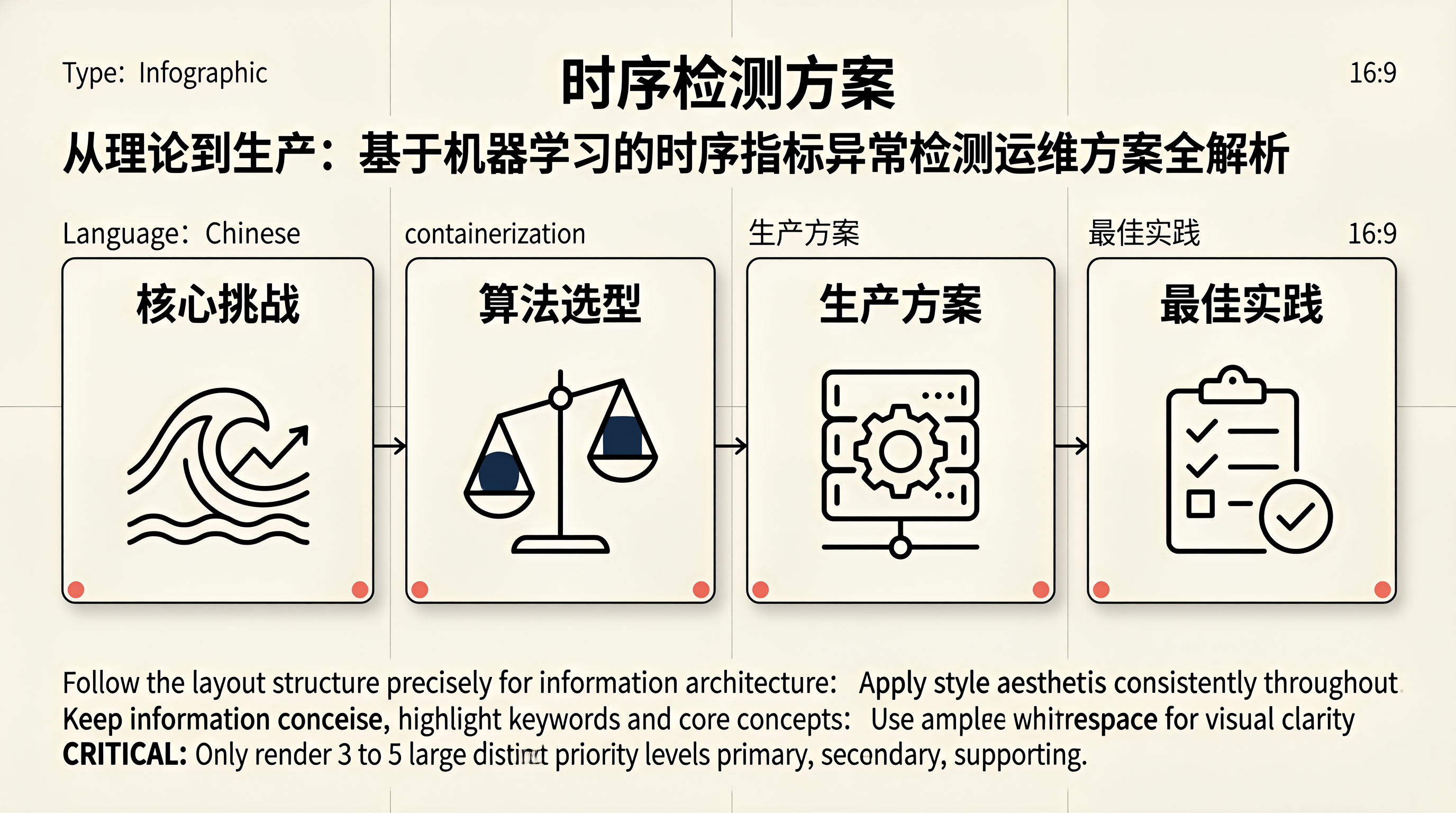
从理论到生产:基于机器学习的时序指标异常检测运维方案全解析
一、 时序异常检测的核心挑战
1.1 运维时序数据的特点
| 多周期性(日/周/月) | 模型需要识别多种周期 | STL 分解或 Prophet |
| 趋势变化(业务增长) | 基线会漂移 | 定期重训练 |
| 缺失值(宕机/网络中断) | 影响模型输入 | 前向填充 + 异常值标记 |
| 节假日效应 | 正常流量波动被误判为异常 | 标记节假日 |
| 突发噪声(非故障的临时波动) | 提高误报率 | 多算法投票 |
1.2 一个完整的检测框架
flowchart TD
subgraph Offline["离线训练阶段"]
A["历史数据"] –> B["数据清洗"]
B –> C["特征工程"]
C –> D["模型训练"]
D –> E["模型评估"]
end
subgraph Online["在线检测阶段"]
F["实时数据"] –> G["特征提取"]
G –> H["模型推理"]
H –> I["异常评分"]
I –> J["告警决策"]
end
subgraph Feedback["反馈回路"]
K["人工反馈"] –> L["模型更新"]
end
E –> H
J –> K
L –> H
二、 算法选型与对比
2.1 候选算法评估
我们在实际项目中对比了 4 类算法,下面是详细评估:
2.2 统计方法(3-sigma, MAD, IQR)
# stats_methods.py — 统计方法实现
import numpy as np
import pandas as pd
class StatisticalDetector:
"""统计方法异常检测"""
def detect_mad(self, series: pd.Series, threshold: float = 3.0):
"""MAD(中位数绝对偏差)方法"""
median = np.median(series)
mad = np.median(np.abs(series – median))
modified_z_scores = 0.6745 * (series – median) / mad
return np.abs(modified_z_scores) > threshold
def detect_k_sigma(self, series: pd.Series, k: float = 3.0):
"""K-sigma 方法"""
mean, std = np.mean(series), np.std(series)
return np.abs(series – mean) > k * std
优点:计算快、可解释性强缺点:无法处理周期性、对非正态分布效果差适用:CPU 使用率、内存使用率(近似正态分布)
2.3 时序分解方法(STL, Prophet)
# prophet_detector.py — Prophet 检测(核心代码)
from prophet import Prophet
def train_and_detect(df, changepoint_prior_scale=0.02):
"""Prophet 训练 + 检测"""
model = Prophet(
changepoint_prior_scale=changepoint_prior_scale,
interval_width=0.99
)
model.add_country_holidays(country_name='CN')
model.fit(df)
forecast = model.predict(df)
anomalies = df[
(df['y'] > forecast['yhat_upper']) |
(df['y'] < forecast['yhat_lower'])
]
return anomalies
优点:自动处理周期性和节假日、可解读趋势/周期/残差缺点:训练需要 3 天 + 数据、冷启动问题适用:QPS、延迟、错误率(强周期性指标)
2.4 隔离森林(Isolation Forest)
# isolation_forest_detector.py
from sklearn.ensemble import IsolationForest
class IFDetector:
def __init__(self, contamination=0.05):
self.model = IsolationForest(
contamination=contamination,
random_state=42,
n_estimators=100
)
def detect(self, features: np.ndarray):
predictions = self.model.fit_predict(features)
return predictions == -1 # -1 表示异常
优点:无需假设数据分布、可处理高维特征缺点:无法建模时间相关性适用:多维度指标联合检测
2.5 LSTM Autoencoder
# lstm_ae_detector.py — LSTM 自编码器(简版)
import torch
import torch.nn as nn
class LSTMAutoencoder(nn.Module):
"""LSTM 自编码器"""
def __init__(self, input_size, hidden_size=64):
super().__init__()
self.encoder = nn.LSTM(input_size, hidden_size, batch_first=True)
self.decoder = nn.LSTM(hidden_size, input_size, batch_first=True)
def forward(self, x):
_, (hidden, _) =