LeetCode 236. 二叉树的最近公共祖先 Java 实现
思路:递归后序遍历
从根节点开始递归:
· 如果当前节点为空,或当前节点就是 p 或 q,直接返回当前节点。
· 分别递归左右子树,得到 left 和 right。
· 如果 left 和 right 都非空,说明 p 和 q 分别在左右两侧,当前节点就是最近公共祖先。
· 否则,返回非空的那一个(说明两个目标节点都在同一侧,或只找到了其中一个)。
Java 代码
class Solution {
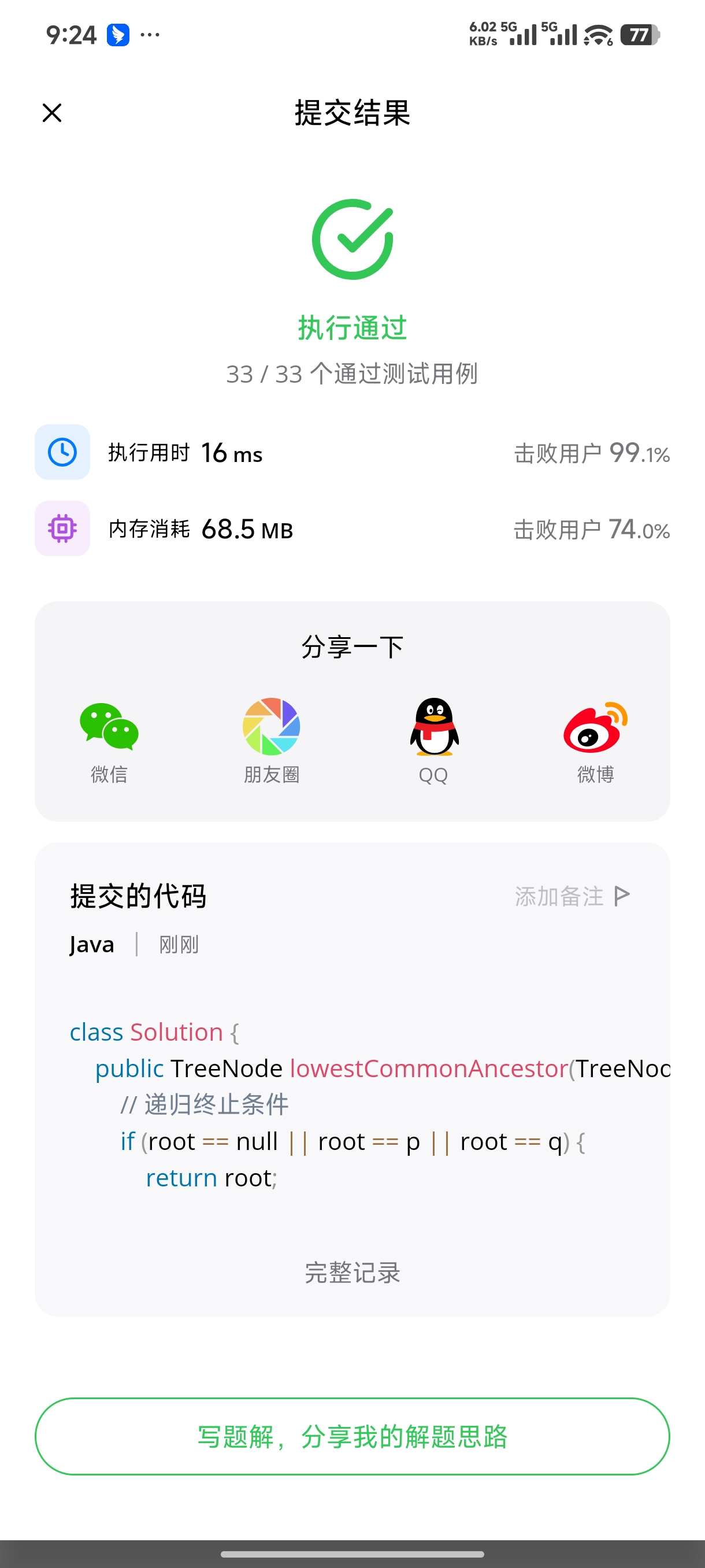
public TreeNode lowestCommonAncestor(TreeNode root, TreeNode p, TreeNode q) {
// 递归终止条件
if (root == null || root == p || root == q) {
return root;
}
// 后序遍历:先处理左右子树
TreeNode left = lowestCommonAncestor(root.left, p, q);
TreeNode right = lowestCommonAncestor(root.right, p, q);
// 左右都找到了,说明 p、q 分布在两侧,当前节点就是 LCA
if (left != null && right != null) {
return root;
}
// 否则返回非空的那一侧
return left != null ? left : right;
}
}
复杂度分析
· 时间复杂度:O(n),每个节点最多访问一次。
· 空间复杂度:O(h),递归栈深度为树高。最坏情况下(链状树)为 O(n)。
示例
// 树结构:
// 3
// / \\
// 5 1
// / \\ / \\
// 6 2 0 8
// / \\
// 7 4
p = 5, q = 1 → 3
p = 5, q = 4 → 5
p = 6, q = 4 → 5
关键点
· 递归函数含义:在以 root 为根的子树中,寻找 p 和 q 的最近公共祖先。
· 如果当前节点就是 p 或 q,直接返回它,因为不可能再往下找到更近的祖先。
· 左右子树返回值都非空,说明两个目标节点分居两侧,当前节点即为答案。
· 只需要一次 DFS,无需额外存储路径。
附:迭代写法(父指针 + 祖先集合)
class Solution {
public TreeNode lowestCommonAncestor(TreeNode root, TreeNode p, TreeNode q) {
Map<TreeNode, TreeNode> parent = new HashMap<>();
Deque<TreeNode> stack = new ArrayDeque<>();
parent.put(root, null);
stack.push(root);
// 遍历整棵树,记录每个节点的父节点
while (!parent.containsKey(p) || !parent.containsKey(q)) {
TreeNode node = stack.pop();
if (node.left != null) {
parent.put(node.left, node);
stack.push(node.left);
}
if (node.right != null) {
parent.put(node.right, node);
stack.push(node.right);
}
}
// 记录 p 到根的所有祖先
Set<TreeNode> ancestors = new HashSet<>();
while (p != null) {
ancestors.add(p);
p = parent.get(p);
}
// 从 q 向上找第一个在 p 祖先集合中的节点
while (!ancestors.contains(q)) {
q = parent.get(q);
}
return q;
}
}
迭代写法时间复杂度 O(n),空间复杂度 O(n),适合不想用递归或树很深的情况。