问题描述
小红正在玩一个字母游戏,她有一串由小写字母组成的字符串。她想要通过重新排列这些字母,构造出一个回文字符串。但是,她希望这个回文字符串是所有可能回文串中字典序最小的那个。请你帮助小红完成这个任务。
给定一个字符串 s,你需要重新排列其中的字母(可以任意调整顺序),构造出一个回文串,并且这个回文串的字典序要尽可能小。如果无法构造回文串,则返回空字符串。
要求:
测试样例
样例1:
输入:s = "aabb" 输出:"abba" 解释:可以构造的回文串有 "abba" 和 "baab",其中 "abba" 的字典序更小。
样例2:
输入:s = "abc" 输出:"" 解释:无法构造回文串,因为只有一个 'a'、一个 'b' 和一个 'c',无法满足回文串的对称性。
样例3:
输入:s = "aabbbcc" 输出:"abcbcba" 解释:字符频率为 a:2, b:3, c:2。字典序最小的构造方式:左半部分按字母顺序使用字符得到 "abc",中间字符使用剩余的 'b',最终形成回文 "abcbcba"(字典序小于其他可能如 "abbcbba")。
约束条件
- 1 ≤ s.length ≤ 10^5
- s 仅由小写英文字母组成
- 如果存在多个解,返回字典序最小的那个
- 如果无法构造回文串,返回空字符串
程序代码
#include <stdio.h>
#include <string.h>
#include <stdlib.h>
char* smallestPalindrome(char* s) {
int n = strlen(s);
int count[26] = {0};
// 统计字符频率
for (int i = 0; i < n; i++) {
count[s[i] – 'a']++;
}
// 检查奇数次的字符个数
int oddCount = 0;
int oddChar = -1;
for (int i = 0; i < 26; i++) {
if (count[i] % 2 == 1) {
oddCount++;
oddChar = i;
}
}
// 超过一个奇数次的字符,无法构成回文
if (oddCount > 1) {
char* result = (char*)malloc(1);
result[0] = '\\0';
return result;
}
// 构造结果
char* result = (char*)malloc((n + 1) * sizeof(char));
int idx = 0;
// 左半部分:按 a~z 顺序,每个字符取 count/2 个
for (int i = 0; i < 26; i++) {
int half = count[i] / 2;
for (int j = 0; j < half; j++) {
result[idx++] = 'a' + i;
}
}
// 中间字符(如果有)
if (oddChar != -1) {
result[idx++] = 'a' + oddChar;
}
// 右半部分:左半部分的逆序
for (int i = idx – 1 – (oddChar != -1 ? 1 : 0); i >= 0; i–) {
result[idx++] = result[i];
}
result[idx] = '\\0';
return result;
}
int main() {
char* r1 = smallestPalindrome("aabb");
char* r2 = smallestPalindrome("abc");
char* r3 = smallestPalindrome("aabbbcc");
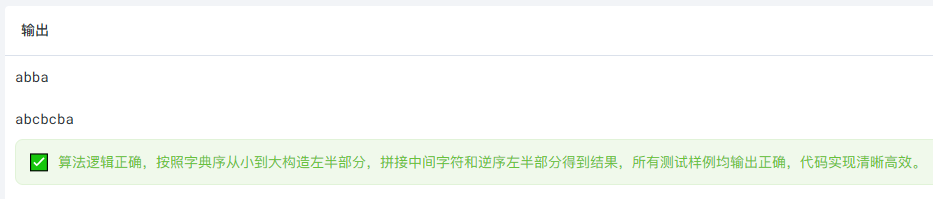
printf("%s\\n", r1); // abba
printf("%s\\n", r2); // (空)
printf("%s\\n", r3); // abcbcba
free(r1);
free(r2);
free(r3);
return 0;
}
运行结果