Hi~!这里是奋斗的明志,很荣幸您能阅读我的文章,诚请评论指点,欢迎欢迎 ~~ 🌱🌱个人主页:奋斗的明志 🌱🌱所属专栏:RabbitMQ
📚本系列文章为个人学习笔记,在这里撰写成文一为巩固知识,二为展示我的学习过程及理解。文笔、排版拙劣,望见谅。

发布订阅模式、路由模式、通配符模式
- 一、Publish/Subscribe(发布/订阅)
-
- 1、引入依赖
- 2、编写配置类
- 3、编写生产者代码
- 4、编写消费者代码
- 二、Routing (路由模式)
-
- 1、引入依赖
- 2、编写配置类
- 3、编写生产者代码
- 4、编写消费者代码
- 三、Topics (通配符模式)
-
- 1、引入依赖
- 2、编写配置类
- 3、编写生产者代码
- 4、编写消费者代码
一、Publish/Subscribe(发布/订阅)
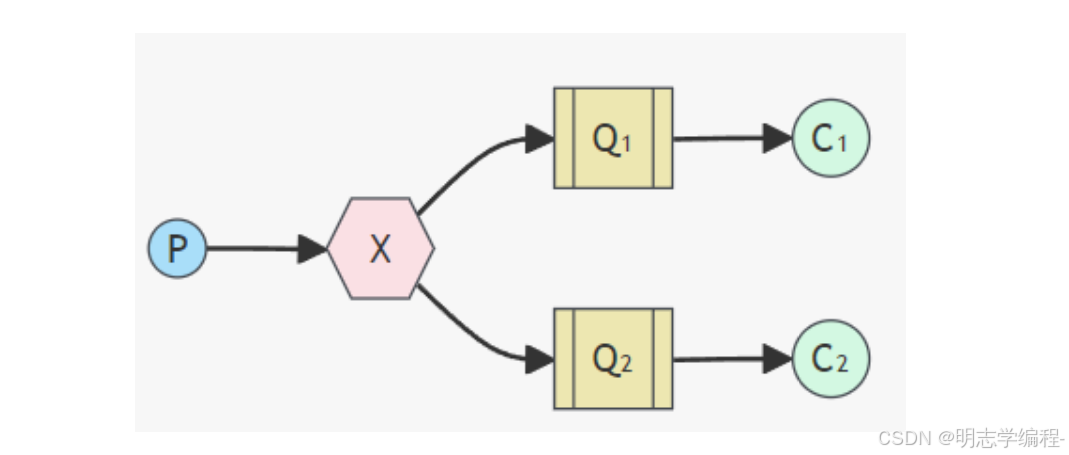
在发布/订阅模型中,多了一个Exchange角色. Exchange 常见有三种类型, 分别代表不同的路由规则 a) Fanout:广播,将消息交给所有绑定到交换机的队列 (Publish/Subscribe模式) b) Direct:定向,把消息交给符合指定routing key的队列(Routing模式) c) Topic:通配符,把消息交给符合routing pattern(路由模式)的队列(Topics模式) 也就分别对应不同的工作模式
1、引入依赖
<dependencies>
<!— https://mvnrepository.com/artifact/com.rabbitmq/amqp–client —>
<dependency>
<groupId>com.rabbitmq</groupId>
<artifactId>amqp–client</artifactId>
<version>5.20.0</version>
</dependency>
</dependencies>
2、编写配置类
package rabbitmq.constant;
public class Constants {
public static final String HOST = "123.57.16.61";
public static final Integer PORT = 5672;
public static final String USERNAME = "study";
public static final String PASSWORD = "study";
public static final String VIRTUAL_HOST = "bite";
//发布订阅模式
public static final String FANOUT_EXCHANGE = "fanout.exchange";
public static final String FANOUT_QUEUE1 = "fanout.queue1";
public static final String FANOUT_QUEUE2 = "fanout.queue2";
}
3、编写生产者代码
package rabbitmq.fanout;
import com.rabbitmq.client.BuiltinExchangeType;
import com.rabbitmq.client.Channel;
import com.rabbitmq.client.Connection;
import com.rabbitmq.client.ConnectionFactory;
import rabbitmq.constant.Constants;
import java.io.IOException;
import java.util.concurrent.TimeoutException;
public class Producer {
public static void main(String[] args) throws IOException, TimeoutException {
ConnectionFactory connectionFactory = new ConnectionFactory();
connectionFactory.setHost(Constants.HOST);
connectionFactory.setPort(Constants.PORT);
connectionFactory.setUsername(Constants.USERNAME);
connectionFactory.setPassword(Constants.PASSWORD);
connectionFactory.setVirtualHost(Constants.VIRTUAL_HOST);
Connection connection = connectionFactory.newConnection();
Channel channel = connection.createChannel();
//声明交换机
/**
* 交换机名称,交换机类型,开启可持久化(关机数据不会丢失)
*/
channel.exchangeDeclare(Constants.FANOUT_EXCHANGE, BuiltinExchangeType.FANOUT, true);
//声明队列
//queueDeclare 队列声明
channel.queueDeclare(Constants.FANOUT_QUEUE1, true, false, false, null);
channel.queueDeclare(Constants.FANOUT_QUEUE2, true, false, false, null);
//交换机和队列进行绑定
channel.queueBind(Constants.FANOUT_QUEUE1, Constants.FANOUT_EXCHANGE, "");
channel.queueBind(Constants.FANOUT_QUEUE2, Constants.FANOUT_EXCHANGE, "");
//发布消息
String msg = "hello fanout…";
//basicPublish (基础发布)
channel.basicPublish(Constants.FANOUT_EXCHANGE, "", null, msg.getBytes());
System.out.println("消息发送成功!!!");
//关闭资源
channel.close();
connection.close();
}
}
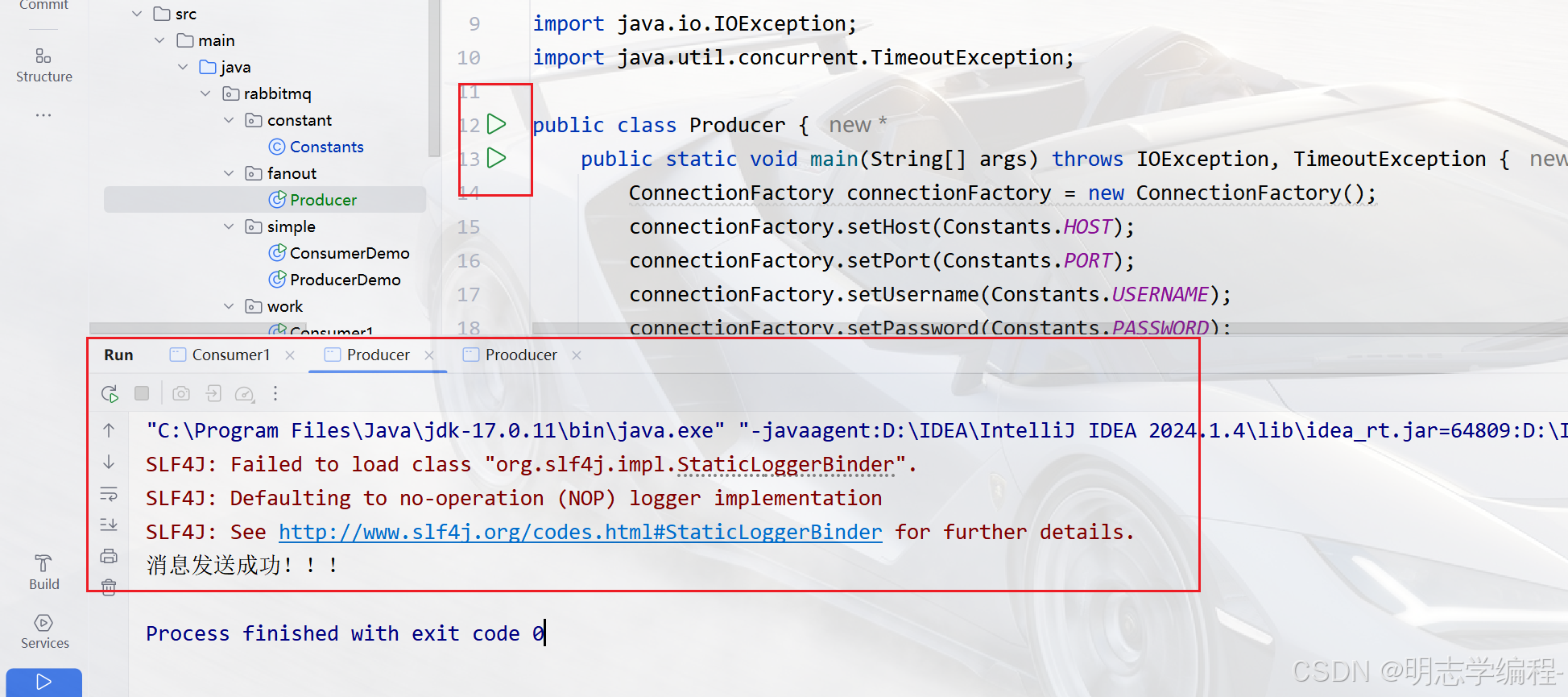
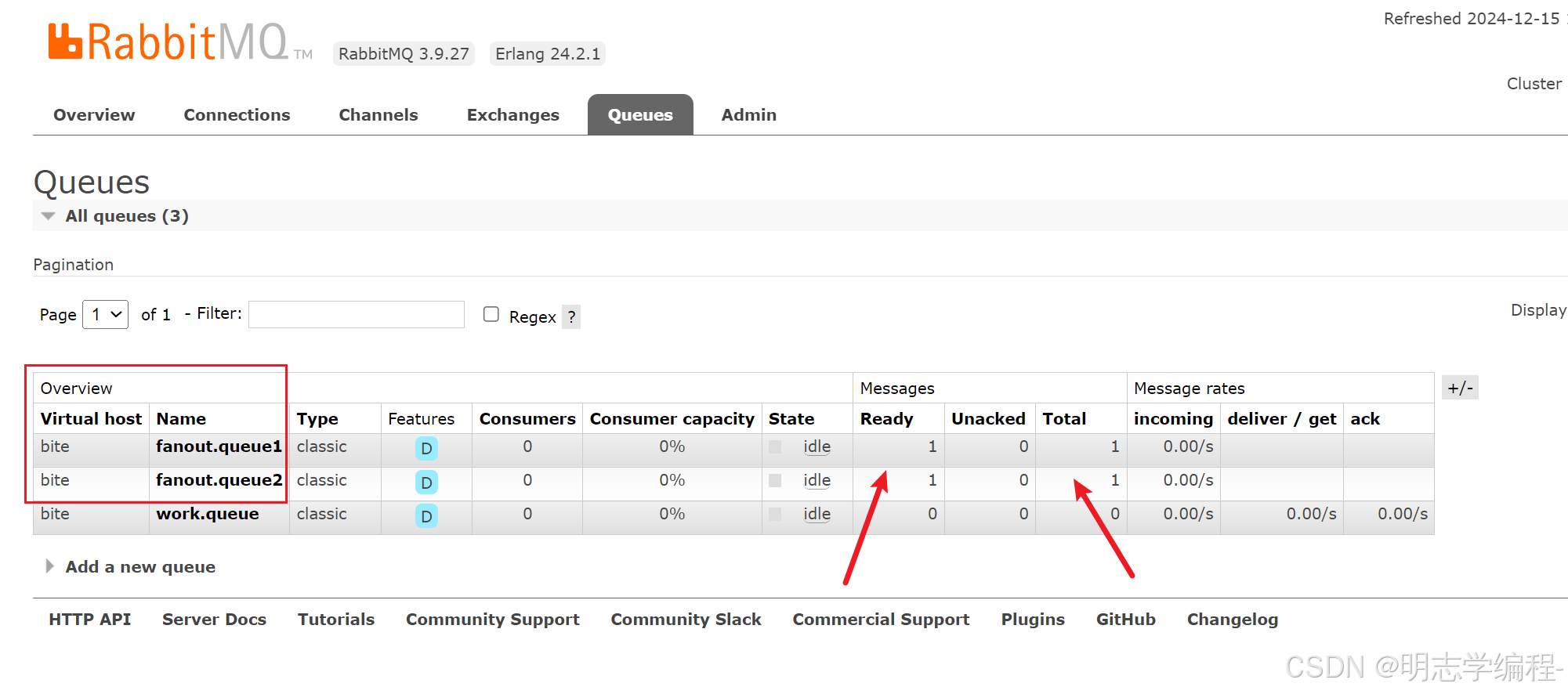
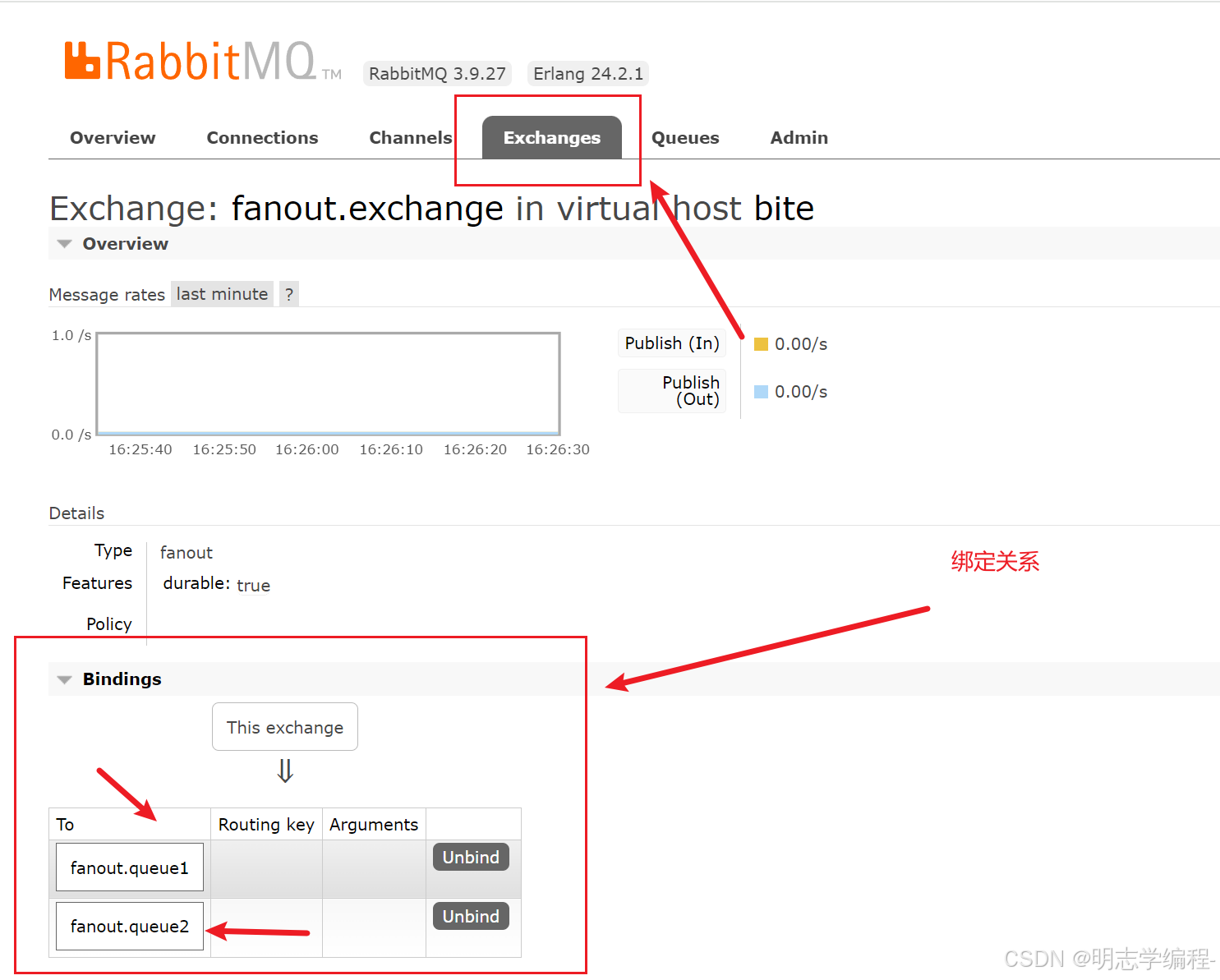
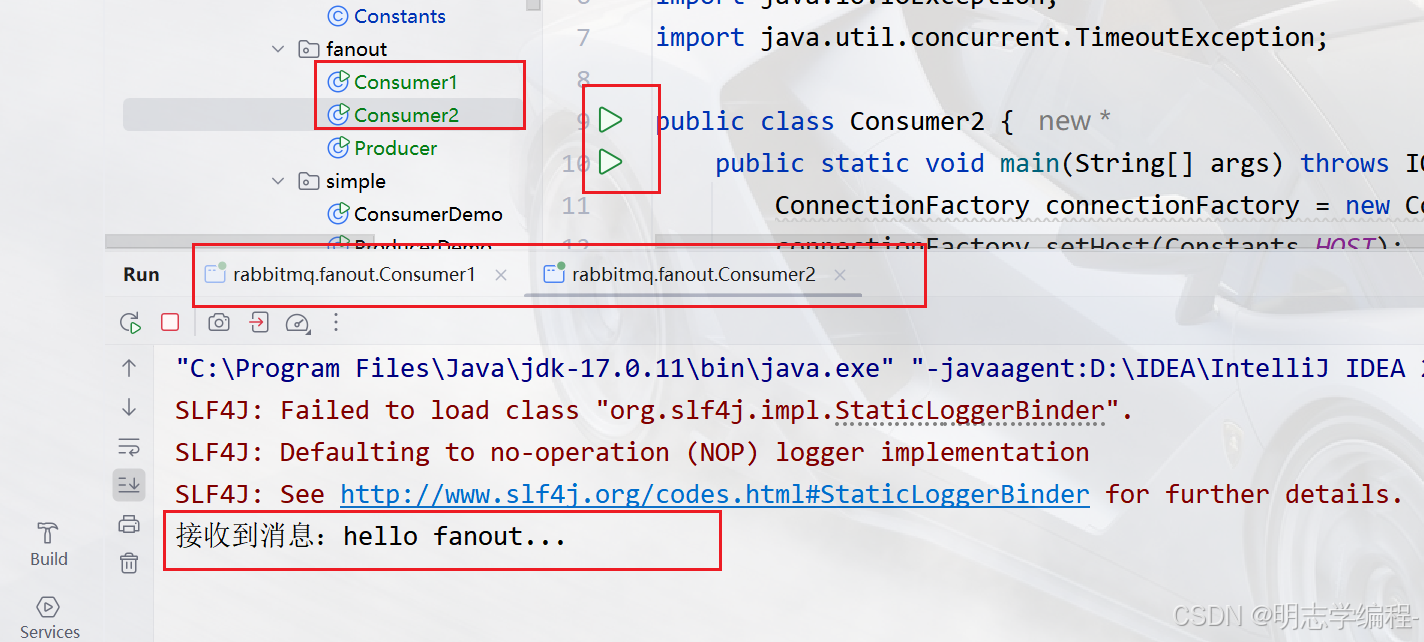
点击运行:
4、编写消费者代码
消费者1:
package rabbitmq.fanout;
import com.rabbitmq.client.*;
import rabbitmq.constant.Constants;
import java.io.IOException;
import java.util.concurrent.TimeoutException;
public class Consumer1 {
public static void main(String[] args) throws IOException, TimeoutException {
ConnectionFactory connectionFactory = new ConnectionFactory();
connectionFactory.setHost(Constants.HOST);
connectionFactory.setPort(Constants.PORT);
connectionFactory.setUsername(Constants.USERNAME);
connectionFactory.setPassword(Constants.PASSWORD);
connectionFactory.setVirtualHost(Constants.VIRTUAL_HOST);
Connection connection = connectionFactory.newConnection();
Channel channel = connection.createChannel();
//声明队列
//queueDeclare 队列声明 (也可以省略)
channel.queueDeclare(Constants.FANOUT_QUEUE1, true, false, false, null);
//消费消息
DefaultConsumer consumer = new DefaultConsumer(channel){
@Override
public void handleDelivery(String consumerTag, Envelope envelope, AMQP.BasicProperties properties, byte[] body) throws IOException {
System.out.println("接收到消息:" + new String(body));
}
};
channel.basicConsume(Constants.FANOUT_QUEUE1,true,consumer);
}
}
消费者2:
package rabbitmq.fanout;
import com.rabbitmq.client.*;
import rabbitmq.constant.Constants;
import java.io.IOException;
import java.util.concurrent.TimeoutException;
public class Consumer2 {
public static void main(String[] args) throws IOException, TimeoutException {
ConnectionFactory connectionFactory = new ConnectionFactory();
connectionFactory.setHost(Constants.HOST);
connectionFactory.setPort(Constants.PORT);
connectionFactory.setUsername(Constants.USERNAME);
connectionFactory.setPassword(Constants.PASSWORD);
connectionFactory.setVirtualHost(Constants.VIRTUAL_HOST);
Connection connection = connectionFactory.newConnection();
Channel channel = connection.createChannel();
//声明队列
//queueDeclare 队列声明 (也可以省略)
channel.queueDeclare(Constants.FANOUT_QUEUE2, true, false, false, null);
//消费消息
DefaultConsumer consumer = new DefaultConsumer(channel){
@Override
public void handleDelivery(String consumerTag, Envelope envelope, AMQP.BasicProperties properties, byte[] body) throws IOException {
System.out.println("接收到消息:" + new String(body));
}
};
channel.basicConsume(Constants.FANOUT_QUEUE2,true,consumer);
}
}
二、Routing (路由模式)
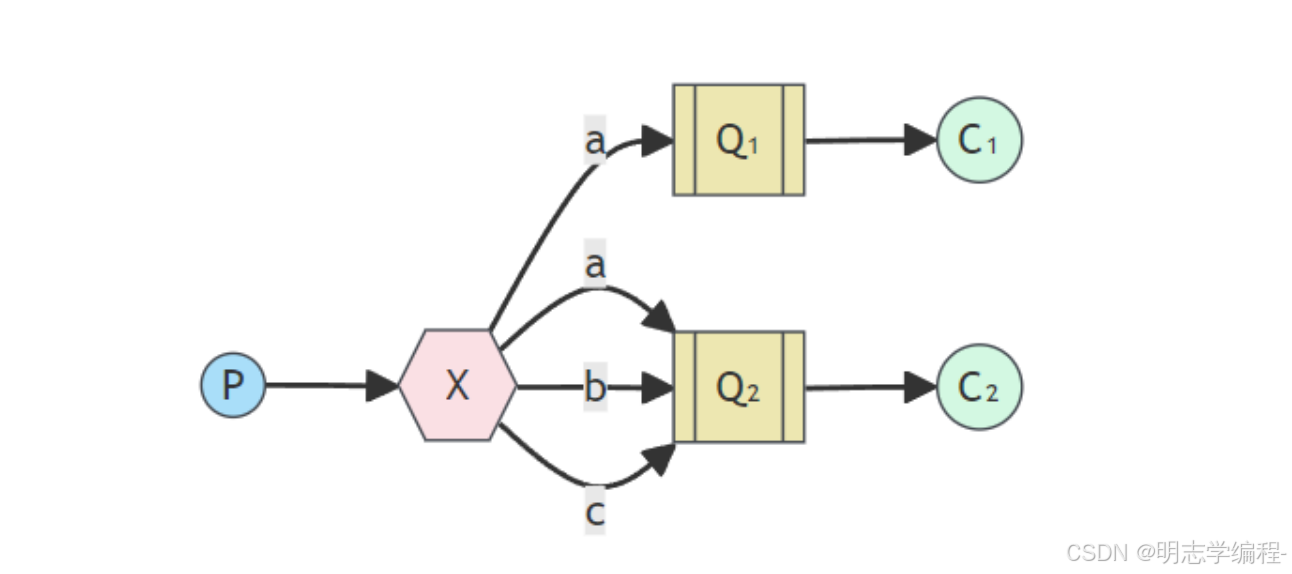
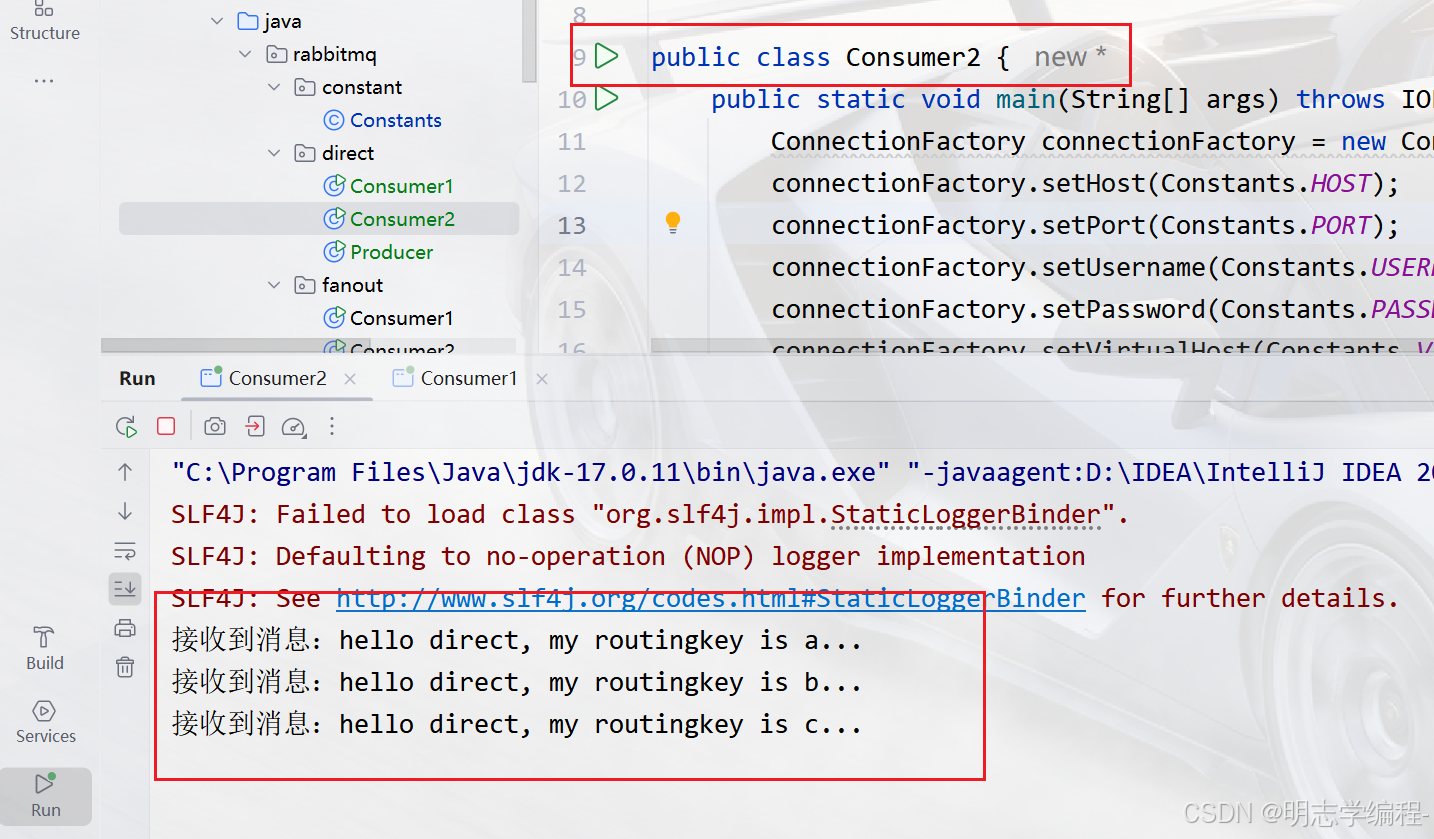
队列和交换机的绑定, 不能是任意的绑定了, 而是要指定⼀个BindingKey(RoutingKey的⼀种) 消息的发送方在向 Exchange 发送消息时, 也需要指定消息的 RoutingKey Exchange也不再把消息交给每⼀个绑定的key, 而是根据消息的RoutingKey进行判断, 只有队列绑定时的BindingKey和发送消息的RoutingKey 完全⼀致, 才会接收到消息
1、引入依赖
<dependencies>
<!— https://mvnrepository.com/artifact/com.rabbitmq/amqp–client —>
<dependency>
<groupId>com.rabbitmq</groupId>
<artifactId>amqp–client</artifactId>
<version>5.20.0</version>
</dependency>
</dependencies>
2、编写配置类
package rabbitmq.constant;
public class Constants {
public static final String HOST = "123.57.16.61";
public static final Integer PORT = 5672;
public static final String USERNAME = "study";
public static final String PASSWORD = "study";
public static final String VIRTUAL_HOST = "bite";
//路由模式
public static final String DIRECT_EXCHANGE = "direct.exchange";
public static final String DIRECT_QUEUE1 = "direct.queue1";
public static final String DIRECT_QUEUE2 = "direct.queue2";
}
3、编写生产者代码
package rabbitmq.direct;
import com.rabbitmq.client.BuiltinExchangeType;
import com.rabbitmq.client.Channel;
import com.rabbitmq.client.Connection;
import com.rabbitmq.client.ConnectionFactory;
import rabbitmq.constant.Constants;
import java.io.IOException;
import java.util.concurrent.TimeoutException;
public class Producer {
public static void main(String[] args) throws IOException, TimeoutException {
ConnectionFactory connectionFactory = new ConnectionFactory();
connectionFactory.setHost(Constants.HOST);
connectionFactory.setPort(Constants.PORT);
connectionFactory.setUsername(Constants.USERNAME);
connectionFactory.setPassword(Constants.PASSWORD);
connectionFactory.setVirtualHost(Constants.VIRTUAL_HOST);
Connection connection = connectionFactory.newConnection();
Channel channel = connection.createChannel();
//声明交换机
/**
* 交换机名称,交换机类型,开启可持久化(关机数据不会丢失)
*/
channel.exchangeDeclare(Constants.DIRECT_EXCHANGE, BuiltinExchangeType.DIRECT, true);
//声明队列
//queueDeclare 队列声明
channel.queueDeclare(Constants.DIRECT_QUEUE1, true, false, false, null);
channel.queueDeclare(Constants.DIRECT_QUEUE2, true, false, false, null);
//交换机和队列进行绑定
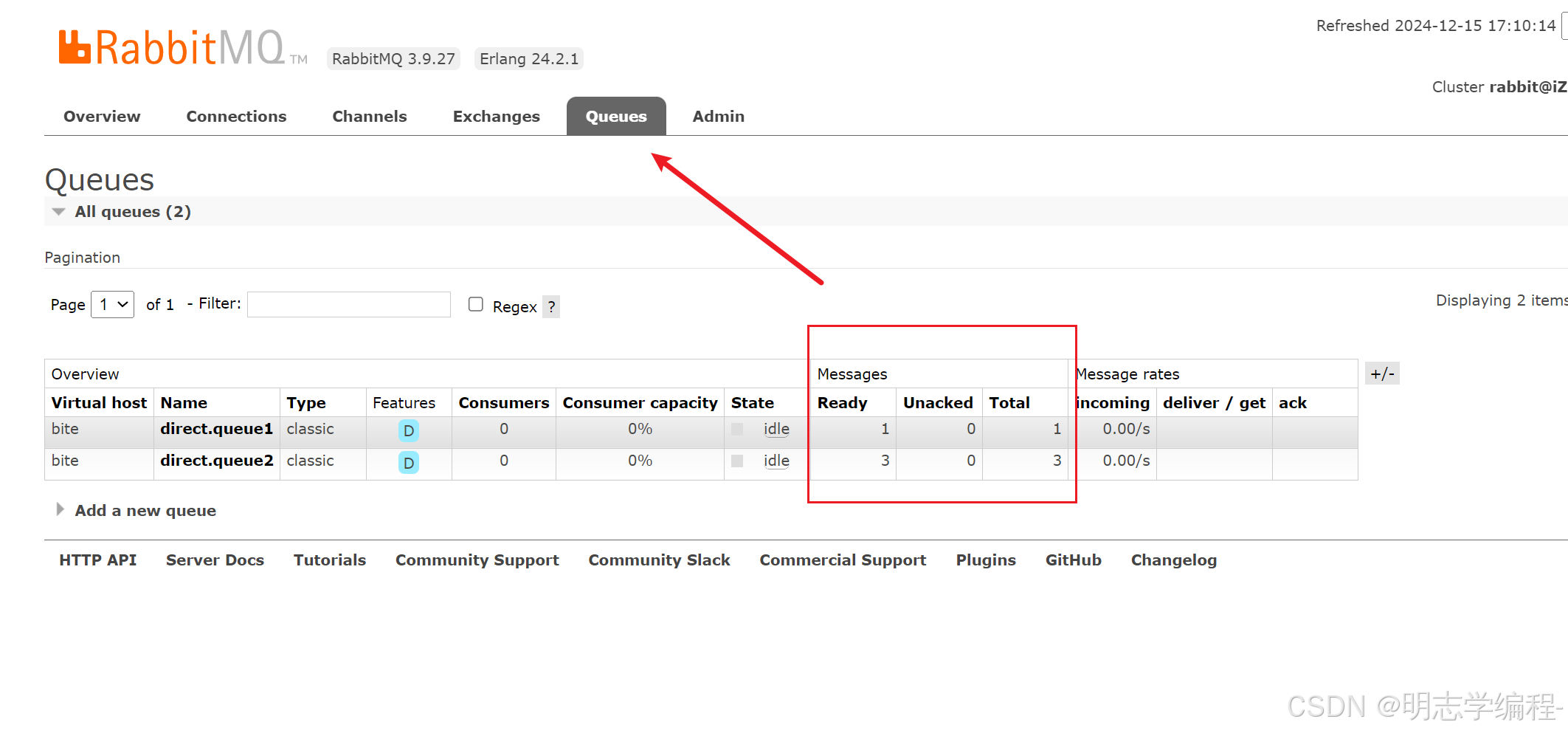
channel.queueBind(Constants.DIRECT_QUEUE1, Constants.DIRECT_EXCHANGE, "a");
channel.queueBind(Constants.DIRECT_QUEUE2, Constants.DIRECT_EXCHANGE, "a");
channel.queueBind(Constants.DIRECT_QUEUE2, Constants.DIRECT_EXCHANGE, "b");
channel.queueBind(Constants.DIRECT_QUEUE2, Constants.DIRECT_EXCHANGE, "c");
//发布消息
String msg_a = "hello direct, my routingkey is a…";
//basicPublish (基础发布)
channel.basicPublish(Constants.DIRECT_EXCHANGE, "", null, msg_a.getBytes());
String msg_b = "hello direct, my routingkey is b…";
channel.basicPublish(Constants.DIRECT_EXCHANGE, "", null, msg_b.getBytes());
String msg_c = "hello direct, my routingkey is c…";
channel.basicPublish(Constants.DIRECT_EXCHANGE, "", null, msg_c.getBytes());
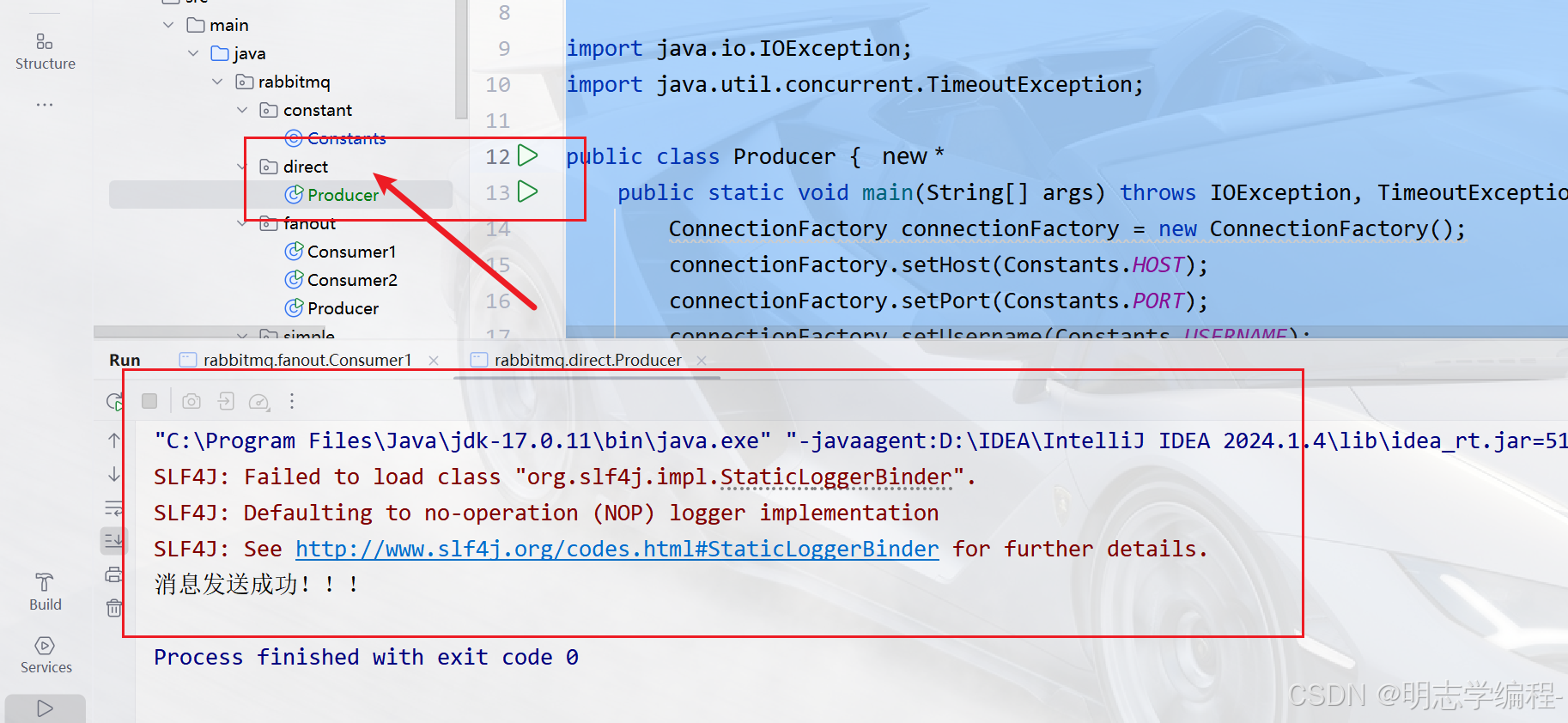
System.out.println("消息发送成功!!!");
//关闭资源
channel.close();
connection.close();
}
}
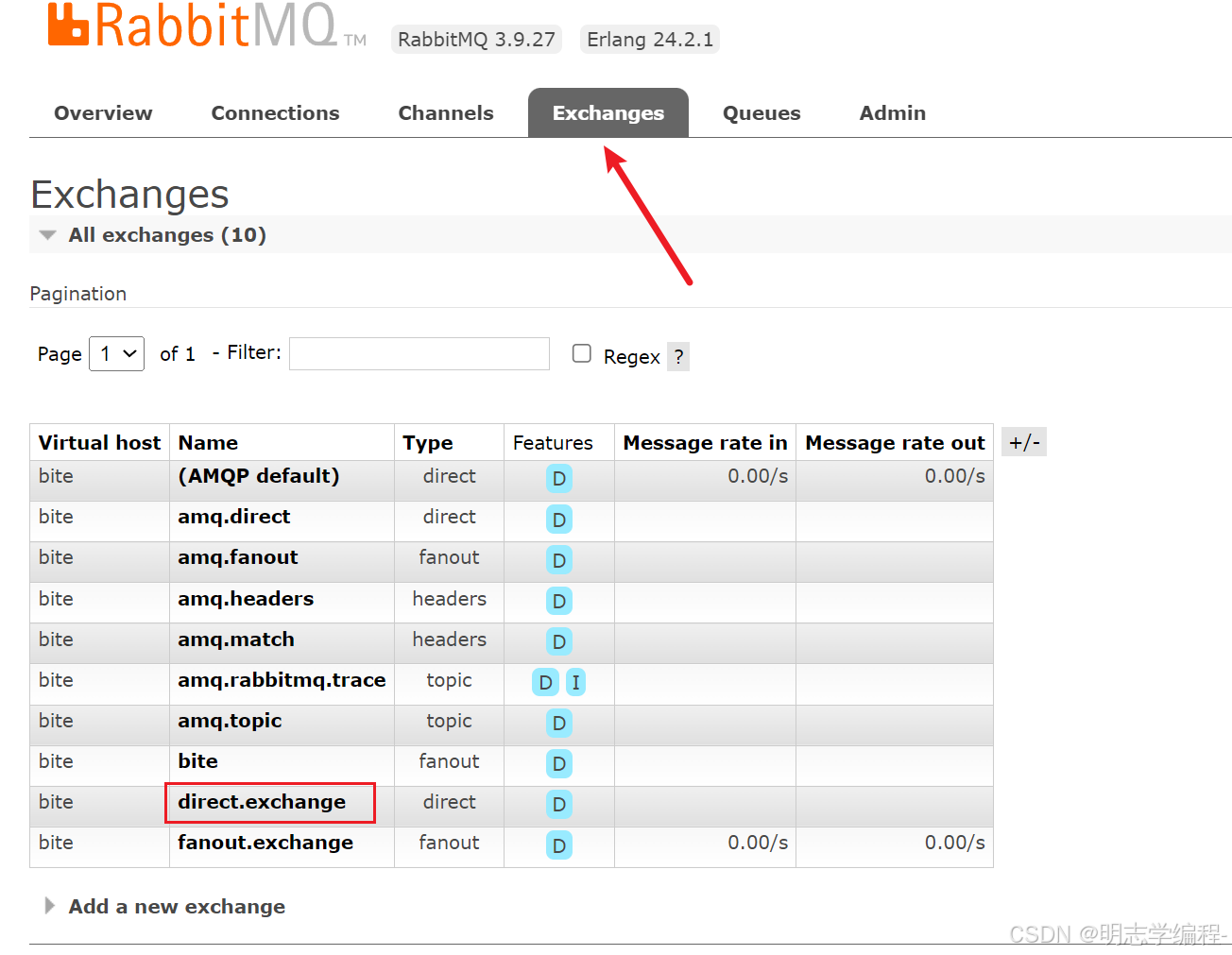
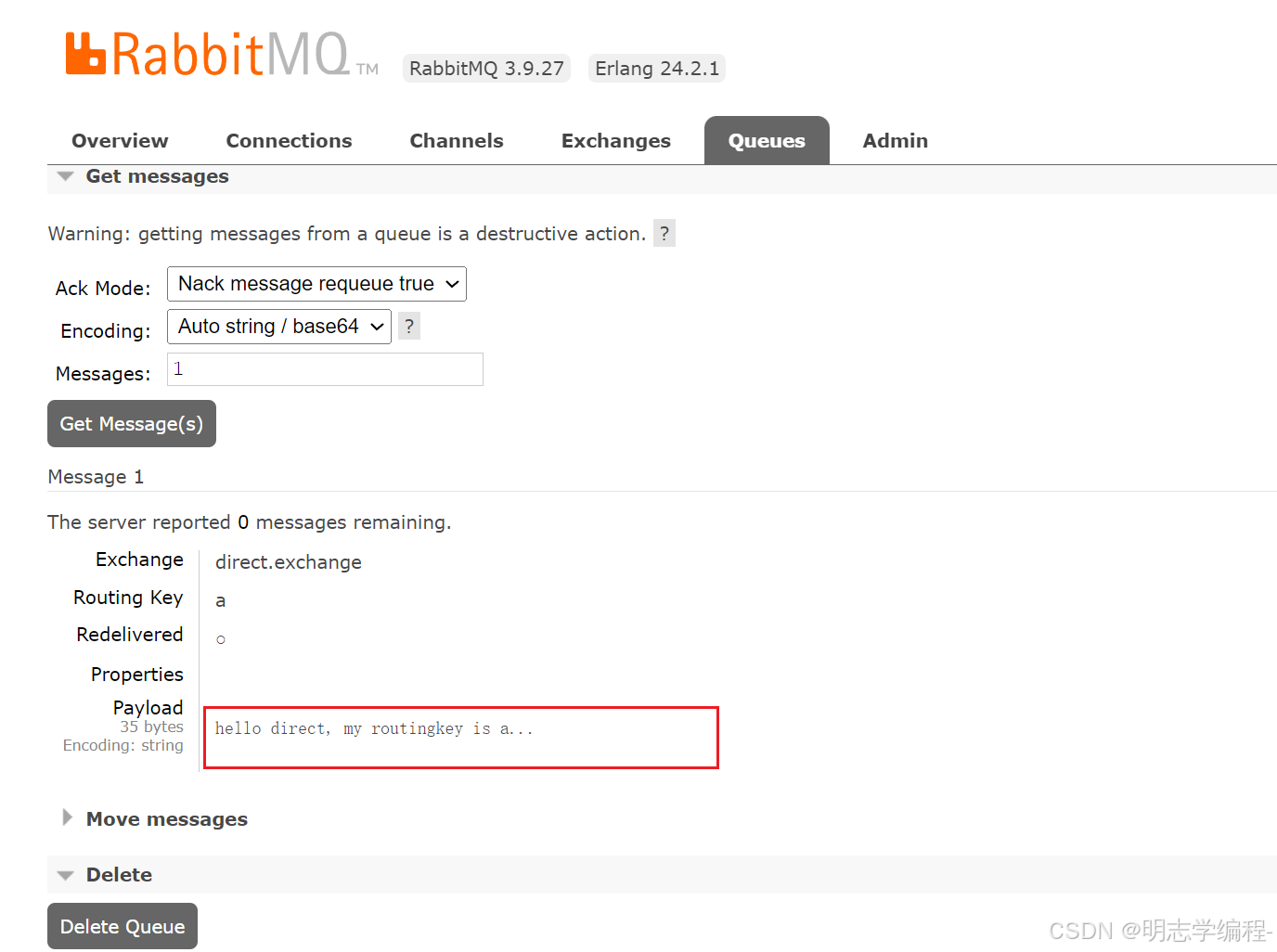
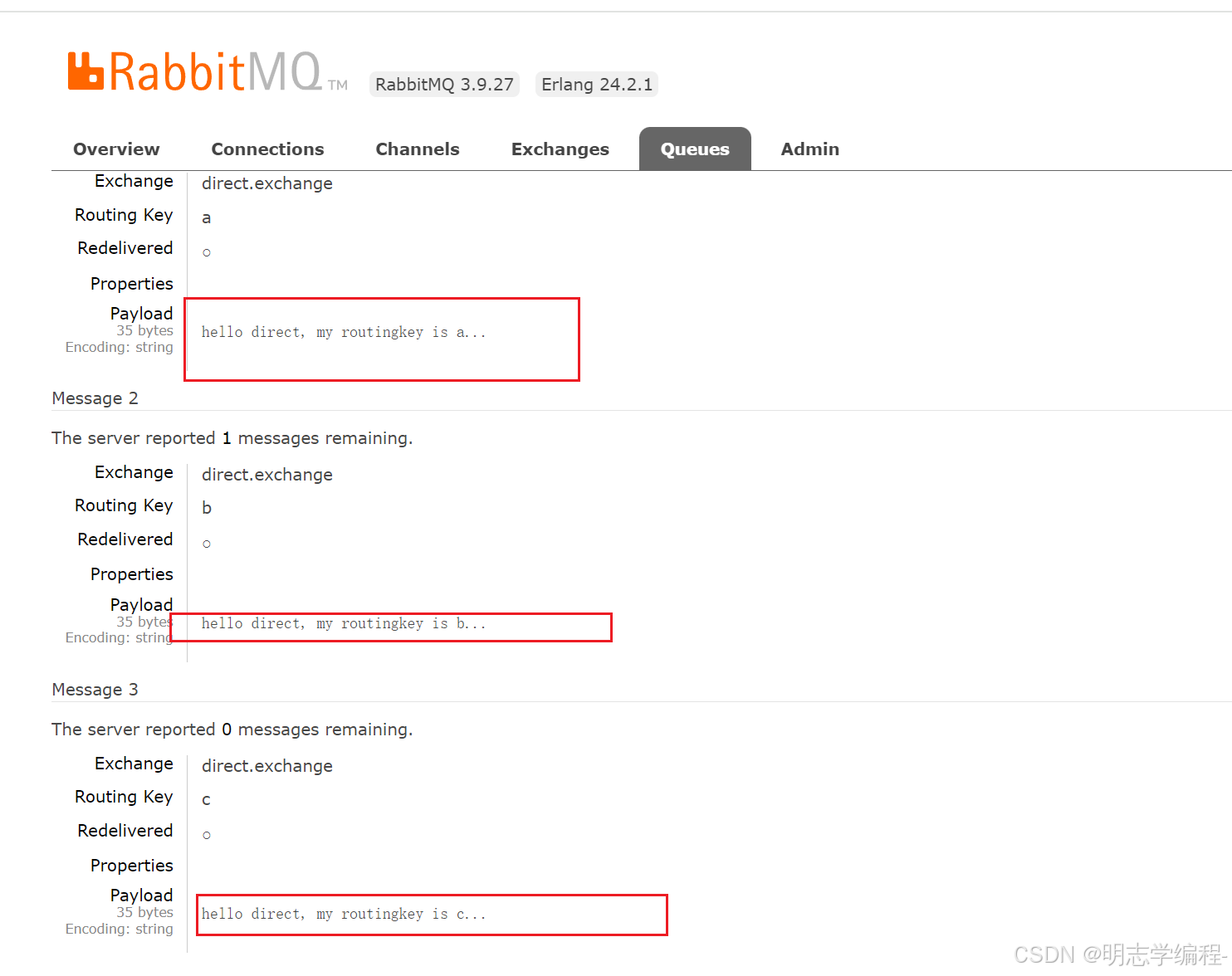
4、编写消费者代码
消费者1:
package rabbitmq.direct;
import com.rabbitmq.client.*;
import rabbitmq.constant.Constants;
import java.io.IOException;
import java.util.concurrent.TimeoutException;
public class Consumer1 {
public static void main(String[] args) throws IOException, TimeoutException {
ConnectionFactory connectionFactory = new ConnectionFactory();
connectionFactory.setHost(Constants.HOST);
connectionFactory.setPort(Constants.PORT);
connectionFactory.setUsername(Constants.USERNAME);
connectionFactory.setPassword(Constants.PASSWORD);
connectionFactory.setVirtualHost(Constants.VIRTUAL_HOST);
Connection connection = connectionFactory.newConnection();
Channel channel = connection.createChannel();
//声明队列
//queueDeclare 队列声明 (也可以省略)
channel.queueDeclare(Constants.DIRECT_QUEUE1, true, false, false, null);
//消费消息
DefaultConsumer consumer = new DefaultConsumer(channel){
@Override
public void handleDelivery(String consumerTag, Envelope envelope, AMQP.BasicProperties properties, byte[] body) throws IOException {
System.out.println("接收到消息:" + new String(body));
}
};
channel.basicConsume(Constants.DIRECT_QUEUE1,true,consumer);
}
}
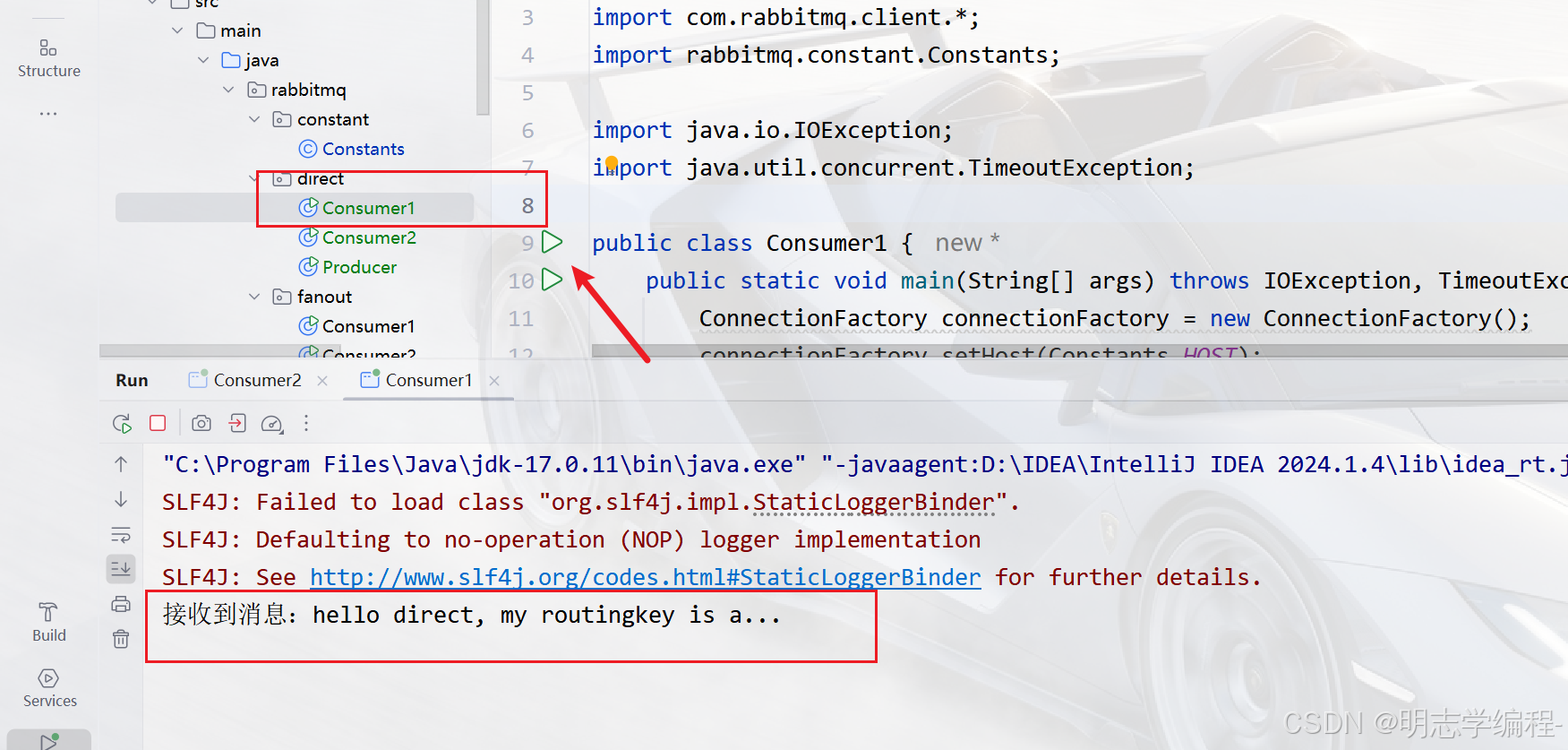
消费者2:
package rabbitmq.direct;
import com.rabbitmq.client.*;
import rabbitmq.constant.Constants;
import java.io.IOException;
import java.util.concurrent.TimeoutException;
public class Consumer2 {
public static void main(String[] args) throws IOException, TimeoutException {
ConnectionFactory connectionFactory = new ConnectionFactory();
connectionFactory.setHost(Constants.HOST);
connectionFactory.setPort(Constants.PORT);
connectionFactory.setUsername(Constants.USERNAME);
connectionFactory.setPassword(Constants.PASSWORD);
connectionFactory.setVirtualHost(Constants.VIRTUAL_HOST);
Connection connection = connectionFactory.newConnection();
Channel channel = connection.createChannel();
//声明队列
//queueDeclare 队列声明 (也可以省略)
channel.queueDeclare(Constants.DIRECT_QUEUE2, true, false, false, null);
//消费消息
DefaultConsumer consumer = new DefaultConsumer(channel){
@Override
public void handleDelivery(String consumerTag, Envelope envelope, AMQP.BasicProperties properties, byte[] body) throws IOException {
System.out.println("接收到消息:" + new String(body));
}
};
channel.basicConsume(Constants.DIRECT_QUEUE2,true,consumer);
}
}
三、Topics (通配符模式)
Topics 和Routing模式的区别是:
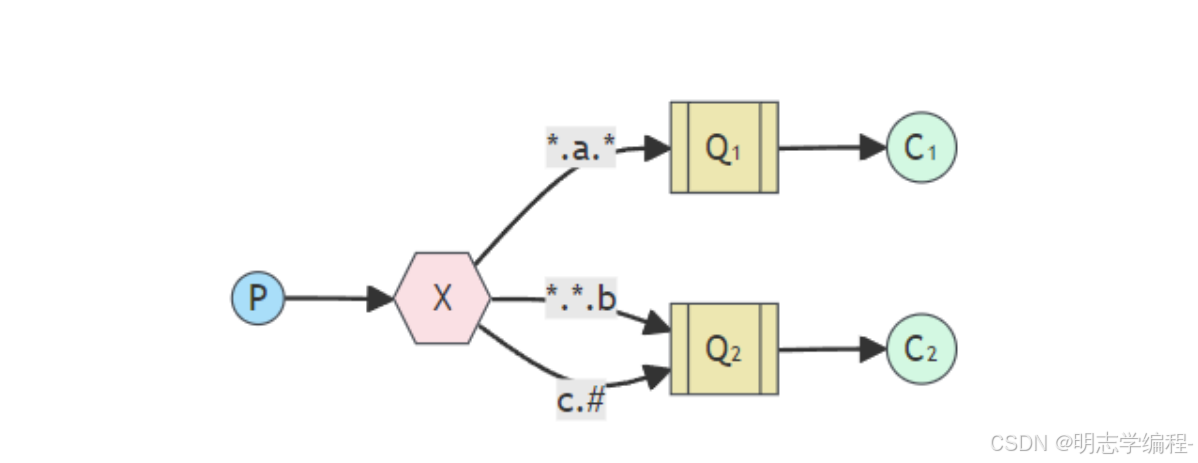
在topic类型的交换机在匹配规则上, 有些要求:
- * 表⽰⼀个单词 # 表⽰多个单词(0-N个)
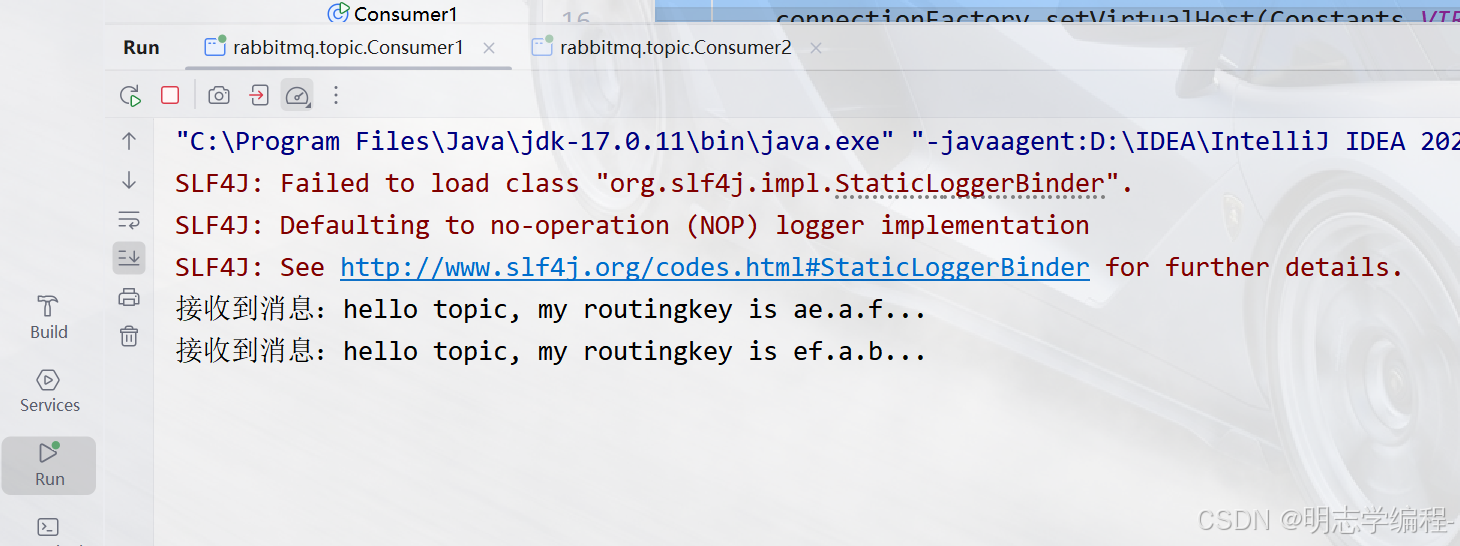
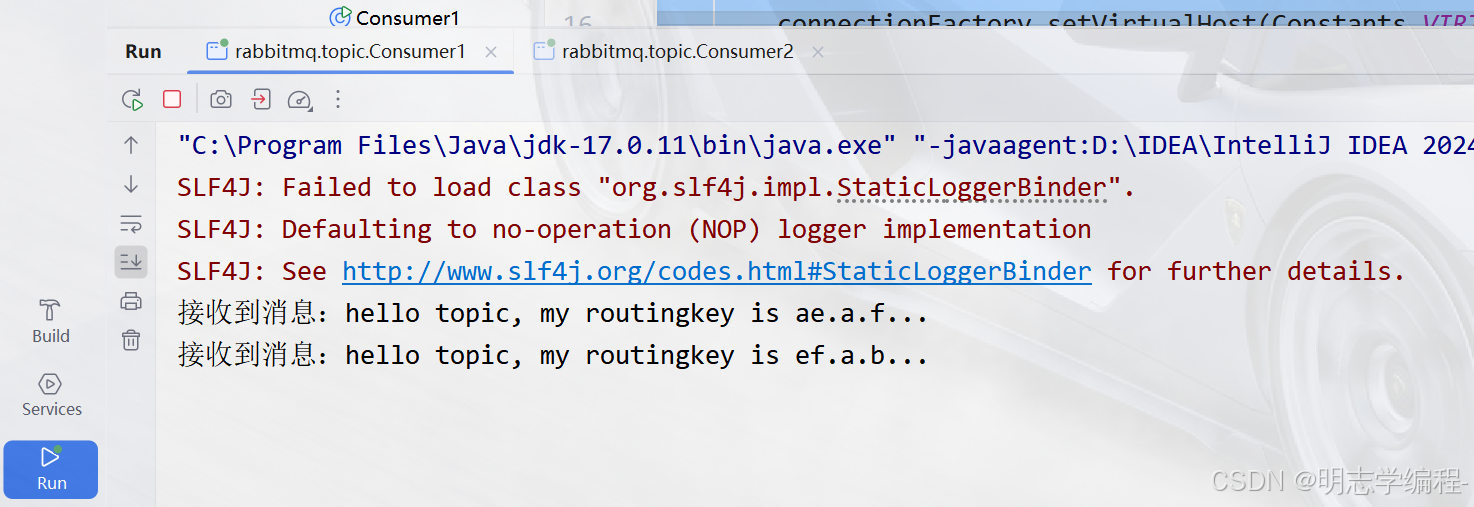
比如: • Binding Key 为"d.a.b" 会同时路由到Q1 和Q2 • Binding Key 为"d.a.f" 会路由到Q1 • Binding Key 为"c.e.f" 会路由到Q2 • Binding Key 为"d.b.f" 会被丢弃, 或者返回给⽣产者(需要设置mandatory参数)
1、引入依赖
<dependencies>
<!— https://mvnrepository.com/artifact/com.rabbitmq/amqp–client —>
<dependency>
<groupId>com.rabbitmq</groupId>
<artifactId>amqp–client</artifactId>
<version>5.20.0</version>
</dependency>
</dependencies>
2、编写配置类
package rabbitmq.constant;
public class Constants {
public static final String HOST = "123.57.16.61";
public static final Integer PORT = 5672;
public static final String USERNAME = "study";
public static final String PASSWORD = "study";
public static final String VIRTUAL_HOST = "bite";
//通配符模式
public static final String TOPIC_EXCHANGE = "topic.exchange";
public static final String TOPIC_QUEUE1 = "topic.queue1";
public static final String TOPIC_QUEUE2 = "topic.queue2";
3、编写生产者代码
package rabbitmq.topic;
import com.rabbitmq.client.BuiltinExchangeType;
import com.rabbitmq.client.Channel;
import com.rabbitmq.client.Connection;
import com.rabbitmq.client.ConnectionFactory;
import rabbitmq.constant.Constants;
import java.io.IOException;
import java.util.concurrent.TimeoutException;
public class Producer {
public static void main(String[] args) throws IOException, TimeoutException {
ConnectionFactory connectionFactory = new ConnectionFactory();
connectionFactory.setHost(Constants.HOST);
connectionFactory.setPort(Constants.PORT);
connectionFactory.setUsername(Constants.USERNAME);
connectionFactory.setPassword(Constants.PASSWORD);
connectionFactory.setVirtualHost(Constants.VIRTUAL_HOST);
Connection connection = connectionFactory.newConnection();
Channel channel = connection.createChannel();
//声明交换机
/**
* 交换机名称,交换机类型,开启可持久化(关机数据不会丢失)
*/
channel.exchangeDeclare(Constants.TOPIC_EXCHANGE, BuiltinExchangeType.TOPIC, true);
//声明队列
//queueDeclare 队列声明
channel.queueDeclare(Constants.TOPIC_QUEUE1, true, false, false, null);
channel.queueDeclare(Constants.TOPIC_QUEUE2, true, false, false, null);
//交换机和队列进行绑定
channel.queueBind(Constants.TOPIC_QUEUE1, Constants.TOPIC_EXCHANGE, "*.a.*");
channel.queueBind(Constants.TOPIC_QUEUE2, Constants.TOPIC_EXCHANGE, "*.*.b");
channel.queueBind(Constants.TOPIC_QUEUE2, Constants.TOPIC_EXCHANGE, "c.#");
//发布消息
String msg_a = "hello topic, my routingkey is ae.a.f…";
//basicPublish (基础发布)
channel.basicPublish(Constants.TOPIC_EXCHANGE, "ae.a.f", null, msg_a.getBytes());
String msg_b = "hello topic, my routingkey is ef.a.b…";
channel.basicPublish(Constants.TOPIC_EXCHANGE, "ef.a.b", null, msg_b.getBytes());
String msg_c = "hello topic, my routingkey is c.ef.b…";
channel.basicPublish(Constants.TOPIC_EXCHANGE, "c.ef.b", null, msg_c.getBytes());
System.out.println("消息发送成功!!!");
//关闭资源
channel.close();
connection.close();
}
}
4、编写消费者代码
消费者1:
package rabbitmq.topic;
import com.rabbitmq.client.*;
import rabbitmq.constant.Constants;
import java.io.IOException;
import java.util.concurrent.TimeoutException;
public class Consumer1 {
public static void main(String[] args) throws IOException, TimeoutException {
ConnectionFactory connectionFactory = new ConnectionFactory();
connectionFactory.setHost(Constants.HOST);
connectionFactory.setPort(Constants.PORT);
connectionFactory.setUsername(Constants.USERNAME);
connectionFactory.setPassword(Constants.PASSWORD);
connectionFactory.setVirtualHost(Constants.VIRTUAL_HOST);
Connection connection = connectionFactory.newConnection();
Channel channel = connection.createChannel();
//声明队列
//queueDeclare 队列声明 (也可以省略)
channel.queueDeclare(Constants.TOPIC_QUEUE1, true, false, false, null);
//消费消息
DefaultConsumer consumer = new DefaultConsumer(channel){
@Override
public void handleDelivery(String consumerTag, Envelope envelope, AMQP.BasicProperties properties, byte[] body) throws IOException {
System.out.println("接收到消息:" + new String(body));
}
};
channel.basicConsume(Constants.TOPIC_QUEUE1,true,consumer);
}
}
消费者2:
package rabbitmq.topic;
import com.rabbitmq.client.*;
import rabbitmq.constant.Constants;
import java.io.IOException;
import java.util.concurrent.TimeoutException;
public class Consumer2 {
public static void main(String[] args) throws IOException, TimeoutException {
ConnectionFactory connectionFactory = new ConnectionFactory();
connectionFactory.setHost(Constants.HOST);
connectionFactory.setPort(Constants.PORT);
connectionFactory.setUsername(Constants.USERNAME);
connectionFactory.setPassword(Constants.PASSWORD);
connectionFactory.setVirtualHost(Constants.VIRTUAL_HOST);
Connection connection = connectionFactory.newConnection();
Channel channel = connection.createChannel();
//声明队列
//queueDeclare 队列声明 (也可以省略)
channel.queueDeclare(Constants.TOPIC_QUEUE2, true, false, false, null);
//消费消息
DefaultConsumer consumer = new DefaultConsumer(channel){
@Override
public void handleDelivery(String consumerTag, Envelope envelope, AMQP.BasicProperties properties, byte[] body) throws IOException {
System.out.println("接收到消息:" + new String(body));
}
};
channel.basicConsume(Constants.TOPIC_QUEUE2,true,consumer);
}
}