目录
- 1. stack的介绍和使用
- 1.1 stack的介绍
- 1.2 stack的使用
- 1.3 stack的模拟实现
- 2. queue的介绍和使用
- 2.1 queue的介绍
- 2.2 queue的使用
- 2.3 queue的模拟实现
- 3.1 priority_queue的介绍和使用
- 3.1 priority_queue的介绍
- 3.2 priority_queue的使用
- 3.3 在OJ中的使用
- 4. 容器适配器
- 4.1 什么是适配器
- 4.2 STL标准库中stack和queue的底层结构
- 4.3 deque的简单介绍
- 4.4 为什么选择deque作为stack和queue的底层默认容器
- 4.5 STL标准库中对于stack和queue的模拟实现
1. stack的介绍和使用
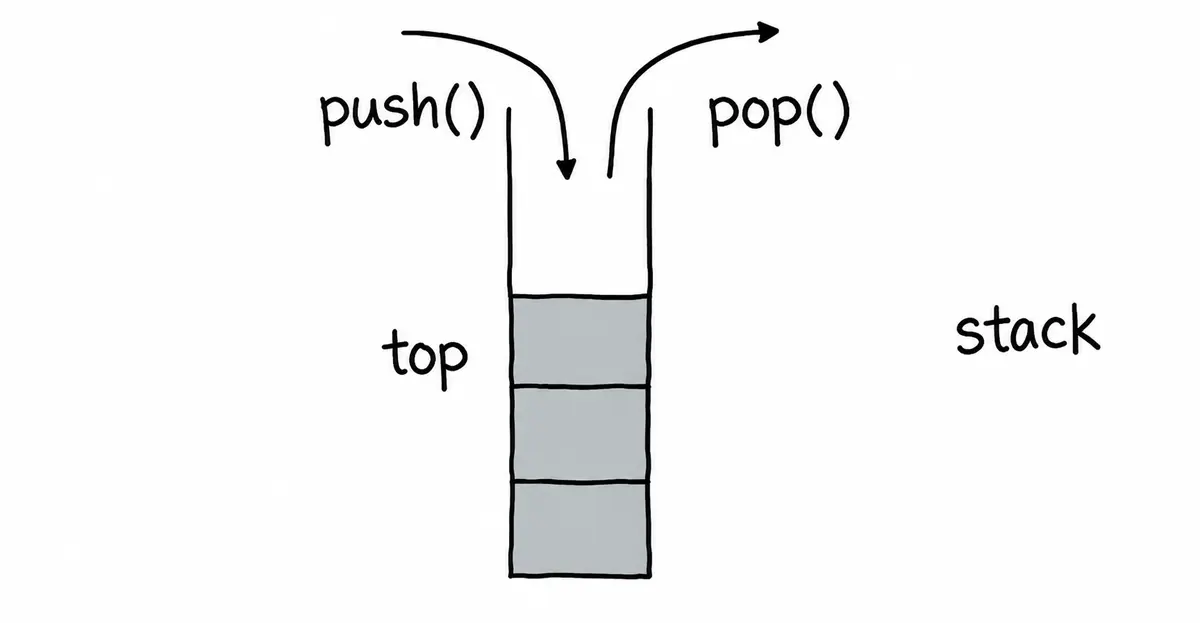
1.1 stack的介绍
stack的文档介绍 cplusplus.com/reference/stack/stack/?kw=stack
 [[]]
1.2 stack的使用
| stack | 构造空的栈 |
| empty | 检测 stack 是否为空 |
| size | 返回 stack 中元素的个数 |
| top | 返回栈顶元素的引用 |
| push | 将元素 val 压入 stack 中 |
| pop | 将 stack 中尾部的元素弹出 |
最小栈
155. 最小栈 – 力扣(LeetCode)
class MinStack
{
public:
void push(int x)
{
// 只要是压栈,先将元素保存到_elem中
_elem.push(x);
// 如果x小于_min中栈顶的元素,将x再压入_min中
if (_min.empty() || x <= _min.top())
_min.push(x);
}
void pop()
{
// 如果_min栈顶的元素等于出栈的元素,_min顶的元素要移除
if (_min.top() == _elem.top())
_min.pop();
_elem.pop();
}
int top() { return _elem.top(); }
int getMin() { return _min.top(); }
private:
// 保存栈中的元素
std::stack<int> _elem;
// 保存栈的最小值
std::stack<int> _min;
};
栈的弹出压入序列
栈的压入、弹出序列_牛客题霸_牛客网
class Solution
{
public:
bool IsPopOrder(vector<int> pushV, vector<int> popV)
{
// 入栈和出栈的元素个数必须相同
if (pushV.size() != popV.size())
return false;
// 用s来模拟入栈与出栈的过程
int outIdx = 0;
int inIdx = 0;
stack<int> s;
while (outIdx < popV.size())
{
// 如果s是空,或者栈顶元素与出栈的元素不相等,就入栈
while (s.empty() || s.top() != popV[outIdx])
{
if (inIdx < pushV.size())
s.push(pushV[inIdx++]);
else
return false;
}
// 栈顶元素与出栈的元素相等,出栈
s.pop();
outIdx++;
}
return true;
}
};
逆波兰表达式求值
150. 逆波兰表达式求值 – 力扣(LeetCode)
class Solution
{
public:
int evalRPN(vector<string>& tokens)
{
stack<int> s;
for (size_t i = 0; i < tokens.size(); ++i)
{
string& str = tokens[i];
// str为数字
if (!("+" == str || "-" == str || "*" == str || "/" == str))
{
s.push(atoi(str.c_str()));
}
else
{
// str为操作符
int right = s.top();
s.pop();
int left = s.top();
s.pop();
switch (str[0])
{
case '+':
s.push(left + right);
break;
case '-':
s.push(left – right);
break;
case '*':
s.push(left * right);
break;
case '/':
// 题目说明了不存在除数为0的情况
s.push(left / right);
break;
}
}
}
return s.top();
}
};
练习:
用两个栈实现队列 232. 用栈实现队列 – 力扣(LeetCode)
1.3 stack的模拟实现
从栈的接口中可以看出,栈实际是一种特殊的 vector,因此使用 vector 完全可以模拟实现 stack。
#include <vector>
namespace bite
{
template<class T>
class stack
{
public:
stack() {}
void push(const T& x) { _c.push_back(x); }
void pop() { _c.pop_back(); }
T& top() { return _c.back(); }
const T& top() const { return _c.back(); }
size_t size() const { return _c.size(); }
bool empty() const { return _c.empty(); }
private:
std::vector<T> _c;
};
}
2. queue的介绍和使用
2.1 queue的介绍
queue的文档介绍 cplusplus.com/reference/queue/queue/
翻译
- empty:检测队列是否为空
- size:返回队列中有效元素的个数
- front:返回队头元素的引用
- back:返回队尾元素的引用
- push_back:在队列尾部入队列
- pop_front:在队列头部出队列

2.2 queue的使用
| queue | 构造空的队列 |
| empty | 检测队列是否为空,是返回 true,否则返回 false |
| size | 返回队列中有效元素的个数 |
| front | 返回队头元素的引用 |
| back | 返回队尾元素的引用 |
| push | 在队尾将元素 val 入队列 |
| pop | 将队头元素出队列 |
练习:
用队列实现栈 225. 用队列实现栈 – 力扣(LeetCode)
2.3 queue的模拟实现
因为 queue 的接口中存在头删和尾插,因此使用 vector 来封装效率太低,故可以借助 list 来模拟实现 queue,具体如下:
#include <list>
namespace bite
{
template<class T>
class queue
{
public:
queue() {}
void push(const T& x) { _c.push_back(x); }
void pop() { _c.pop_front(); }
T& back() { return _c.back(); }
const T& back() const { return _c.back(); }
T& front() { return _c.front(); }
const T& front() const { return _c.front(); }
size_t size() const { return _c.size(); }
bool empty() const { return _c.empty(); }
private:
std::list<T> _c;
};
}
3.1 priority_queue的介绍和使用
3.1 priority_queue的介绍
priority_queue文档介绍 cplusplus.com/reference/queue/priority_queue/
翻译
- empty():检测容器是否为空
- size():返回容器中有效元素个数
- front():返回容器中第一个元素的引用
- push_back():在容器尾部插入元素
- pop_back():删除容器尾部元素
3.2 priority_queue的使用
优先级队列默认使用 vector 作为其底层存储数据的容器,在 vector 上又使用了堆算法将 vector 中元素构造成堆的结构,因此 priority_queue 就是堆,所有需要用到堆的位置,都可以考虑使用 priority_queue。注意:默认情况下 priority_queue 是大堆。
| priority_queue | 构造一个空的优先级队列 |
| empty | 检测优先级队列是否为空,是返回 true,否则返回 false |
| top | 返回优先级队列中最大(最小)元素,即堆顶元素 |
| push | 在优先级队列中插入元素 x |
| pop | 删除优先级队列中最大(最小)元素,即堆顶元素 |
注意
#include <vector>
#include <queue>
#include <functional> // greater算法的头文件
void TestPriorityQueue()
{
// 默认情况下,创建的是大堆,其底层按照小于号比较
vector<int> v{3, 2, 7, 6, 0, 4, 1, 9, 8, 5};
priority_queue<int> q1;
for (auto& e : v)
q1.push(e);
cout << q1.top() << endl;
// 如果要创建小堆,将第三个模板参数换成greater比较方式
priority_queue<int, vector<int>, greater<int>> q2(v.begin(), v.end());
cout << q2.top() << endl;
}
class Date
{
public:
Date(int year = 1900, int month = 1, int day = 1)
: _year(year)
, _month(month)
, _day(day)
{}
bool operator<(const Date& d) const
{
return (_year < d._year) ||
(_year == d._year && _month < d._month) ||
(_year == d._year && _month == d._month && _day < d._day);
}
bool operator>(const Date& d) const
{
return (_year > d._year) ||
(_year == d._year && _month > d._month) ||
(_year == d._year && _month == d._month && _day > d._day);
}
friend ostream& operator<<(ostream& _cout, const Date& d)
{
_cout << d._year << "-" << d._month << "-" << d._day;
return _cout;
}
private:
int _year;
int _month;
int _day;
};
void TestPriorityQueue()
{
// 大堆,需要用户在自定义类型中提供<的重载
priority_queue<Date> q1;
q1.push(Date(2018, 10, 29));
q1.push(Date(2018, 10, 28));
q1.push(Date(2018, 10, 30));
cout << q1.top() << endl;
// 如果要创建小堆,需要用户提供>的重载
priority_queue<Date, vector<Date>, greater<Date>> q2;
q2.push(Date(2018, 10, 29));
q2.push(Date(2018, 10, 28));
q2.push(Date(2018, 10, 30));
cout << q2.top() << endl;
}
3.3 在OJ中的使用
数组中第K个大的元素
215. 数组中的第K个最大元素 – 力扣(LeetCode)
class Solution
{
public:
int findKthLargest(vector<int>& nums, int k)
{
// 将数组中的元素先放入优先级队列中
priority_queue<int> p(nums.begin(), nums.end());
// 将优先级队列中前k-1个元素删除掉
for (int i = 0; i < k – 1; ++i)
{
p.pop();
}
return p.top();
}
};
4. 容器适配器
4.1 什么是适配器
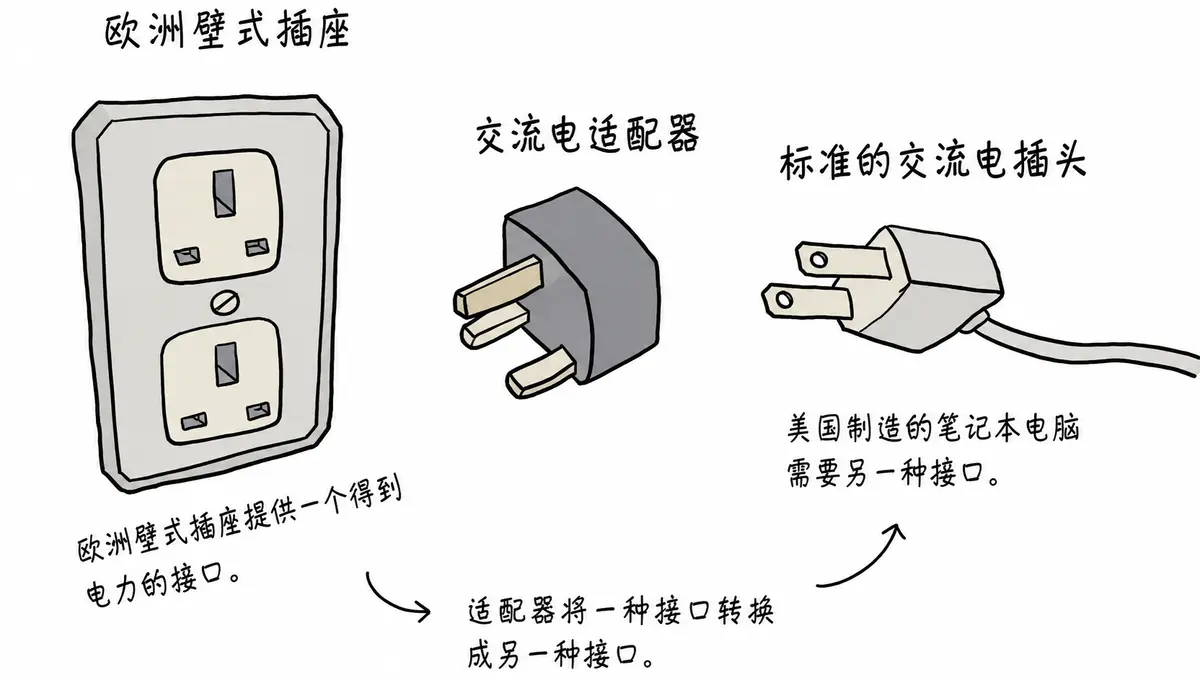
适配器是一种设计模式(设计模式是一套被反复使用的、多数人知晓的、经过分类编目的、代码设计经验的总结),该种模式是将一个类的接口转换成客户希望的另外一个接口。
4.2 STL标准库中stack和queue的底层结构
虽然 stack 和 queue 中也可以存放元素,但在 STL 中并没有将其划分在容器的行列,而是将其称为容器适配器,这是因为 stack 和队列只是对其他容器的接口进行了包装,STL 中 stack 和 queue 默认使用 deque,比如:



4.3 deque的简单介绍(了解)
4.3.1 deque的原理介绍
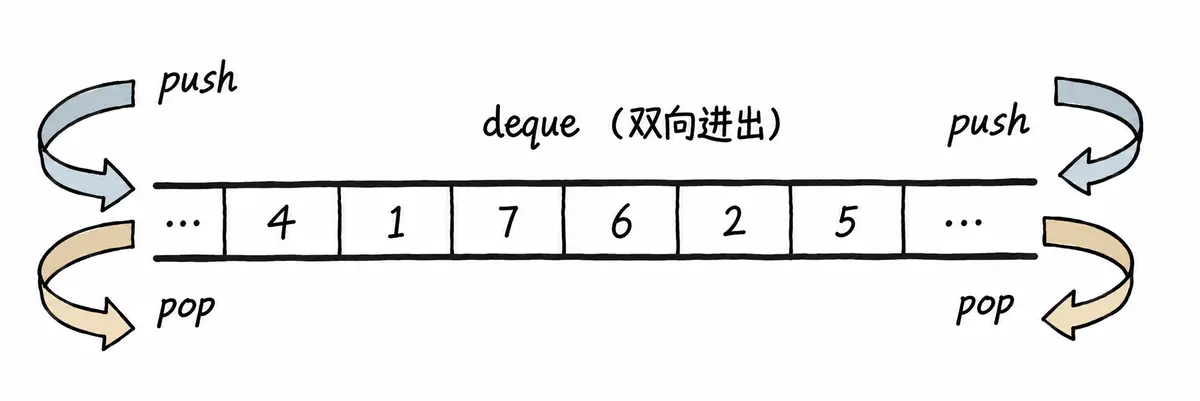
deque(双端队列):是一种双开口的“连续”空间的数据结构,双开口的含义是:可以在头尾两端进行插入和删除操作,且时间复杂度为 O(1)。与 vector 比较,头插效率高,不需要搬移元素;与 list 比较,空间利用率比较高。
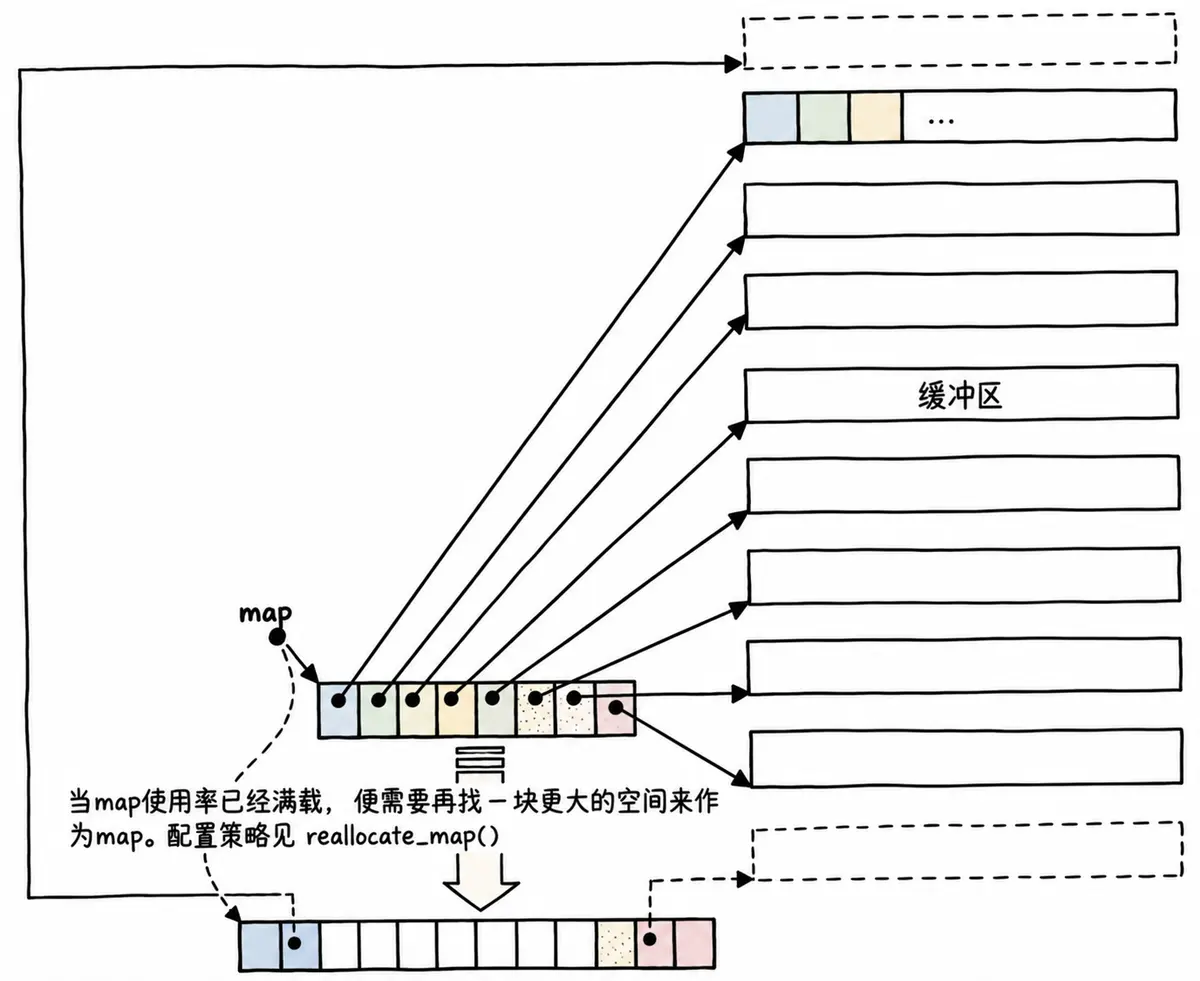
deque 并不是真正连续的空间,而是由一段段连续的小空间拼接而成的,实际 deque 类似于一个动态的二维数组,其底层结构如下图所示:
双端队列底层是一段假象的连续空间,实际是分段连续的,为了维护其“整体连续”以及随机访问的假象,落在了 deque 的迭代器身上,因此 deque 的迭代器设计就比较复杂,如下图所示:
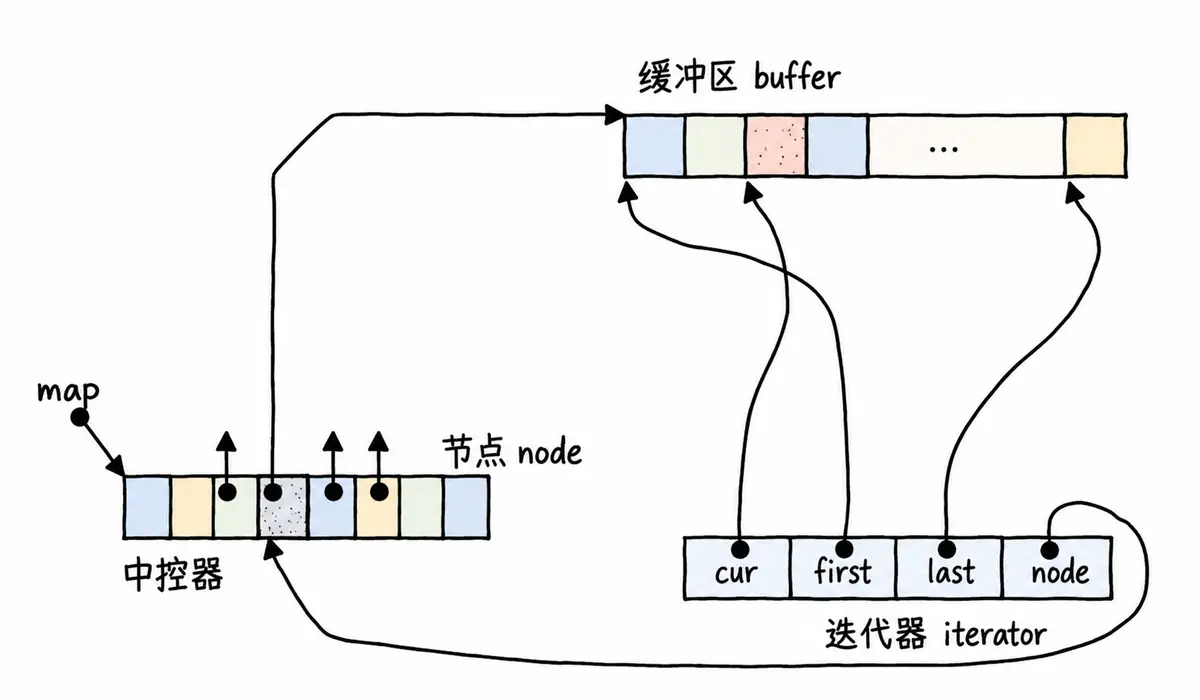
那 deque 是如何借助其迭代器维护其假想连续的结构的呢?

4.3.2 deque的缺陷
与 vector 比较,deque 的优势是:头部插入和删除时,不需要搬移元素,效率特别高,而且在扩容时,也不需要搬移大量的元素,因此其效率是比 vector 高的。
与 list 比较,其底层是连续空间,空间利用率比较高,不需要存储额外字段。
但是,deque 有一个致命缺陷:不适合遍历,因为在遍历时,deque 的迭代器要频繁地去检测其是否移动到某段小空间的边界,导致效率低下,而序列式场景中,可能需要经常遍历。因此在实际中,需要线性结构时,大多数情况下优先考虑 vector 和 list,deque 的应用并不多,而目前能看到的一个应用就是,STL 用其作为 stack 和 queue 的底层数据结构。
4.4 为什么选择deque作为stack和queue的底层默认容器
stack 是一种后进先出的特殊线性数据结构,因此只要具有 push_back() 和 pop_back() 操作的线性结构,都可以作为 stack 的底层容器,比如 vector 和 list 都可以;queue 是先进先出的特殊线性数据结构,只要具有 push_back() 和 pop_front() 操作的线性结构,都可以作为 queue 的底层容器,比如 list。但是 STL 中对 stack 和 queue 默认选择 deque 作为其底层容器,主要是因为:
结合了 deque 的优点,而完美地避开了其缺陷。
4.5 STL标准库中对于stack和queue的模拟实现
4.5.1 stack的模拟实现
#include <deque>
namespace bite
{
template<class T, class Con = deque<T>>
// template<class T, class Con = vector<T>>
// template<class T, class Con = list<T>>
class stack
{
public:
stack() {}
void push(const T& x) { _c.push_back(x); }
void pop() { _c.pop_back(); }
T& top() { return _c.back(); }
const T& top() const { return _c.back(); }
size_t size() const { return _c.size(); }
bool empty() const { return _c.empty(); }
private:
Con _c;
};
}
4.5.2 queue的模拟实现
#include <deque>
#include <list>
namespace bite
{
template<class T, class Con = deque<T>>
// template<class T, class Con = list<T>>
class queue
{
public:
queue() {}
void push(const T& x) { _c.push_back(x); }
void pop() { _c.pop_front(); }
T& back() { return _c.back(); }
const T& back() const { return _c.back(); }
T& front() { return _c.front(); }
const T& front() const { return _c.front(); }
size_t size() const { return _c.size(); }
bool empty() const { return _c.empty(); }
private:
Con _c;
};
}
实现100%通过率-171主机测评](https://www.171host.com/wp-content/uploads/2026/10/20261026130223-6adf4f5f34184-220x80.gif)