目录
一、实验目的
二、实验内容
三、实验方法
四、算法特色
五、实验结果及分析
一、实验目的
二、实验内容
三、实验方法
1.模型架构(ImprovedCNN)
- 特征提取器(features):
- 由四个连续的卷积模块构成。
- 每个模块包含一个卷积层(Conv2d)、一个批量归一化层(BatchNorm2d)、一个ReLU激活函数和一个最大池化层(MaxPool2d)。
- 卷积层通道数逐层增加(3->32->64->128->256),用于提取从低级到高级的图像特征。
- 池化层将特征图的尺寸减半,从而减少计算量并增大感受野。
- 分类器(classifier):
- 首先通过Flatten层将来自特征提取器的多维特征图展平为一维向量。
- 接着是一个包含512个神经元的全连接层(Linear),并使用ReLU激活函数。
- 为了防止过拟合,引入了一个Dropout层,在训练时以50%的概率随机丢弃神经元。
- 最后是一个输出单元为1的全连接层(Linear),用于输出二分类的原始逻辑值(logits)。
2.训练策略
四、算法特色
五、实验结果及分析
实验源码
facedemo1.py
import os
import pandas as pd
from PIL import Image
import torch
import torch.nn as nn
from torchvision import transforms
from torch.utils.data import Dataset, DataLoader
from sklearn.metrics import accuracy_score
#自定义数据集
class CelebASmileDataset(Dataset):
def __init__(self, csv_file, image_dir, transform=None):
self.data = pd.read_csv(csv_file)
self.image_dir = image_dir
self.transform = transform
def __len__(self):
return len(self.data)
def __getitem__(self, idx):
img_name = self.data.iloc[idx]['image_id']
label = self.data.iloc[idx]['Male']
img_path = os.path.join(self.image_dir, img_name)
image = Image.open(img_path).convert('RGB')
if self.transform:
image = self.transform(image)
return image, torch.tensor(label, dtype=torch.float32)
#CNN 模型
class ImprovedCNN(nn.Module):
def __init__(self):
super(ImprovedCNN, self).__init__()
self.features = nn.Sequential(
nn.Conv2d(3, 32, 3, padding=1),
nn.BatchNorm2d(32),
nn.ReLU(),
nn.MaxPool2d(2),
nn.Conv2d(32, 64, 3, padding=1),
nn.BatchNorm2d(64),
nn.ReLU(),
nn.MaxPool2d(2),
nn.Conv2d(64, 128, 3, padding=1),
nn.BatchNorm2d(128),
nn.ReLU(),
nn.MaxPool2d(2),
nn.Conv2d(128, 256, 3, padding=1),
nn.BatchNorm2d(256),
nn.ReLU(),
nn.MaxPool2d(2)
)
self.classifier = nn.Sequential(
nn.Flatten(),
nn.Linear(256 * 4 * 4, 512),
nn.ReLU(),
nn.Dropout(0.5),
nn.Linear(512, 1)
)
def forward(self, x):
x = self.features(x)
x = self.classifier(x)
return x.squeeze(1) # [batch_size]
#图像预处理 + 数据增强
train_transform = transforms.Compose([transforms.Resize((64, 64)),transforms.RandomHorizontalFlip(),transforms.ToTensor()])
test_transform = transforms.Compose([transforms.Resize((64, 64)),transforms.ToTensor()])
#数据加载
train_dataset = CelebASmileDataset("train.csv", r"C:\\Users\\L1307\\Desktop\\deep learning\\face statics\\CelebA-001\\img_train", train_transform)
test_dataset = CelebASmileDataset("test.csv", r"C:\\Users\\L1307\\Desktop\\deep learning\\face statics\\CelebA-001\\img_test", test_transform)
train_loader = DataLoader(train_dataset, batch_size=64, shuffle=True)
test_loader = DataLoader(test_dataset, batch_size=64, shuffle=False)
#模型与训练设置
device = torch.device("cuda" if torch.cuda.is_available() else "cpu")
model = ImprovedCNN().to(device)
criterion = nn.BCEWithLogitsLoss() # 更稳定
optimizer = torch.optim.Adam(model.parameters(), lr=0.0005)
best_acc = 0.0
best_model_path = "best_model.pth"
#训练与验证
for epoch in range(10):
model.train()
total_loss = 0
total_correct = 0
total_samples = 0
for imgs, labels in train_loader:
imgs, labels = imgs.to(device), labels.to(device)
outputs = model(imgs)
loss = criterion(outputs, labels)
optimizer.zero_grad()
loss.backward()
optimizer.step()
total_loss += loss.item()
preds = (torch.sigmoid(outputs) > 0.5).float()
total_correct += (preds == labels).sum().item()
total_samples += labels.size(0)
train_acc = total_correct / total_samples
# 测试
model.eval()
all_preds, all_labels = [], []
with torch.no_grad():
for imgs, labels in test_loader:
imgs, labels = imgs.to(device), labels.to(device)
outputs = model(imgs)
preds = (torch.sigmoid(outputs) > 0.5).int()
all_preds.extend(preds.cpu().tolist())
all_labels.extend(labels.cpu().tolist())
acc = accuracy_score(all_labels, all_preds)
print(f"Epoch {epoch+1} | Loss: {total_loss/len(train_loader):.4f} | Train Acc: {train_acc*100:.2f}% | Test Acc: {acc*100:.2f}%")
if acc > best_acc:
best_acc = acc
torch.save(model.state_dict(), best_model_path)
print(f"✅ 新最佳模型已保存 | Test Acc: {acc*100:.2f}%")
# 最终测试
print("\\n 加载并测试保存的最佳模型")
model.load_state_dict(torch.load(best_model_path))
model.eval()
all_preds, all_labels = [], []
with torch.no_grad():
for imgs, labels in test_loader:
imgs, labels = imgs.to(device), labels.to(device)
outputs = model(imgs)
preds = (torch.sigmoid(outputs) > 0.5).int()
all_preds.extend(preds.cpu().tolist())
all_labels.extend(labels.cpu().tolist())
final_acc = accuracy_score(all_labels, all_preds)
print(f"最终测试准确率: {final_acc*100:.2f}%")
facedemo2.py
import torch
import torch.nn as nn
from torchvision import transforms
import cv2
from PIL import Image
#模型定义:与训练时结构一致
class ImprovedCNN(nn.Module):
def __init__(self):
super(ImprovedCNN, self).__init__()
self.features = nn.Sequential(
nn.Conv2d(3, 32, 3, padding=1),
nn.BatchNorm2d(32),
nn.ReLU(),
nn.MaxPool2d(2),
nn.Conv2d(32, 64, 3, padding=1),
nn.BatchNorm2d(64),
nn.ReLU(),
nn.MaxPool2d(2),
nn.Conv2d(64, 128, 3, padding=1),
nn.BatchNorm2d(128),
nn.ReLU(),
nn.MaxPool2d(2),
nn.Conv2d(128, 256, 3, padding=1),
nn.BatchNorm2d(256),
nn.ReLU(),
nn.MaxPool2d(2)
)
self.classifier = nn.Sequential(
nn.Flatten(),
nn.Linear(256 * 4 * 4, 512),
nn.ReLU(),
nn.Dropout(0.5),
nn.Linear(512, 1)
)
def forward(self, x):
x = self.features(x)
x = self.classifier(x)
return x.squeeze(1)
#加载模型
device = torch.device("cuda" if torch.cuda.is_available() else "cpu")
model = ImprovedCNN().to(device)
model.load_state_dict(torch.load("best_model.pth", map_location=device))
model.eval()
#图像预处理
transform = transforms.Compose([
transforms.Resize((64, 64)),
transforms.ToTensor(),
])
#摄像头初始化
cap = cv2.VideoCapture(0)
face_cascade = cv2.CascadeClassifier(cv2.data.haarcascades + 'haarcascade_frontalface_default.xml')
print("摄像头启动,按 'q' 退出")
while True:
ret, frame = cap.read()
if not ret:
print("摄像头读取失败")
break
gray = cv2.cvtColor(frame, cv2.COLOR_BGR2GRAY)
faces = face_cascade.detectMultiScale(gray, scaleFactor=1.3, minNeighbors=5)
for (x, y, w, h) in faces:
padding = int(0.1 * h)
x1 = max(0, x – padding)
y1 = max(0, y – padding)
x2 = min(frame.shape[1], x + w + padding)
y2 = min(frame.shape[0], y + h + padding)
face = frame[y1:y2, x1:x2]
if face.shape[0] < 64 or face.shape[1] < 64:
continue
# 转换为 PIL 图像,预处理
pil_image = Image.fromarray(cv2.cvtColor(face, cv2.COLOR_BGR2RGB))
input_tensor = transform(pil_image).unsqueeze(0).to(device)
# 推理
with torch.no_grad():
output = model(input_tensor)
prob = torch.sigmoid(output)
pred = (prob > 0.5).float().item()
# 画框和标签
label = "Male" if pred == 1 else "Female"
color = (0, 255, 0) if pred == 1 else (0, 0, 255)
cv2.rectangle(frame, (x1, y1), (x2, y2), color, 2)
cv2.putText(frame, label, (x1, y1 – 10), cv2.FONT_HERSHEY_SIMPLEX, 0.8, color, 2)
cv2.imshow("Male Detection", frame)
if cv2.waitKey(1) & 0xFF == ord('q'):
break
cap.release()
cv2.destroyAllWindows()
模型训练结果
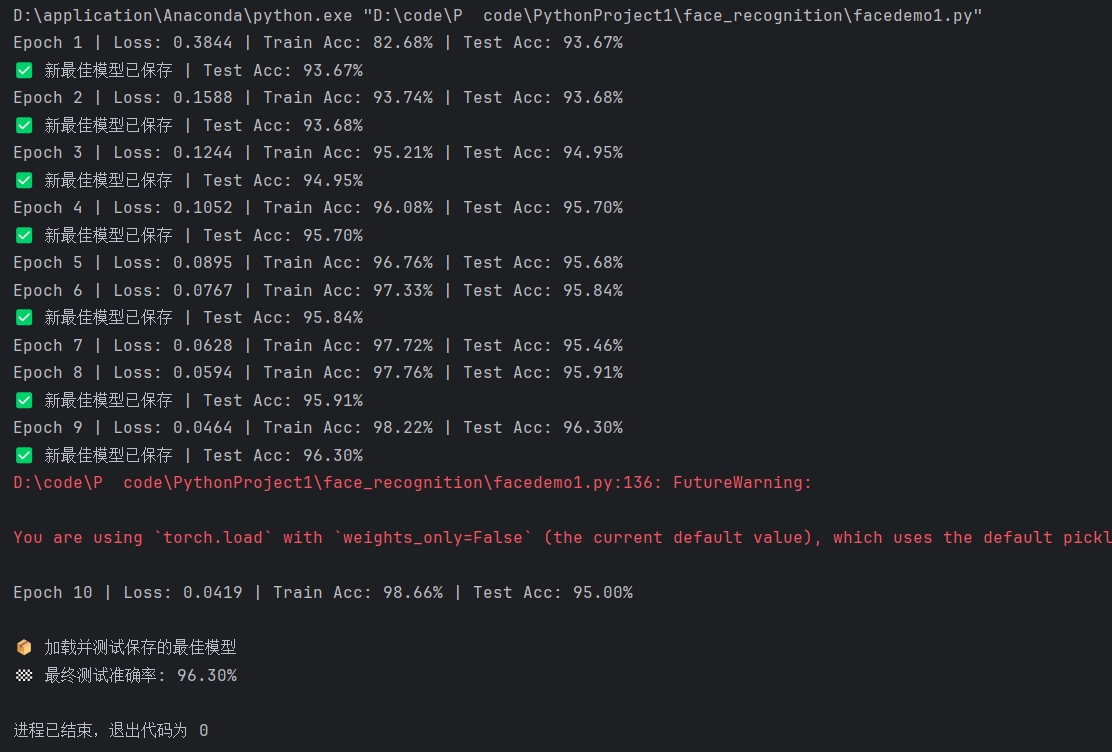 在facedemo1.py的训练过程中,每个周期结束后会输出该周期的训练损失、训练准确率和测试准确率。典型的输出格式如下:
模型在10个周期的训练中表现良好。训练损失(Loss)从最初的0.3844稳步下降到0.0419,同时训练准确率(Train Acc)从82.68%一路上升至98.66%。这表明模型充分学习了训练数据集的特征。训练结束后,加载性能最佳的模型进行最终测试,得到的“最终测试准确率”为96.30%。